

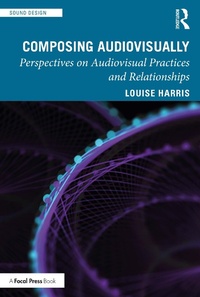
Composing Audiovisually
Perspectives on audiovisual practices and relationships
1st Edition
Published on 20. July 2021
228 pages
978-1-000-40732-7 (ISBN)
Description

What does the Coen Brothers' Barton Fink have in common with Norman McLaren's Synchromy? Or with audiovisual sculpture? Or contemporary music video? Composing Audiovisually interrogates how the relationship between the audiovisual media in these works, and our interaction with them, might allow us to develop mechanisms for talking about and understanding our experience of audiovisual media across a broad range of modes. Presenting close readings of audiovisual artefacts, conversations with artists, consideration of contemporary pedagogy and a detailed conceptual and theoretical framework that considers the nature of contemporary audiovisual experience, this book attempts to address gaps in our discourse on audiovisual modes, and offer possible starting points for future, genuinely transdisciplinary thinking in the field.
Reviews / Votes
Situating practice firmly at the heart of her discourse, Dr. Harris unpacks the creative process from a composer's perspective, revealing valuable insights which challenging traditional media hierarchies and elaborate nuanced understandings of audiovisual composition. This text will be of importance to students, fellow composers and auiodvisuolologists, providing a desperately needed injection of new perspectives into the topic.Andrew Knight-Hill, University of Greenwich, London.
Harris courageously crafts transdisciplinary inroads into difficult territory, providing teachers, composers, students and theorists multi-perspectival approaches to a broad range of audiovisual practice and identifying and challenging limits of current language and conceptions.
Bret Battey, De Montfort University, Leicester
More details
Series
Edition
1. Auflage
Language
English
Place of publication
London
United Kingdom
Publishing group
Taylor & Francis Ebooks
Target group
College/higher education
Professional and scholarly
Illustrations
47 Tables, black and white; 7 Line drawings, black and white; 7 Illustrations, black and white
ISBN-13
978-1-000-40732-7 (9781000407327)
Copyright in bibliographic data and cover images is held by Nielsen Book Services Limited or by the publishers or by their respective licensors: all rights reserved.
Schweitzer Classification
Other editions
Additional editions
Book
07/2021
1st Edition
CRC Press
€179.51
Shipment within 15-20 days
Book
07/2021
1st Edition
CRC Press
€63.20
Shipment within 15-20 days
Person
Louise Harris is an audiovisual composer and Senior Lecturer in Sonic and Audiovisual Practices at The University of Glasgow. In her creative work, she specialises in the creation and exploration of audiovisual relationships utilising electronic music, recorded sound and computer-generated visual environments in fixed media, performance and large-scale installation contexts.
Content
Introduction
Section 1 - Thinking Audiovisually
Thinking Audiovisually
Chapter One - Discourse on Audiovisual Experience
Chapter Two - Analysis of questionnaire results
Chapter Three - Defining Transperceptual Attention
Coda - some terminology for Transperceptual Attention
Section 2 - Composing Audiovisually
Composing Audiovisually
Chapter Four - the elements of audiovisual composition
Chapter Five - Teaching Audiovisually
Section 3 - Analysing Audiovisually
Analysing Audiovisually
Case Study 1 - For Tashi
Case Study 2 - Cinechine
Case Study 3 - pebbles
Case Study 4 - Hitchcock Etudes
Case Study 5 - Close to be close to me
Case Study 6 - A Love Story
Case Study 7 - Open Air
Reflections
Epilogue - Final Reflections
Section 1 - Thinking Audiovisually
Thinking Audiovisually
Chapter One - Discourse on Audiovisual Experience
Chapter Two - Analysis of questionnaire results
Chapter Three - Defining Transperceptual Attention
Coda - some terminology for Transperceptual Attention
Section 2 - Composing Audiovisually
Composing Audiovisually
Chapter Four - the elements of audiovisual composition
Chapter Five - Teaching Audiovisually
Section 3 - Analysing Audiovisually
Analysing Audiovisually
Case Study 1 - For Tashi
Case Study 2 - Cinechine
Case Study 3 - pebbles
Case Study 4 - Hitchcock Etudes
Case Study 5 - Close to be close to me
Case Study 6 - A Love Story
Case Study 7 - Open Air
Reflections
Epilogue - Final Reflections
