

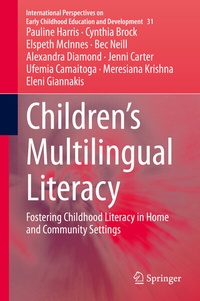
Children's Multilingual Literacy
Description

This book offers a comprehensive report on a three-year, cross-cultural, critical participatory action research study, conducted in children's homes and communities in Fiji. This project contributed to building sustainable local capacity in communities without access to early childhood services, so as to promote preschool children's literacy development in their home languages and English. The book includes rich descriptions of the young children's lived, multilingual literacy practices in their home and community contexts. This work advances research-based practices for fostering young children's multilingual literacy and building community capacity in a post-colonial Pasifika context; further, it shares valuable insights into processes and complexities that are inherent to multiliteracy and cross-cultural research.
Reviews / Votes
"The book . contain useful black-and-white photographs to illustrate the research. . It is a user-friendly guide for counsellors, academics, researchers, students and teachers interested in multilingual literacy in children. Written in plain English, it is easy to understand, which increases its usefulness and applicability, also making it a valuable guide for parents. It will help to promote understanding of literacy and development of community approaches to supporting and fostering young children's multilingual literacy at home and in the community." (Nico Irawan, Pratiwi Retnaningdyah and Ali Mustofa, International Review of Education, Vol. 67, 2021)More details
Other editions
Additional editions
Persons
Dr Elspeth McInnes is an Associate Professor of Sociology in Education at the Education Futures Unit, University of South Australia. Her research focuses on young children's wellbeing and development in families and education services.
Dr Bec Neill teaches across the child protection and digital technologies curricula at the Education Futures Unit, University of South Australia and has a professional background and degree in Information Systems.
Alexandra Diamond is a Lecturer in Early Childhood Development at the Education Futures Unit, University of South Australia. Her PhD study focuses on very young children's language socialisation in a rural Indo-Fijian community.
Dr Jenni Carter is a Lecturer in English and Literacy, and a researcher on Educational and Social Inclusion, at the Education Futures Unit, University of South Australia. Her current research is concerned with arts-based approaches to literacy.
Ufemia Camaitoga is an Early Childhood Education Consultant and National President of the Fiji Early Childhood Teachers Association. She is actively engaged in forging early childhood partnerships across organisations and people.
Meresiana Krishna has worked as an early childhood educator in diverse settings in Fiji and with governmental and non-governmental agencies, faith-based organisations, and the Fiji Early Childhood Teachers Association.
Dr Eleni Giannakis has served as Research Assistant to the de Lissa Chair at the University of South Australia. She has expertise in children's citizenship and Indigenous literacies practices.
