

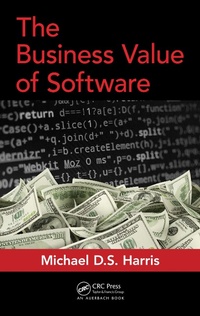
The Business Value of Software
Published on 1. September 2017
239 pages
978-1-4987-8290-6 (ISBN)
Description

In business, driving value is a key strategy and typically starts at the top of an organization. In today's digital age, driving software value is also an important, and often overlooked, key strategy. Executives, and the corporate board, need to expect the highest level of business value from the software the organization is developing, buying, and selling. In today's digital transformation marketplace, it is imperative that organizations start driving business value from software development initiatives.
For many years, the cost of software development challenged organizations with questions such as:
How do we allocate software development costs?
Should these costs be considered an overhead expense?
Are we getting the most value possible for our investment?
A fundamental problem has been built into these questions - the focus on cost. In almost every other part of the organization, maximizing profit or, in the case of a not-for-profit, maximizing the funds available, provides a clear focus with metrics to determine success or failure. In theory, simply aligning software spending with the maximizing profit goals should be sufficient to avoid any questions about value for money. Unfortunately, this alignment hasn't turned out to be so simple, and the questions persist, particularly at the strategic or application portfolio level.
In this book, Michael D.S. Harris describes how a software business value culture-one where all stakeholders, including technology and business-have a clear understanding of the goals and expected business value from software development. The book shows readers how they can transform software development from a cost or profit center to a business value center. Only a culture of software as a value center enables an organization to constantly maximize business value flow through software development. If your organization is starting to ask how it can change software from a cost-center to a value-center, this book is for you.
For many years, the cost of software development challenged organizations with questions such as:
How do we allocate software development costs?
Should these costs be considered an overhead expense?
Are we getting the most value possible for our investment?
A fundamental problem has been built into these questions - the focus on cost. In almost every other part of the organization, maximizing profit or, in the case of a not-for-profit, maximizing the funds available, provides a clear focus with metrics to determine success or failure. In theory, simply aligning software spending with the maximizing profit goals should be sufficient to avoid any questions about value for money. Unfortunately, this alignment hasn't turned out to be so simple, and the questions persist, particularly at the strategic or application portfolio level.
In this book, Michael D.S. Harris describes how a software business value culture-one where all stakeholders, including technology and business-have a clear understanding of the goals and expected business value from software development. The book shows readers how they can transform software development from a cost or profit center to a business value center. Only a culture of software as a value center enables an organization to constantly maximize business value flow through software development. If your organization is starting to ask how it can change software from a cost-center to a value-center, this book is for you.
More details
Language
English
Place of publication
Philadelphia, PA
United States
Publishing group
Taylor & Francis Inc
Target group
Professional and scholarly
Illustrations
25 Illustrations, black and white
File size
12,70 MB
ISBN-13
978-1-4987-8290-6 (9781498782906)
Copyright in bibliographic data and cover images is held by Nielsen Book Services Limited or by the publishers or by their respective licensors: all rights reserved.
Schweitzer Classification
Other editions
Additional editions
Michael D. S. Harris
The Business Value of Software
Book
01/2023
1st Edition
Auerbach
€75.75
Shipment within 10-20 days
Michael D. S. Harris
The Business Value of Software
Book
08/2017
1st Edition
Auerbach Publishers Inc.
€93.00
Shipment within 15-20 days
Person
Michael D. S. Harris is a recognized author and speaker on a range of topics related to the Value Visualization of IT. He is considered a thought leader in the software development industry and has more than 30 years of broad management experience in the IT field, including periods in R&D, development, production, business, and academia. Mr. Harris has held numerous senior executive positions in Fortune 500 companies, including: Fidelity National Services (NYSE: FIS), Sanchez Computer Associates (NASDAQ: SCAI) and MasterCard International (NASDAQ: MA). Currently, Mr. Harris is president, CEO and majority owner of David Consulting Group.
Content
Why Software Value. Six Things the C-Suite Should Know about Software Value. Make the Business Value of Software Visible. Forms of Software Value. Establishing Software Value Strategies. Business Value from Products and Programs. Establishing Software Value Tactics. Metrics for Business Value in Software Development. The Software Value Management Office. The Business Value of Software Estimation. Mergers and Acquisitions: Software Value and Risks. Broader Impact of Software Value Management. Appendix: Waterfall and Agile Software Development Methodologies.
