

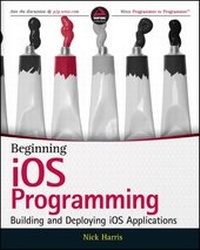
Beginning iOS Programming
Description

More details
Other editions
Additional editions
Person
Content
Introduction xix
<b>Chapter 1: Building a Real-World iOS App: Bands 1</b>
Introducing Bands 2
Getting Started 3
Scoping the App 4
Defining the Features 5
Creating a Development Plan 6
Summary 6
<b>Chapter 2: Introduction to Objective-C 9</b>
Exploring the History of Objective-C 9
Explaining the Basics 10
Learning About Objects and Classes 12
Instantiating Objects 16
Managing Memory 22
Introducing Automatic Reference Counting 26
Adding Properties to a Class 27
Explaining Strings 32
Using Basic Data Structures 35
Discussing Advanced Concepts 39
Explaining the Model-View-Controller Design Pattern 39
Learning About Protocols and Delegates 41
Using Blocks 44
Handling Errors 44
Summary 47
<b>Chapter 3: Starting a New App 51</b>
Creating a New App in Xcode 51
Discussing Xcode Templates 54
Learning About Bundle Identifiers 54
Exploring the Xcode Project Layout 55
Discussing the UIKit Framework 56
Discussing the Main Storyboard 56
Adding a Label to a Storyboard 56
Exploring Interface Builder 57
Setting Attributes 58
Exploring the Inspectors 59
Aligning UI Objects 59
Running in the Simulator 59
Choosing a Device 60
Learning to Test on All Device Sizes 61
Learning About Auto Layout 62
Discussing Auto Layout Basics 64
Testing Rotation 64
Exploring Application Settings 66
Setting Version and Build Numbers 66
Setting Supported Rotation Orientations 67
Setting the App Icon 68
Setting Launch Images 70
Running on a Device 71
Summary 72
<b>Chapter 4: Creating a User Input Form 75</b>
Introducing the Band Model Object 75
Creating the Band Model Object 76
Creating Enumerations 77
Adding Properties to the Band Model Object 78
Building an Interactive User Interface 79
Learning About IBOutlet 79
Using UITextField and UITextFieldDelegate 81
Using UITextView and UITextViewDelegate 84
Using UIButton and IBAction 85
Using UIStepper 87
Using UISegmentedControl 89
Using UISwitch 90
Saving and Retrieving Data 91
Implementing the NSCoding Protocol 91
Saving Data 93
Retrieving Saved Data 95
Deleting Saved Data 97
Summary 100
<b>Chapter 5: Using Table Views 103</b>
Exploring Table Views 104
Learning About Tables 104
Learning About Cells 107
Implementing the Bands Data Source 110
Creating the Band Storage 110
Adding Bands 113
Displaying Bands 119
Implementing Sections and Index 121
Adding Section Headers 122
Showing the Section Index 122
Editing Table Data 123
Enabling Edit Mode 124
Deleting Cells and Data 125
Modifying Data 126
Summary 130
<b>Chapter 6: Integrating the Camera and Photo Library in iOS Apps 133</b>
Adding an Image View and Gesture Recognizer 134
Enabling User Interactions with a UIImageView 134
Learning About Gesture Recognizers 136
Selecting a Picture from the Photo Library 139
Learning About UIImagePickerController 140
Determining Device Capabilities 140
Allowing Picture Editing 141
Saving Band Images 143
Deleting Band Images 145
Taking a Picture with the Camera 147
Summary 150
<b>Chapter 7: Integrating Social Media 153</b>
Sending E-mails and Text Messages 154
Using the E-mail Composer 154
Using the Message Composer 160
Simplifying Social Network Integration 163
Introducing the Activity View Controller 164
Learning About Twitter Integration 167
Learning About Facebook Integration 168
Learning About Flickr Integration 169
Limiting Sharing Options 170
Summary 172
<b>Chapter 8: Using Web Views 175</b>
Learning About Web Views 175
Loading a URL 180
Loading a URL That Contains Special Characters 182
Showing User Feedback 183
Adding Navigation 186
Creating a Toolbar 186
Opening Safari 191
Summary 193
<b>Chapter 9: Exploring Maps and Local Search 195</b>
Learning About Map Views 196
Getting the User's Location 198
Changing the Map Type 201
Performing a Local Search 203
Animating Annotations 209
Interacting with Annotations 211
Summary 215
<b>Chapter 10: Getting Started with Web Services 219</b>
Learning About Web Services 220
Exploring the iTunes Search API 220
Discussing JSON 221
Adding the Search View 223
Introducing NSURLSession 227
Creating and Scheduling a Data Task 227
Parsing JSON 231
Displaying Search Results 233
Previewing Tracks 236
Showing Tracks in iTunes 239
Summary 240
<b>Chapter 11: Creating a Universal App 243</b>
Transitioning to a Universal App 244
Supporting Rotation Using Auto Layout 249
Learning About Popovers 250
Presenting Action Sheets in Popovers 250
Using the UIPopoverController 252
Finishing the iPad Implementation 258
Summary 265
<b>Chapter 12: Deploying Your iOS App 267</b>
Deploying the App to Beta Testers 268
Registering Beta Devices 269
Generating Digital Certificates 271
Creating an App ID and Ad Hoc Provisioning Profile 274
Signing and Deploying an Ad Hoc Build 276
Submitting the App to Apple 280
Exploring iTunes Connect 280
Creating an App Store Provisioning Profile 283
Validating and Submitting an App 284
<i>Summary 285</i>
<i>Appendix: Answers to Exercises 287</i>
<i>Index 293</i>
