

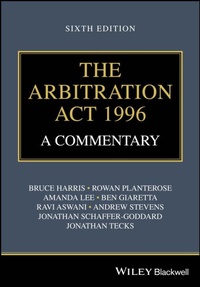
The Arbitration Act 1996
Description

Understand the law governing arbitration in England and Wales
The Arbitration Act 1996, in force across England and Wales since 31 January 1997 and amended by the Arbitration Act 2025, consolidated prior legislation and transformed the practice of arbitration in those countries. Many challenging questions arising from the Act continue to occupy the courts, particularly the Commercial and Technology & Construction Courts, and guidance from legal experts continues to contribute to active debate on its interpretation.
The Arbitration Act 1996: A Commentary provides a practical, accessible, section-by-section overview of both the 1996 and 2025 Acts. Intended for arbitrators, lawyers, and practitioners who need a clear understanding of the Acts' practical application, it covers the key cases that have shaped its interpretation, and has long been used by the Chartered Institute of Arbitrators as a recommended training text.
Readers of the sixth edition will also find:
- Detailed commentary on the Arbitration Act 2025, keeping English arbitration law at the cutting edge
- Comprehensive updates reflecting new case law and court guidance
- Analysis of over 100 new arbitration cases and their impact on interpretation of the Act
- Practical, user-friendly organisation, supporting application by arbitration practitioners
The Arbitration Act 1996: A Commentary is an essential resource for arbitrators, barristers, solicitors, and other professionals working in, or connected with, arbitration.
"What is needed... is comprehensive guidance from those who have actual experience and knowledge of arbitration, whether as arbitrators or parties to arbitration. This new edition provides that guidance in full measure, just as have the previous editions. To my mind it is a source of invaluable assistance to all involved in English arbitration." -LORD SAVILLE of Newdigate
More details
Other editions
Additional editions
Previous edition
Persons
Bruce Harris is a full-time commercial and maritime arbitrator. He has written, lectured and talked extensively on arbitration, and was President of the London Maritime Arbitrators Association in 1990/2 and 2020/21, and Chairman of the Chartered Institute of Arbitrators in 1993/4. He was a member of the Departmental Advisory Committee on Arbitration Law ('DAC') and in 2006 chaired a committee that conducted a major survey into the Act's working.
Rowan Planterose was a former practising barrister, subsequently a solicitor, Chartered Arbitrator and adjudicator. As a partner at DAC Beachcroft LLP, he was a construction and commercial lawyer in the firm's Global Group, devoting much of his time to arbitration either as representative of a party or as arbitrator, and having responsibility for the firm's arbitration service line. He was a member of the Chartered Institute of Arbitrators' Professional Committee, its Council and Executive Board and an honorary member of Arbrix (the arbitration group of the Royal Institution of Chartered Surveyors). He lectured widely on both domestic and international arbitration matters.
Amanda Lee is an arbitrator and consultant at Costigan King, London. She is a Fellow of the Chartered Institute of Arbitrators ('CIArb') and a dual- qualified solicitor-advocate and New York attorney. Amanda holds numerous advisory roles and regularly speaks and publishes on topics relating to international dispute resolution. She is a former member of the CIArb's Board of Management and served as Global Chair of its Young Members' Group and Public Relations Officer for its London Branch. Amanda is an award- winning advocate for diversity in ADR and the founder of Careers in Arbitration and ARBalance.
Ben Giaretta is a Chartered Arbitrator who has worked extensively in international arbitration across the world. He has held several posts in the Chartered Institute of Arbitrators, including Deputy Chair of the Board of Trustees and Chair of the London Branch. He has been a partner and Asia Head of Dispute Resolution of Ashurst LLP, based in Singapore, a partner at Mishcon de Reya LLP and Head of Dispute Resolution at Fox Williams LLP, where he remains a partner. He is a Court Assistant of the Worshipful Company of Arbitrators and a member of the boards of London International Disputes Week and the London Chamber of Arbitration and Mediation.
Ravi Aswani is a barrister practising from 36 Stone in London. He started his career predominantly as a litigator with some work in arbitration. This has changed over the past two decades with the proliferation in popularity of arbitration clauses in contracts. Now, a substantial proportion of Ravi's work is in arbitration (or arbitration-related applications in court).
Andrew Stevens is a commercial barrister (England & Wales, 2007) with DIFC and AIFC rights of audience. He obtained a BA and MA in law from the University of Cambridge. He practises from Quadrant Chambers predominantly as counsel in international arbitration (most often seated in London, various European seats, Hong Kong and Singapore), and in litigation in the Commercial Court and Technology and Construction Court, including claims under the 1996 Act and anti-suit injunctions. He acted as counsel for the LMAA in Halliburton v. Chubb in the UK Supreme Court. He is in his second term as a UK delegate to the International Chamber of Commerce Commission on Arbitration and ADR. His main practice areas are energy, oil & gas, construction, infrastructure, shipbuilding, shipping and commodities.
Jonathan Schaffer-Goddard is a dual-qualified barrister and New York attorney. He is a member of 4 Pump Court in London and formerly practised from Holwell Shuster and Goldberg LLP in New York. He completed his LLM at New York University School of Law, where he received the law school's prize for international litigation and arbitration. He has written widely on topics in international arbitration and regularly appears before courts and tribunals on both sides of the Atlantic.
Jonathan Tecks is a retired dispute resolution professional. He practised as a barrister, Chartered Arbitrator and mediator. He also lectured, trained and assessed in those disciplines with various academic and professional institutions including the University of the West of England, the University College of Estate Management, the Chartered Institute of Arbitrators and, most recently, the Institute of Family Law Arbitrators.
Content
Biographical Notes viii
Foreword to Sixth Edition x
Preface to Sixth Edition xi
Important Note on the Arbitration Act 2025 xii
References and Abbreviations xiii
1. Materials 1
A. Arbitration Clauses 1
B. Agreements Prior to or on Constitution of Arbitration 3
C. Agreements as to Tribunal and Court Powers 8
D. Checklist for Preliminary Meetings 10
E. Agreement with Arbitrator on Resignation 13
F. Checklist for Awards 14
G. Agreements as to Costs 16
H. Arbitration Claims General Note on Arbitration Claims 17
2. The Arbitration Act 1996 23
Text of the Act and Commentary 23
Arrangement of Sections 25
3. Appendices 577
The Arbitration Act 1996 (Commencement No. 1) Order 1996 579
The Arbitration Act 1950, Part II 581
The Consumer Rights Act 2015, Part II 589
The Arbitration Act 2025 596
Table of Cases 605
Index to Commentary 629
