

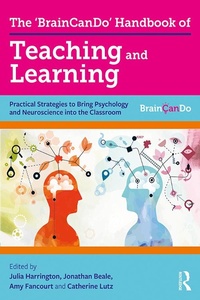
The 'BrainCanDo' Handbook of Teaching and Learning
Practical Strategies to Bring Psychology and Neuroscience into the Classroom
1st Edition
Published on 12. July 2020
262 pages
978-0-429-58863-1 (ISBN)
Description

The 'BrainCanDo' Handbook of Teaching and Learning provides teachers and school leaders with a concise summary of how some of the latest research in educational neuroscience and psychology can improve learning outcomes. It aims to create a mechanism through which our growing understanding of the brain can be applied in the world of education. Subjects covered include memory, social development, mindsets and character.
Written by practising teachers working in collaboration with researchers, the chapters provide a toolkit of practical ideas which incorporate evidence from psychology and neuroscience into teaching practice with the aim of improving educational outcomes for all. By increasing both teachers' and pupils' understanding of the developing brain, 'BrainCanDo' aims to improve cognitive performance and attainment, foster a love of learning and enable a healthy and productive approach to personal development.
This book will appeal to educators, primarily those working in secondary schools, but also those within higher and primary school education. It will also be of interest to students of education, professionals looking to enhance their teaching and researchers working in the fields of education, psychology and neuroscience.
Written by practising teachers working in collaboration with researchers, the chapters provide a toolkit of practical ideas which incorporate evidence from psychology and neuroscience into teaching practice with the aim of improving educational outcomes for all. By increasing both teachers' and pupils' understanding of the developing brain, 'BrainCanDo' aims to improve cognitive performance and attainment, foster a love of learning and enable a healthy and productive approach to personal development.
This book will appeal to educators, primarily those working in secondary schools, but also those within higher and primary school education. It will also be of interest to students of education, professionals looking to enhance their teaching and researchers working in the fields of education, psychology and neuroscience.
Reviews / Votes
BrainCanDo aims to develop an educational approach informed by the latest evidence in educational neuroscience and psychology. What impressed me most... in this volume, is the commitment of BrainCanDo to leverage the latest research in the learning sciences into practical strategies to improve teaching. What most sets this volume apart from others in the field is its focus on adolescence. The second crucial strength of this volume is how it encourages a culture of research - that at all levels of education, teaching should be informed by evidence.Michael S. C. Thomas, Professor of Cognitive Neuroscience at Birkbeck, University of London and Director of the University of London Centre for Educational Neuroscience. BrainCanDo aims to develop an educational approach informed by the latest evidence in educational neuroscience and psychology. What impressed me most... in this volume, is the commitment of BrainCanDo to leverage the latest research in the learning sciences into practical strategies to improve teaching. What most sets this volume apart from others in the field is its focus on adolescence. The second crucial strength of this volume is how it encourages a culture of research - that at all levels of education, teaching should be informed by evidence.
Michael S. C. Thomas, Professor of Cognitive Neuroscience at Birkbeck, University of London and Director of the University of London Centre for Educational Neuroscience.
Undeniably, the work they have accomplished is deeply impressive. The opportunities they have created for their staff to work on research projects with researchers of international standing is admirable and there is much we can draw from their descriptions of gains in learning their students have made.
Megan Dixon, TES
The 'BrainCanDo' Handbook of Teaching and Learning is incredibly rooted in evidence and might be one of the most research-informed books we have ever come across.
Innerdrive
More details
Edition
1. Auflage
Language
English
Place of publication
London
United Kingdom
Publishing group
Taylor & Francis Ltd
Target group
Professional and scholarly
Product notice
Reflowable
Illustrations
5 Tables, black and white; 8 Line drawings, black and white; 1 Halftones, black and white; 9 Illustrations, black and white
ISBN-13
978-0-429-58863-1 (9780429588631)
Copyright in bibliographic data and cover images is held by Nielsen Book Services Limited or by the publishers or by their respective licensors: all rights reserved.
Schweitzer Classification
Other editions
Additional editions
Julia Harrington | Jonathan Beale | Amy Fancourt
The 'BrainCanDo' Handbook of Teaching and Learning
Practical Strategies to Bring Psychology and Neuroscience into the Classroom
Book
07/2020
1st Edition
CRC Press
€207.20
Shipment within 15-20 days
Julia Harrington | Jonathan Beale | Amy Fancourt
The 'BrainCanDo' Handbook of Teaching and Learning
Practical Strategies to Bring Psychology and Neuroscience into the Classroom
Book
07/2020
1st Edition
CRC Press
€39.10
Shipment within 15-20 days
Persons
Julia Harrington is headmistress at Queen Anne's School and founder and chief executive officer of BrainCanDo. She has featured in and been interviewed by publications and media outlets including the Times, the Telegraph, the Guardian and the BBC.
Jonathan Beale is researcher-in-residence at Eton College, a research fellow for BrainCanDo and head of public speaking at Queen Anne's School. He is the co-editor of two books for Routledge: Wittgenstein and Scientism (2017) and Wittgenstein and Contemporary Moral Philosophy (forthcoming - 2022). He has published articles on philosophy and education in journals and media outlets, including the New York Times.
Amy Fancourt is head of psychology at Queen Anne's School and director of research for BrainCanDo. She has published articles on psychology and education in journals, including Nature Scientific Reports, Frontiers, Psychomusicology, Impact and Mind, Brain and Education, and in media outlets, including the Times.
Catherine Lutz is training and development manager for BrainCanDo and a PhD candidate in psychology at the University of Essex, writing a doctoral thesis on the theme of the motivational role of pregame speeches in relation to elite athletic performance.
Jonathan Beale is researcher-in-residence at Eton College, a research fellow for BrainCanDo and head of public speaking at Queen Anne's School. He is the co-editor of two books for Routledge: Wittgenstein and Scientism (2017) and Wittgenstein and Contemporary Moral Philosophy (forthcoming - 2022). He has published articles on philosophy and education in journals and media outlets, including the New York Times.
Amy Fancourt is head of psychology at Queen Anne's School and director of research for BrainCanDo. She has published articles on psychology and education in journals, including Nature Scientific Reports, Frontiers, Psychomusicology, Impact and Mind, Brain and Education, and in media outlets, including the Times.
Catherine Lutz is training and development manager for BrainCanDo and a PhD candidate in psychology at the University of Essex, writing a doctoral thesis on the theme of the motivational role of pregame speeches in relation to elite athletic performance.
Content
About the Editors and Contributors
Foreword
Michael Thomas
Introduction: The BrainCanDo Approach to Teaching and Learning
Julia Harrington, Jonathan Beale, Amy Fancourt and Catherine Lutz
Part 1: Controversies and Applications
Chapter 1: Educational Neuroscience and Educational Neuroscientism
Jonathan Beale
Chapter 2: How BrainCanDo has been Applied at Queen Anne's School
Gill Little
Part 2: Becoming a Successful Learner
Chapter 3: Developing Character Education in Schools: An Evidence-based Approach
Iro Konstantinou and Jonnie Noakes
Chapter 4: The Impact of Working Memory and Learning Difficulties in the Classroom
Amy Fancourt and Joni Holmes
Part 3: Motivation
Chapter 5: Motivational Contagion in Education
Laura Burgess, Patricia Riddell and Kou Murayama
Chapter 6: Mindset and Motivation: An Introduction to Potential Influences on Academic Achievement
Catherine Lutz
Chapter 7: Using an Executive Function-focused Approach to Build Self-regulation, Metacognition and Motivation in All Learners
Laurie Faith, Bettina Hohnen, Victoria Bagnall and Imogen Moore-Shelley
Part 4: Well-being
Chapter 8: Sleepy Teens in the Classroom
Frances Le Cornu Knight
Chapter 9: Gratitude, Subjective Well-being and Prosociality: Implications for Adolescence and Education
Sarah A. Buckingham and Joseph O. L. Buckingham
Part 5: Subject-specific Research
Chapter 10: Brain and Cognitive Development During Adolescence: Implications for Science and Mathematics Education
Annie Brookman-Byrne and Iroise Dumontheil
Chapter 11: The Impact of Music on Adolescents' Cognitive and Socio-emotional Learning
Daniel Muellensiefen and Peter Harrison
Index
Foreword
Michael Thomas
Introduction: The BrainCanDo Approach to Teaching and Learning
Julia Harrington, Jonathan Beale, Amy Fancourt and Catherine Lutz
Part 1: Controversies and Applications
Chapter 1: Educational Neuroscience and Educational Neuroscientism
Jonathan Beale
Chapter 2: How BrainCanDo has been Applied at Queen Anne's School
Gill Little
Part 2: Becoming a Successful Learner
Chapter 3: Developing Character Education in Schools: An Evidence-based Approach
Iro Konstantinou and Jonnie Noakes
Chapter 4: The Impact of Working Memory and Learning Difficulties in the Classroom
Amy Fancourt and Joni Holmes
Part 3: Motivation
Chapter 5: Motivational Contagion in Education
Laura Burgess, Patricia Riddell and Kou Murayama
Chapter 6: Mindset and Motivation: An Introduction to Potential Influences on Academic Achievement
Catherine Lutz
Chapter 7: Using an Executive Function-focused Approach to Build Self-regulation, Metacognition and Motivation in All Learners
Laurie Faith, Bettina Hohnen, Victoria Bagnall and Imogen Moore-Shelley
Part 4: Well-being
Chapter 8: Sleepy Teens in the Classroom
Frances Le Cornu Knight
Chapter 9: Gratitude, Subjective Well-being and Prosociality: Implications for Adolescence and Education
Sarah A. Buckingham and Joseph O. L. Buckingham
Part 5: Subject-specific Research
Chapter 10: Brain and Cognitive Development During Adolescence: Implications for Science and Mathematics Education
Annie Brookman-Byrne and Iroise Dumontheil
Chapter 11: The Impact of Music on Adolescents' Cognitive and Socio-emotional Learning
Daniel Muellensiefen and Peter Harrison
Index
