

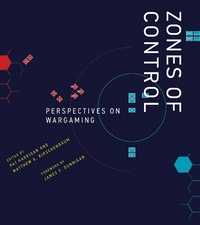
Zones of Control
Description

Games with military themes date back to antiquity, and yet they are curiously neglected in much of the academic and trade literature on games and game history. This volume fills that gap, providing a diverse set of perspectives on wargaming's past, present, and future. In Zones of Control, contributors consider wargames played for entertainment, education, and military planning, in terms of design, critical analysis, and historical contexts. They consider both digital and especially tabletop games, most of which cover specific historical conflicts or are grounded in recognizable real-world geopolitics. Game designers and players will find the historical and critical contexts often missing from design and hobby literature; military analysts will find connections to game design and the humanities; and academics will find documentation and critique of a sophisticated body of cultural work in which the complexity of military conflict is represented in ludic systems and procedures.
Each section begins with a long anchoring chapter by an established authority, which is followed by a variety of shorter pieces both analytic and anecdotal. Topics include the history of playing at war; operations research and systems design; wargaming and military history; wargaming's ethics and politics; gaming irregular and non-kinetic warfare; and wargames as artistic practice.
Contributors Jeremy Antley, Richard Barbrook, Elizabeth M. Bartels, Ed Beach, Larry Bond, Larry Brom, Lee Brimmicombe-Wood, Rex Brynen, Matthew B. Caffrey, Jr., Luke Caldwell, Catherine Cavagnaro, Robert M. Citino, Laurent Closier, Stephen V. Cole, Brian Conley, Greg Costikyan, Patrick Crogan, John Curry, James F. Dunnigan, Robert J. Elder, Lisa Faden, Mary Flanagan, John A. Foley, Alexander R. Galloway, Sharon Ghamari-Tabrizi, Don R. Gilman, A. Scott Glancy, Troy Goodfellow, Jack Greene, Mark Herman, Kacper Kwiatkowski, Tim Lenoir, David Levinthal, Alexander H. Levis, Henry Lowood, Elizabeth Losh, Esther MacCallum-Stewart, Rob MacDougall, Mark Mahaffey, Bill McDonald, Brien J. Miller, Joseph Miranda, Soraya Murray, Tetsuya Nakamura, Michael Peck, Peter P. Perla, Jon Peterson, John Prados, Ted S. Raicer, Volko Ruhnke, Philip Sabin, Thomas C. Schelling, Marcus Schulzke, Miguel Sicart, Rachel Simmons, Ian Sturrock, Jenny Thompson, John Tiller, J. R. Tracy, Brian Train, Russell Vane, Charles Vasey, Andrew Wackerfuss, James Wallis, James Wallman, Yuna Huh Wong
More details
Other editions
Additional editions
Persons
Matthew G. Kirschenbaum is Associate Professor in the Department of English at the University of Maryland and the author of the award-winning Mechanisms: New Media and the Forensic Imagination (MIT Press).
Henry Lowood is Curator for History of Science and Technology and for Film and Media collections at Stanford University and the coeditor of The Machinima Reader (MIT Press).
Timothy LENOIR is the Kimberly Jenkins Chair for New Technologies and Society at Duke University. He has published several books and articles on the history of biomedical science from the nineteenth century to the present, and is currently engaged in an investigation of the introduction of computers into biomedical research from the early 1960s to the present.
Miguel Sicart is Associate Professor at the Center for Computer Game Research at IT University Copenhagen. He is the author of The Ethics of Computer Games and Beyond Choices: The Design of Ethical Gameplay, both published by the MIT Press.
Elizabeth Losh directs the Culture, Art, and Technology Program at Sixth College at the University of California, San Diego. She is the author of Virtualpolitik: An Electronic History of Government Media-Making in a Time of War, Scandal, Disaster, Miscommunication, and Mistakes (MIT Press) and the coauthor of Understanding Rhetoric: A Graphic Guide to Writing.
Alexander R. Galloway is Assistant Professor of Media Ecology at New York University.
Mary Flanagan is Sherman Fairchild Distinguished Professor in Digital Humanities, Director of the Tiltfactor game research laboratory, and Professor in the Department of Film and Media Studies at Dartmouth College. She is the author of Critical Play: Radical Game Design (MIT Press).
