

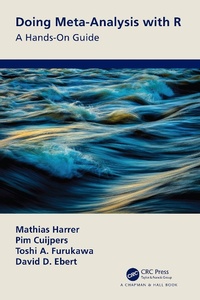
Doing Meta-Analysis with R
A Hands-On Guide
1st Edition
Published on 14. September 2021
500 pages
978-1-000-43563-4 (ISBN)
Description

Doing Meta-Analysis with R: A Hands-On Guide serves as an accessible introduction on how meta-analyses can be conducted in R. Essential steps for meta-analysis are covered, including calculation and pooling of outcome measures, forest plots, heterogeneity diagnostics, subgroup analyses, meta-regression, methods to control for publication bias, risk of bias assessments and plotting tools. Advanced but highly relevant topics such as network meta-analysis, multi-three-level meta-analyses, Bayesian meta-analysis approaches and SEM meta-analysis are also covered. A companion R package, dmetar, is introduced at the beginning of the guide. It contains data sets and several helper functions for the meta and metafor package used in the guide.
The programming and statistical background covered in the book are kept at a non-expert level, making the book widely accessible.
Features
Contains two introductory chapters on how to set up an R environment and do basic imports/manipulations of meta-analysis data, including exercises
Describes statistical concepts clearly and concisely before applying them in R
Includes step-by-step guidance through the coding required to perform meta-analyses, and a companion R package for the book
The programming and statistical background covered in the book are kept at a non-expert level, making the book widely accessible.
Features
Contains two introductory chapters on how to set up an R environment and do basic imports/manipulations of meta-analysis data, including exercises
Describes statistical concepts clearly and concisely before applying them in R
Includes step-by-step guidance through the coding required to perform meta-analyses, and a companion R package for the book
Reviews / Votes
"I would recommend this book if you are interested in a resource for conducting and interpreting metaanalysis methods and use R as your primary programming language."- Charlotte Bolch, ISCB News, September 2022.
"This text is instrumental in effectively completing a meta-analysis. Full stop. It is particularly profitable for the adept use of R to calculate and analyze effect sizes from basic to more advanced models."
- Christopher J. Lortie, Journal of Statistical Software, May 2022.
More details
Edition
1. Auflage
Language
English
Place of publication
London
United Kingdom
Publishing group
Taylor & Francis Ltd
Target group
Professional and scholarly
Illustrations
4 Tables, black and white; 76 Line drawings, black and white; 76 Illustrations, black and white
ISBN-13
978-1-000-43563-4 (9781000435634)
Copyright in bibliographic data and cover images is held by Nielsen Book Services Limited or by the publishers or by their respective licensors: all rights reserved.
Schweitzer Classification
Other editions
Additional editions
Book
09/2021
1st Edition
Chapman & Hall/CRC
€123.10
Shipment within 15-20 days
Persons
Mathias Harrer is a research associate at the Friedrich-Alexander-University Erlangen-Nuremberg. Mathias' research focuses on biostatistical and technological approaches in psychotherapy research, methods for clinical research synthesis, and on the development of statistical software.
Pim Cuijpers is professor of Clinical Psychology at the VU University Amsterdam. He is specialized in conducting randomized controlled trials and meta-analyses, with a focus on the prevention and treatment of common mental disorders. Pim has published more than 800 articles in international peer-reviewed scientific journals; many of which are meta-analyses of clinical trials.
Toshi A. Furukawa is professor of Health Promotion and Human Behavior at the Kyoto University School of Public Health. His seminal research focuses both on theoretical aspects of research synthesis and meta-analysis, as well as their application in evidence-based medicine.
David D. Ebert is professor of Psychology and Behavioral Health Technology at the Technical University of Munich. David's research focuses internet-based intervention, clinical epidemiology, as well as applied research synthesis in this field.
Pim Cuijpers is professor of Clinical Psychology at the VU University Amsterdam. He is specialized in conducting randomized controlled trials and meta-analyses, with a focus on the prevention and treatment of common mental disorders. Pim has published more than 800 articles in international peer-reviewed scientific journals; many of which are meta-analyses of clinical trials.
Toshi A. Furukawa is professor of Health Promotion and Human Behavior at the Kyoto University School of Public Health. His seminal research focuses both on theoretical aspects of research synthesis and meta-analysis, as well as their application in evidence-based medicine.
David D. Ebert is professor of Psychology and Behavioral Health Technology at the Technical University of Munich. David's research focuses internet-based intervention, clinical epidemiology, as well as applied research synthesis in this field.
Content
1. Introduction. 2.Discovering R. 3. Effect Sizes. 4. Pooling Effect Sizes. 5. Between-Study Heterogeneity. 6. Forest Plots. 7. Subgroup Analyses. 8. Meta-Regression. 9. Publication Bias. 10. "Multilevel" Meta-Analysis. 11. Structural Equation Modeling Meta-Analysis. 12. Network Meta-Analysis. 13. Bayesian Meta-Analysis. 14. Power Analysis. 15. Risk of Bias Plots. 16. Reporting & Reproducibility. 17. Effect Size Calculation & Conversion.
