

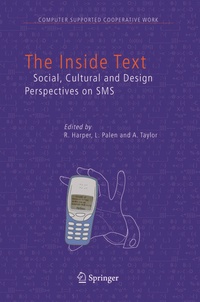
The Inside Text
Description

SMS or Text is one of the most popular forms of messaging. Yet, despite its immense popularity, SMS has remained unexamined by science. Not only that, but the commercial organisations, who have been forced to offer SMS by a demanding public, have had very little idea why it has been successful. Indeed, they have, until very recently, planned to replace SMS with other messaging services such as MMS.
This book is the first to bring together scientific studies into the values that 'texting' provides, examining both cultural variation in countries as different as the Philippines and Germany, as well as the differences between SMS and other communications channels like Instant Messaging and the traditional letter. It presents usability and design research which explores how SMS will evolve and what is likely to be the pattern of person-to-person messaging in the future. In short, The Inside Text is a fundamental resource for anyone interested in mobile communications at the start of the 21st Century.
More details
Other editions
Additional editions
Persons
Content
Rich Ling
Introduction The mobile telephone - often in the form of SMS - provides teens with a rich social life. It is used to coordinate activities and hold peer groups together. It is used as a symbolic umbilical cord to connect teens with their parents and it is a device through which teen's emancipation is mediated. Indeed, teens' adoption of the mobile telephone - and their intense use of SMS - is one of the surprises surrounding the technology. Reports from Japan (Hashimoto 2002), Finland (Kasesniemi and Rautiainen 2002), the general European scene (Mante-Meijer and al. 2001), the UK (Harper 2003) the Philippines (Ellwood-Clayton 2003) and of course Norway (Ling 2000; Ling 2001b; Ling and Helmersen 2000; Ling and Yttri 2003) all point in this direction. This point is also made in the chapters in this collection.
Emancipation, peer acceptance and the testing of various behaviors are a complex of activities that characterize adolescence. During adolescence, there is a strong motivation for teens to establish themselves as independent social actors who are outside the sphere of their parents. Indeed, emancipation from one's parents is one of the central issues for teens. The dynamic nature of modern society means that teens will emerge into a society that is at least somewhat different than that of their parents. Thus, the approach one takes to emancipation will be different from that of previous generations. This is simply because - unlike the situation in traditional societies - the situation changes from generation to generation. The skills needed, the technologies used and the educational background upon which one relies change and develop across generations. Because of this, the teen is an active agent in shaping his or her own socialization (Glaser and Strauss 1971, 57 - 88). During this period, the peer group plays a central role in this transition. It provides the teen with a group in which he or she can help to decide on activities and where he or she can take part in establishing the fashion and mode of the group.
The peer group also helps one to work out a relationship to the various facets of adult life. This includes issues such as sexuality, forms of consumption, relationship to authority and degrees of social/normative deviance. Where the parents can provide the teen with an ordered sense of life, the peer group provides the teen with a sphere in which he or she can assert control and participate more fully in decision making (Giordano 1995; Harter 1990; see also Savin-Williams and Berndt 1990; Youniss 1980; Youniss and Smollar 1985).
The peer group provides teens with a sphere of life wherein they can experience reciprocal self-disclosure and emotional support outside family units. According to Fine, the peer group is protective of its members and it is active in the development of an ideoculture, that is, a whole system of nicknames, jokes, styles of clothing, songs, artifacts etc. (1987, 126).
