

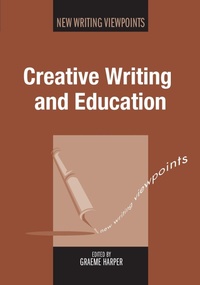
Creative Writing and Education
Published on 1. April 2015
236 pages
978-1-78309-355-7 (ISBN)
Description

This book explores creative writing and its various relationships to education through a number of short, evocative chapters written by key players in the field. At times controversial, the book presents issues, ideas and pedagogic practices related to creative writing in and around education, with a focus on higher education. The volume aims to give the reader a sense of contemporary thinking and to provide some alternative points of view, offering examples of how those involved feel about the relationship between creative writing and education. Many of the contributors play notable roles in national and international organizations concerned with creative writing and education. The book also includes a Foreword by Philip Gross, who won the 2009 TS Eliot Prize for poetry.
Reviews / Votes
Creative Writing and Education recognises the complexities involved when imaginative activity is captured and framed by the educational establishment, and by prevailing 'myths' around such an awkward convergence. This book's varied and provocative international insights broaden and deepen the possibilities for creativity in writing and teaching, fusing experience, method and inspiration. -- Steven Earnshaw, Sheffield Hallam University, UK This is a tremendously stimulating and timely book. Global in scope yet sensitive to local conditions, this is a collection that will help recast the future of Creative Writing in Education at large. Teeming with expert dialogues and punctuated by synoptic commentaries, the volume is unusual in spanning school, college and university, and in exploring the relations between Creative Writing, research and teaching. I thought I had thought a lot about these things. It makes me think again - afresh.-- Rob Pope, Emeritus Professor, Oxford Brookes University, UK In Creative Writing and Education leading scholars and teachers offer students and faculty illuminating new perspectives on creative writing in the university setting. The book bypasses old debates about whether creative writing can be taught to instead examine how creative writing is and might be undertaken and taught at a time where universities and the wider cultural industries experience rapid change. -- Stuart Glover, University of Queensland, Australia One of the main contributions of this book is in the comparison of different approaches to the pedagogy of creative writing and their application to a wide range of institutional contexts. In particular, the conversation updates research papers in creative writing pedagogy...I recommend this book to teachers of creative writing in High Schools, Teacher Training Colleges and Universities. I recommend it to writers who conduct workshops in Writers' Centres. And I recommend it to students, especially PhD students interested in working out pedagogies of creative writing. -- Dominique Hecq, Swinburne University of Technology, Australia * Bukker Tillibul, 2015 *
More details
Series
Language
English
Place of publication
Bristol
United Kingdom
Publishing group
Channel View Publications Ltd
Target group
Professional and scholarly
ISBN-13
978-1-78309-355-7 (9781783093557)
Copyright in bibliographic data and cover images is held by Nielsen Book Services Limited or by the publishers or by their respective licensors: all rights reserved.
Schweitzer Classification
Other editions
Additional editions
Graeme Harper
Creative Writing and Education
Book
04/2015
Multilingual Matters
€40.80
Shipment within 10-20 days
Person
Graeme Harper is a Professor of Creative Writing at Oakland University, Michigan, USA. He is Series Editor of New Writing Viewpoints, as well as Editor of New Writing: the International Journal for the Practice and Theory of Creative Writing. Graeme was the inaugural chair of the Higher Education Committee at the UK's National Association of Writers in Education (NAWE). He is an award-winning fiction writer and a former Commonwealth Scholar in Creative Writing.
Content
Foreword: Philip Gross
Creative Writing and Education: An Introduction: Graeme Harper
Chapter 1. Randall Albers and Steve May: Revelation, Transgression, Disclosure, and the Tyranny of Truth
Chapter 2. Liz Cashdan and Moy McCrory: Dragging the Corpse: Landscape & Memory
Commentary: Marcela Sulak
Chapter 3. Dianne Donnelly: Embracing the Learning Paradigm: How Assessment Drives Creative Writing Pedagogy
Chapter 4. Toby Emert and Maureen Hall: Greater Satisfaction from the Labor: Creative Writing as a Text Response Strategy in the Teacher Education Classroom
Commentary: Paul Munden
Chapter 5. Fan Dai: Creative Writing as Education in the Chinese Context
Commentary: Asma Mansoor
Chapter 6. Craig Batty, Simon Holloway and Gill James (with Graeme Harper): Questions and Answers: Responding to Creative Writing Teaching and Learning
Commentary: Katharine Coles
Chapter 7. Nigel McLoughlin: Interpretation, Affordance and Realised Intention: the transaction(s) between reader and writer.
Chapter 8. Gail Pittaway: Movement, maps, mnemonics and music: teaching fiction and poetry writing using sight and sound
Commentary: Sieneke de Rooij
Chapter 9. Jeri Kroll: Originality and Research: Knowledge Production in Creative Writing Doctoral Degrees
Chapter 10. Kevin Brophy and Elizabeth MacFarlane: Re-designing the lecture in a cyber-world: a creative writing case study
Commentary: Maggie Butt
Chapter 11. Michael Theune and Bob Broad: The Poetry of Evaluation
Chapter 12. Nigel Krauth: The Radical Future of Teaching Creative Writing
Commentary - Brooke Biaz
Creative Writing and Education: An Introduction: Graeme Harper
Chapter 1. Randall Albers and Steve May: Revelation, Transgression, Disclosure, and the Tyranny of Truth
Chapter 2. Liz Cashdan and Moy McCrory: Dragging the Corpse: Landscape & Memory
Commentary: Marcela Sulak
Chapter 3. Dianne Donnelly: Embracing the Learning Paradigm: How Assessment Drives Creative Writing Pedagogy
Chapter 4. Toby Emert and Maureen Hall: Greater Satisfaction from the Labor: Creative Writing as a Text Response Strategy in the Teacher Education Classroom
Commentary: Paul Munden
Chapter 5. Fan Dai: Creative Writing as Education in the Chinese Context
Commentary: Asma Mansoor
Chapter 6. Craig Batty, Simon Holloway and Gill James (with Graeme Harper): Questions and Answers: Responding to Creative Writing Teaching and Learning
Commentary: Katharine Coles
Chapter 7. Nigel McLoughlin: Interpretation, Affordance and Realised Intention: the transaction(s) between reader and writer.
Chapter 8. Gail Pittaway: Movement, maps, mnemonics and music: teaching fiction and poetry writing using sight and sound
Commentary: Sieneke de Rooij
Chapter 9. Jeri Kroll: Originality and Research: Knowledge Production in Creative Writing Doctoral Degrees
Chapter 10. Kevin Brophy and Elizabeth MacFarlane: Re-designing the lecture in a cyber-world: a creative writing case study
Commentary: Maggie Butt
Chapter 11. Michael Theune and Bob Broad: The Poetry of Evaluation
Chapter 12. Nigel Krauth: The Radical Future of Teaching Creative Writing
Commentary - Brooke Biaz
