

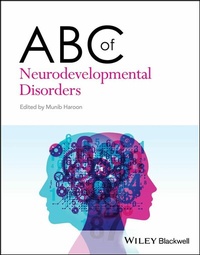
ABC of Neurodevelopmental Disorders
Description

An accessible and up-to-date discussion of the most common neurodevelopmental disorders
ABC of Neurodevelopmental Disorders
In ABC of Neurodevelopmental Disorders, Dr Munib Haroon delivers an insightful and practical introduction to various neurodevelopmental conditions, as well as discussions about their most common comorbid mental health conditions.
The author offers a broad overview of neurodiversity and neurodevelopmental disorders to help you understand how people who are neurodivergent may present in a clinical environment, how they should be assessed, and how they can best be managed. Each chapter provides a list of resources for further reading and for exploring these evolving, important, and fascinating topics in greater detail.
You'll also find:
* A thorough introduction to ADHD, autism, intellectual developmental disorders, tics and Tourette's disorder, developmental co-ordination disorder and specific learning disorder
* An introduction to clinical and non-clinical outcomes for different neurodevelopmental disorders
* Chapters on the assessment of mental health conditions in children, young people and adults with neurodevelopmental disorders
* Discussion about the genetic basis of neurodevelopmental disorders, including a specific chapter on this topic
* A standalone chapter on Foetal Alcohol Spectrum Disorder
Aimed at doctors and mental health practitioners including community paediatricians, psychiatrists, psychologists, counsellors, addiction specialists, social workers and trainees in these fields. ABC of Neurodevelopmental Disorders will also benefit healthcare workers who regularly treat neurodivergent people in a variety of settings.
More details
Other editions
Additional editions
Person
Munib Haroon is a Consultant Community Paediatrician, Mid Yorkshire Teaching NHS Trust.
Content
List of Contributors vii
Preface ix
Acknowledgments xi
List of Abbreviations xiii
1 An Introduction to Neurodevelopmental Disorders 1
Munib Haroon
2 An Introduction to ADHD and Its Presentation 5
Munib Haroon
3 The Assessment and Diagnosis of ADHD in Children and Young People 9
Ayesha Qureshi
4 The Treatment and Outcomes of Children and Young People with ADHD 13
Munib Haroon
5 ADHD: Adult Considerations 16
Munib Haroon
6 An Introduction to Autism 21
Munib Haroon
7 The Presentation Assessment and Diagnosis of Autism in Children and Young People 25
Munib Haroon
8 Interventions for Autistic Children and Young People 31
Munib Haroon
9 Autism: Adult Considerations 36
Munib Haroon
10 An Introduction to Intellectual Developmental Disorders 42
Munib Haroon and Keri- Michèle Lodge
11 The Assessment and Diagnosis of Intellectual Developmental Disorders in Children and Young People 45
Munib Haroon and Keri- Michèle Lodge
12 The Treatment of Intellectual Developmental Disorders in Children and Young People 51
Munib Haroon and Keri- Michèle Lodge
13 Intellectual Developmental Disorders in Adults 55
Keri- Michèle Lodge
14 An Introduction to Tic Disorders and Tourette's Disorder 61
Fraser Scott
15 The Assessment and Diagnosis of Tic Disorders 66
Fraser Scott
16 The Management and Outcome of Tic Disorders 70
Fraser Scott
17 An Introduction to Developmental Coordination Disorder 75
Munib Haroon
18 The Assessment and Diagnosis of Developmental Coordination Disorder 78
Munib Haroon
19 Treatment and Interventions for Developmental Coordination Disorder 81
Munib Haroon
20 An Introduction to Specific Learning Disorder 84
Tracy Laverick and Julie Armstrong
21 The Assessment and Diagnosis of Specific Learning Disorder in Children and Young People 86
Tracy Laverick and Julie Armstrong
22 Specific Learning Disorder: Interventions and Management 90
Tracy Laverick and Julie Armstrong
23 Supporting Specific Learning Disorder into Adulthood 92
Tracy Laverick and Julie Armstrong
24 Foetal Alcohol Spectrum Disorder 94
Elizabeth Birley
25 Mental Health Conditions in Children and Young People with Neurodevelopmental Disorders 101
Monica Shaha Mini Pillay and Munib Haroon
26 Assessing Mental Health Conditions in Children and Young People with Neurodevelopmental Disorders 104
Monica Shaha and Mini Pillay
27 Treating Mental Health Conditions in Children and Young People with Neurodevelopmental Disorders 108
Monica Shaha and Mini Pillay
28 Adult Mental Health in Neurodevelopmental Disorders: Autism 113
Conor Davidson and Sharmi Ghosh
29 Adult Mental Health in Neurodevelopmental Disorders: Intellectual Developmental Disorder Attention Deficit Hyperactivity Disorder Tourette's Disorder and Other Conditions 117
Alwyn Kam
30 The Genetic Basis of Neurodevelopmental Disorders 123
F. Lucy Raymond
31 Neurodivergency on a Day- to- Day Basis 129
Munib Haroon
Index 135
CHAPTER 1
An Introduction to Neurodevelopmental Disorders
Munib Haroon
OVERVIEW
- Neurodevelopmental disorders (NDDs) are relatively common conditions.
- They arise in the developing brain and so have features typically present in childhood.
- They can present with developmental differences and alterations in personal, social, academic or occupational functioning.
- They include autism, ADHD, Tourette's disorder/tic disorders, developmental coordination disorder, intellectual developmental disorders (intellectual disability) and specific learning disorder.
- NDDs often co-occur in the same individual.
- NDDs are associated with mental health difficulties and other physical conditions.
- NDDs can be viewed as diversity/difference/divergence, difficulty, disorders or disabilities, according to context and different models of health.
What is a neurodevelopmental disorder?
Neurodevelopmental disorders (see Box 1.1) arise in the developing brain; their features are typically present from childhood (but may escape attention until later on in adolescence or adulthood). They may include differences in patterns of development or result in alterations in personal, social, academic or occupational functioning.
Depending on the person and their situation, these conditions may be considered as natural (neuro) diversity, difference, neurodivergency and/or as difficulties, disorders or disabilities (see Box 1.1). There is typically a strong genetic component behind them, meaning that they can cluster in families. In addition, they often seem to co-occur in the same individual.
Classification schemes
Two of the main classification schemes in healthcare, the International Classification of Diseases (ICD) and the Diagnostic and Statistical Manual of Mental Disorders (DSM) (see Figure 1.1), define what conditions are classed as neurodevelopmental disorders. Both of these are well-established, internationally recognised systems and at the time of writing are in their 11th and 5th iterations, plus further text revisions for the latter. While they continue to use slightly different terminology for some conditions, they have become more closely aligned over the years. This is helpful in ensuring the use of consistent terms. That is important, because consistent language can be helpful for clinicians who make diagnoses, but also for researchers, patients, carers and other professionals.
Table 1.1 lists some of the conditions classed as neurodevelopmental disorders; as you can see, the lists under each classification are very similar. Because the DSM is probably the most widely used system and the one that most people are familiar with, this book will use the DSM terminology.
Even after taking account of the conditions deliberately left out of the list in Table 1.1 for simplicity, there do seem to be some notable omissions. Tic disorders do not appear primarily under the ICD-11 classification, but instead appear as a secondary class. There are other conditions that could be said to belong in the classification schemes for neurodevelopmental conditions but are not listed. Examples include epilepsy and schizophrenia. Compelling arguments could be made for including these on the lists, although clearly counter-arguments against locating them there have also been made - and for the moment seem to dominate the discussion.
This demonstrates the somewhat arbitrary nature of classification schemes.
There are other conditions that will be familiar to some people as neurodevelopmental disorders but are not on these lists, for example Asperger's syndrome (see Box 1.2). This illustrates the changing nature of classification schemes. For example, conditions like Asperger's or 'pervasive developmental disorder not otherwise specified' have become subsumed within the more overarching term 'autism spectrum disorder'. There are a number of reasons for this; perhaps the most important is that many conditions are increasingly described as existing on a continuum, with variations in the extent to which individuals with these conditions manifest different features. Whereas previously conditions like autism and Asperger's were seen as more distinct, albeit very similar conditions (similar enough to create a diagnostic dilemma over whether someone had autism or Asperger's), modern terminology sees these conditions as points on a broad spectrum.
Box 1.1 Some definitions
A number of different terms are used throughout this text, such as condition, disorder, disability, neurodiversity, neurodivergent and neurotypical, of which brief definitions are given here. The reader should be aware that there may be variations in how these are used outside of this text.
- Condition: A general or specific state of physical/mental health (i.e. 'you're a highly conditioned athlete' vs 'the condition you have is called eczema'). In ABC of Neurodevelopmental Disorders the word is therefore frequently used to imply a variation from the 'usual' and sometimes in relation to a specific condition.
- Disorder: A condition or illness that affects the usual functioning of the body or mind.
- Disability: A physical or mental condition that has a substantial and long-term negative effect on the ability to do normal daily activities.
- Neurodiversity: The thinking, perceiving, learning and behavioural variations that exist across all humans (e.g. 'Neurodiversity is a fact of life' but not 'I am neurodiverse').
- Neurodivergent: The presence of variations from 'the norm' in thinking/perceive/learning/behaving (e.g. 'I am neurodivergent').
- Neurotypical: As distinct from neurodivergent. The type of thinking/perceiving/learning/behaving that conforms to what is understood to be 'usual' by society and does not fit a recognised pattern of thinking that might be identified as neurodivergent.
Figure 1.1 The classification schemes for neurodevelopmental disorders.
Table 1.1 Comparison of classification schemes ICD-11 and DSM-5-TR for neurodevelopmental disorders (not all disorders are included).
Neurodevelopmental disorders in ICD-11 Neurodevelopmental disorders in DSM-5-TR Disorders of intellectual development Intellectual developmental disorders (intellectual disability) Autism spectrum disorder Autism spectrum disorder Attention deficit hyperactivity disorder Attention deficit/hyperactivity disorder Developmental motor coordination disorder Developmental coordination disorder Developmental learning disorder Specific learning disorder Tic disorders, e.g. Tourette's disorderBox 1.2 John
John is a 25-year-old ex-solicitor. He was originally referred as an 8-year-old to see a paediatrician for possible dyspraxia before being diagnosed two years later with Asperger's syndrome. This was followed with being diagnosed with attention deficit hyperactivity disorder (ADHD) just after starting university. He recently left his job after developing a severe anxiety disorder and is currently tutoring law students online from his home in Cambridge. He has always had insomnia, but has found that not having to work 'office hours' has worsened his sleep-wake routine and he has just started taking melatonin to help with this. He is wondering if he needs to see the adult autism team to have his Asperger's diagnosis reclassified as autism.
Medical models and social models
This title of this book contains the word 'disorders', but is that the correct term for a person with a neurodevelopmental condition?
When viewed from a clinical point of view, the reasons for the word choice are clear. People do not go to an autism clinic (for example) out of a sense of curiosity. It is generally because they are experiencing difficulties of some sort and they (or their carers/parents/partners) are seeking an explanation for these difficulties and/or some kind of support. But are those difficulties necessarily down to an individual's innate make-up?
As we see in the case of Jane (Box 1.3), while there may have been notable differences in behaviour from an early age and she was subsequently diagnosed as being autistic, Jane was doing perfectly well until there was a lot of upheaval in her life (because of events not within her control), and once things were resolved she settled down again.
Is it therefore fair in Jane's case to see the autism as a disorder/disability or even as a medical condition when she is perfectly fine in the right environment? This argument can be generalised to state that in neurodivergent individuals, if the environment is right (whether through support or leaving them alone to get on with things...
