

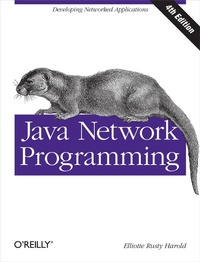
Java Network Programming
Developing Networked Applications
Published on 4. October 2013
506 pages
978-1-4493-6595-0 (ISBN)
Description

This practical guide provides a complete introduction to developing network programs with Java. Youll learn how to use Javas network class library to quickly and easily accomplish common networking tasks such as writing multithreaded servers, encrypting communications, broadcasting to the local network, and posting data to server-side programs.Author Elliotte Rusty Harold provides complete working programs to illustrate the methods and classes he describes. This thoroughly revised fourth edition covers REST, SPDY, asynchronous I/O, and many other recent technologies.Explore protocols that underlie the Internet, such as TCP/IP and UDP/IPLearn how Javas core I/O API handles network input and outputDiscover how the InetAddress class helps Java programs interact with DNSLocate, identify, and download network resources with Javas URI and URL classesDive deep into the HTTP protocol, including REST, HTTP headers, and cookiesWrite servers and network clients, using Javas low-level socket classesManage many connections at the same time with the nonblocking I/O
More details
Other editions
Additional editions
Book
11/2013
4th Edition
O'Reilly
€51.50
Shipment within 10-20 days
Content
- Cover
- Copyright
- Table of Contents
- Preface
- About the Fourth Edition
- Organization of the Book
- Who You Are
- Java Versions
- About the Examples
- Conventions Used in This Book
- Request for Comments
- Using Code Examples
- Safari® Books Online
- How to Contact Us
- Acknowledgments
- Chapter 1. Basic Network Concepts
- Networks
- The Layers of a Network
- The Host-to-Network Layer
- The Internet Layer
- The Transport Layer
- The Application Layer
- IP, TCP, and UDP
- IP Addresses and Domain Names
- Ports
- The Internet
- Internet Address Blocks
- Network Address Translation
- Firewalls
- Proxy Servers
- The Client/Server Model
- Internet Standards
- IETF RFCs
- W3C Recommendations
- Chapter 2. Streams
- Output Streams
- Input Streams
- Marking and Resetting
- Filter Streams
- Chaining Filters Together
- Buffered Streams
- PrintStream
- Data Streams
- Readers and Writers
- Writers
- OutputStreamWriter
- Readers
- Filter Readers and Writers
- PrintWriter
- Chapter 3. Threads
- Running Threads
- Subclassing Thread
- Implementing the Runnable Interface
- Returning Information from a Thread
- Race Conditions
- Polling
- Callbacks
- Futures, Callables, and Executors
- Synchronization
- Synchronized Blocks
- Synchronized Methods
- Alternatives to Synchronization
- Deadlock
- Thread Scheduling
- Priorities
- Preemption
- Thread Pools and Executors
- Chapter 4. Internet Addresses
- The InetAddress Class
- Creating New InetAddress Objects
- Getter Methods
- Address Types
- Testing Reachability
- Object Methods
- Inet4Address and Inet6Address
- The NetworkInterface Class
- Factory Methods
- Getter Methods
- Some Useful Programs
- SpamCheck
- Processing Web Server Logfiles
- Chapter 5. URLs and URIs
- URIs
- URLs
- Relative URLs
- The URL Class
- Creating New URLs
- Retrieving Data from a URL
- Splitting a URL into Pieces
- Equality and Comparison
- Conversion
- The URI Class
- Constructing a URI
- The Parts of the URI
- Resolving Relative URIs
- Equality and Comparison
- String Representations
- x-www-form-urlencoded
- URLEncoder
- URLDecoder
- Proxies
- System Properties
- The Proxy Class
- The ProxySelector Class
- Communicating with Server-Side Programs Through GET
- Accessing Password-Protected Sites
- The Authenticator Class
- The PasswordAuthentication Class
- The JPasswordField Class
- Chapter 6. HTTP
- The Protocol
- Keep-Alive
- HTTP Methods
- The Request Body
- Cookies
- CookieManager
- CookieStore
- Chapter 7. URLConnections
- Opening URLConnections
- Reading Data from a Server
- Reading the Header
- Retrieving Specific Header Fields
- Retrieving Arbitrary Header Fields
- Caches
- Web Cache for Java
- Configuring the Connection
- protected URL url
- protected boolean connected
- protected boolean allowUserInteraction
- protected boolean doInput
- protected boolean doOutput
- protected boolean ifModifiedSince
- protected boolean useCaches
- Timeouts
- Configuring the Client Request HTTP Header
- Writing Data to a Server
- Security Considerations for URLConnections
- Guessing MIME Media Types
- HttpURLConnection
- The Request Method
- Disconnecting from the Server
- Handling Server Responses
- Proxies
- Streaming Mode
- Chapter 8. Sockets for Clients
- Using Sockets
- Investigating Protocols with Telnet
- Reading from Servers with Sockets
- Writing to Servers with Sockets
- Constructing and Connecting Sockets
- Basic Constructors
- Picking a Local Interface to Connect From
- Constructing Without Connecting
- Socket Addresses
- Proxy Servers
- Getting Information About a Socket
- Closed or Connected?
- toString()
- Setting Socket Options
- TCP_NODELAY
- SO_LINGER
- SO_TIMEOUT
- SO_RCVBUF and SO_SNDBUF
- SO_KEEPALIVE
- OOBINLINE
- SO_REUSEADDR
- IP_TOS Class of Service
- Socket Exceptions
- Sockets in GUI Applications
- Whois
- A Network Client Library
- Chapter 9. Sockets for Servers
- Using ServerSockets
- Serving Binary Data
- Multithreaded Servers
- Writing to Servers with Sockets
- Closing Server Sockets
- Logging
- What to Log
- How to Log
- Constructing Server Sockets
- Constructing Without Binding
- Getting Information About a Server Socket
- Socket Options
- SO_TIMEOUT
- SO_REUSEADDR
- SO_RCVBUF
- Class of Service
- HTTP Servers
- A Single-File Server
- A Redirector
- A Full-Fledged HTTP Server
- Chapter 10. Secure Sockets
- Secure Communications
- Creating Secure Client Sockets
- Choosing the Cipher Suites
- Event Handlers
- Session Management
- Client Mode
- Creating Secure Server Sockets
- Configuring SSLServerSockets
- Choosing the Cipher Suites
- Session Management
- Client Mode
- Chapter 11. Nonblocking I/O
- An Example Client
- An Example Server
- Buffers
- Creating Buffers
- Filling and Draining
- Bulk Methods
- Data Conversion
- View Buffers
- Compacting Buffers
- Duplicating Buffers
- Slicing Buffers
- Marking and Resetting
- Object Methods
- Channels
- SocketChannel
- ServerSocketChannel
- The Channels Class
- Asynchronous Channels (Java 7)
- Socket Options (Java 7)
- Readiness Selection
- The Selector Class
- The SelectionKey Class
- Chapter 12. UDP
- The UDP Protocol
- UDP Clients
- UDP Servers
- The DatagramPacket Class
- The Constructors
- The get Methods
- The setter Methods
- The DatagramSocket Class
- The Constructors
- Sending and Receiving Datagrams
- Managing Connections
- Socket Options
- SO_TIMEOUT
- SO_RCVBUF
- SO_SNDBUF
- SO_REUSEADDR
- SO_BROADCAST
- IP_TOS
- Some Useful Applications
- Simple UDP Clients
- UDPServer
- A UDP Echo Client
- DatagramChannel
- Using DatagramChannel
- Chapter 13. IP Multicast
- Multicasting
- Multicast Addresses and Groups
- Clients and Servers
- Routers and Routing
- Working with Multicast Sockets
- The Constructors
- Communicating with a Multicast Group
- Two Simple Examples
- Index
- About the Author
