

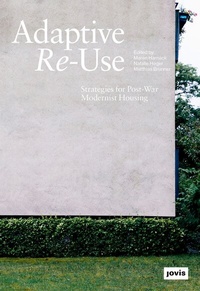
Adaptive Re-Use
Description

In florierenden Regionen stehen die Wohnungsmärkte unter erheblichem Druck. Will man Zersiedelung minimieren und Innenentwicklung fördern, scheinen Wohnsiedlungen der Nachkriegszeit prädestiniert für Nachverdichtung, da das Eigentum oft in den Händen einiger weniger Wohnungsbaugesellschaften liegt, die auch sozialen Wohnungsbau betreiben, und sie als eher wenig dicht wahrgenommen werden. Dabei besteht jedoch die Gefahr, dass die Siedlungen ihre charakteristischen Bau- und Freiraumstrukturen verlieren.
Anhand europäischer Fallbeispiele von 1945 bis 1975 diskutiert Adaptive Re-Use Strategien zur Weiterentwicklung von Nachkriegssiedlungen. In den Beiträgen dieses Sammelbandes erfahren die Leser, wie Wohnsiedlungen aus verschiedenen europäischen Ländern denkmalpflegerisch bewahrt werden, wie die Gebäudestruktur an heutige Anforderungen angepasst werden kann und welche Strategien angewendet werden, um die Entwicklung von Siedlungen der Nachkriegsmoderne für die Zukunft zu sichern.
More details
Other editions
Additional editions
Persons
Content
- Intro
- Contents
- Introduction
- Larger_Taller_Denser Post-War Modernist Housing in the Stuttgart Region
- Large-Scale Heritage A Conservation Perspective on Late Modernist Housing
- Highly Visible &
- Highly Valuable Big Housing Estates of the Boom Years
- Multi-Storey Housing in Britain A Historical and Heritage Overview
- The Crux of Inward Development
- Maintenance, Repair, and Renovation of the Finnish Post-War Housing Stock
- Wolfsburg Preserving Urban Design in Neighbourhoods Built Between 1938 and 1968
- Future Prospects for the Neue Vahr An Interdisciplinary Approach to Drafting a Leitbild
- Conservation or Replacement of Large Housing Estates? Experiences from Bijlmermeer, Amsterdam, the Netherlands
- That's How It Works! Replacing the Student Housing Complex in the Olympic Village, Munich
- Preserving the Legacy of Álvaro Siza
- Bremer Punkt
- Authors
- Image Credits
- Imprint
