

Process Intensification
Description

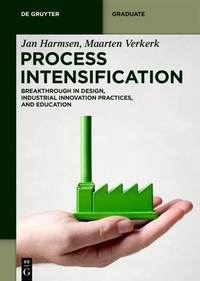
Process Intensification is a comprehensive textbook and treats the theory of process intensification design, and all innovation steps from idea generation to commercial implementation, and all focused on contributing to the UN Sustainable Development Goals. This book covers the 'hard' elements of design, modelling, and experimental validations and the 'soft' elements, values of engineers, interests of stakeholders and beliefs of society.
More details
Other editions
New editions
Additional editions
Persons
Jan Harmsen is currently the Director of Harmsen Consultancy BV (founded in 2010) after a 33-year career at Shell, where he obtained his industrial experience in research, development, design, start-up, operation and de-bottlenecking of chemical processes. Hence, he knows from experience how to innovate, i.e. to get from idea to commercialisation in an effective and efficient way.His experience in chemical process technology as well as biotechnology, is what gives Jan Harmsen a unique approach in process design; knowledge of both these fields help to evaluate the most sustainable processes in industrial technology.
Current positions and functions:
- Independent Consultant Sustainable Process Innovation
- former Teacher Sustainable Design at Groningen University and Delft University of Technology.- current Teacher Sustainable Design at Delft University of Technology. - Editor of the Elsevier Journal of Chemical Engineering, Processing, Process Intensification
- Editor of the Open Springer Journal of Energy, Sustainability and Society
- President of the Dutch Process Technologists Society (Nederlandse vereniging van ProcesTechnologen)
Clients include: AKZONOBEL, Corbion, Det Norske Veritas, DSM, ECN, Flowid, FrieslandCampina, Hogeschool Utrecht, Huntsman, ISPT, University of Groningen, TMC Chemical, TU Delft, TU Einhoven, ZETON.
Maarten Verkerk (1953) is extraordinary professor of Reformational Philosophy. He studied chemistry and theoretical physics in Utrecht (1977) and received his PhD in technical sciences at the Technical University Twente (1982). He was a senior researcher at the Research Laboratory of Philips (1982-1986). In the period 1986-2002 he was manager in the industrial area (development, manufacturing) in The Netherlands, Germany and Taiwan. In the period 2003-2007 he was division manager and director of a psychiatric hospital. In 2004 he received a second PhD at the University Maastricht. The title of this thesis was Trust and Power on the Shop Floor. An ethnographical, ethical, and philosophical study on responsible behaviour in industrial organizations. The research interests of Maarten Verkerk include: feminism, responsibility processes in industrial organizations, change management, ethics of technology, ethics of management and organization, and innovation in health care.
Prof. Verkerk also holds a chair of Reformational Philosophy at the University Maastricht. Besides that he is director of an innovation network in health care (VitaValley).
Content
- Intro
- Preface
- Contents
- Authors' Biographies
- 1 Introduction
- Part A: Theory
- 2 Process intensification design
- 3 The role of sustainable development goals
- 4 Values, interests, and beliefs - three perspectives on industrial innovation practices
- 5 Multidisciplinary assessment - integrating different knowledge types
- Part B: Application of theory: guidelines and methods
- 6 Discovery stage
- 7 Concept stage
- 8 Feasibility stage
- 9 Development stage
- 10 Engineering procurement and construction (EPC) stage
- 11 Start-up and normal operation stage
- Part C: Industrial practice cases
- 12 Summary PI industrial practices
- 13 Rotating cone reactor biomass pyrolysis process
- 14 Eastman chemical methyl acetate multifunctional integration
- 15 Shell OMEGA only monoethylene glycol advanced process
- 16 Intensified ethanol production by cyclic distillation
- 17 Pharmaceuticals case
- Part D: Educating PI - academic and industrial
- 18 Process intensification education BSc courses
- 19 Industrial sustainable intensified process innovation training
- Appendix 1 Pharma case: production increase by combined evaporation crystallization and cooling crystallization
- Index
