

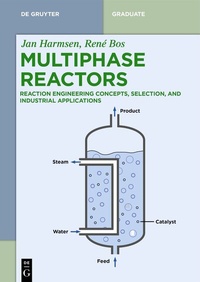
Multiphase Reactors
Description

This Multiphase Reactors book is about fundamentals, selection, design, development (scale-up) and applications of two- and three-phase reactors. It is a graduate textbook focused on creating understanding of the fundamentals, as much as possible without resorting to mathematics. It also is full of real-life industrial applications and examples from the authors' own experiences. The target audience comprises students and industrial practitioners who may or may not have had formal training in chemical reaction engineering. Each chapter explains the subject and contains take home messages, examples, worked out cases, quiz questions, and exercises.
More details
Other editions
Additional editions
Persons
Jan Harmsen is an experienced chemical engineer. He graduated from Twente University in 1977. Since then, he engaged in multiphase reactor development, process research, process development, process design, process start-up and debottlenecking in Shell. He also has over 25 years of experience in teaching sustainable product and process design for MSc, PhD, and PDEng students, at Delft University and Groningen University and also on process scale-up for industrial practitioners.
In his career he engaged in three-phase reactor development; fixed bed, moving bed, biomass fermentation to ethanol, xanthan gum fermentation, fluid bed shale oil retorting, heat transfer in fluid beds, three-phase reactive distillation de-bottlenecking, crystallization start-up optimization by dynamic modelling, reactive distillation, and dividing wall distillation.
Since 2010 he is an independent consultant for Harmsen Consultancy, providing advice, and courses on: sustainable product and process innovation, sustainable product and process concept design, process intensification concept design, industrial process scale-up, and industrial unit operations scale-up. He is (co) author of several books and articles.
René Bos is currently Senior Principal Science Expert within the department Long Range Research and Experimentation at Shell Projects & Technology, Amsterdam. Since June 2018 he is part time (0.2 fte) seconded to Ghent University as guest professor "Industrial Reaction Engineering" at the Laboratory of Chemical Technology (LCT). He received his PhD in chemical engineering at University Twente on "Reactor and catalyst dynamics and stability" in the group of Prof. Roel Westerterp.
He joined Shell in September 1991 where he has had a variety of roles in Amsterdam, Pernis and Houston, mostly within R&D but also at manufacturing sites. In these roles he worked in wide variety of (reactor) technology fields, including ethylene oxide, DeNOx, MTO, SM/PO, Fischer-Tropsch, Gas-to-Chemicals, E-ODH, OCM, syngas technologies and CO 2 conversions, spanning the whole range from ideation, proof of concept, development and pilot plant testing to deployment.
In 2018 he was appointed guest professor at Ghent University. Overall, he (co-) authored 40 scientific publications in the open literature (next to >100 Shell internal research reports) and 42 Patent Applications.
Content
- Intro
- Contents
- Preface
- About the authors
- Part A: Multiphase reactors: chemical reaction engineering
- 1 Introduction
- 2 Overview of multiphase reactors
- Part B: Fundamentals
- 3 Scale-independent basics relevant for all reactors
- 4 Residence time distribution and mixing theory
- 5 Inter- and intraphase mass and heat transfer
- 6 Quantification of mass transfer in G-L(-S) reactors
- 7 Heat management
- 8 Multiphase reactor modeling
- Part C: Stage-gate innovation methods
- 9 Stage-gate innovation methods
- 10 Multiphase reactor selection
- 11 New reaction systems through all innovation stages
- Part D: Education
- 12 Education guidelines
- 13 Industrial cases
- 14 Education case study: polyolefin CRE and scale-up
- Index
