

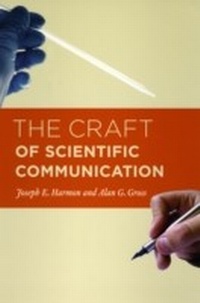
The Craft of Scientific Communication
Description

"This work would be an important manual for any scientist who wishes to publish articles that generate significant impact." - Quarterly Review of Biology The ability to communicate in print and person is essential to the life of a successful scientist. But since writing is often secondary in scientific education and teaching, there remains a significant need for guides that teach scientists how best to convey their research to general and professional audiences. The Craft of Scientific Communicationwill teach science students and scientists alike how to improve the clarity, cogency, and communicative power of their words and images. In this remarkable guide, Joseph E. Harmon and Alan G. Gross have combined their many years of experience in the art of science writing to analyze published examples of how the best scientists communicate. Organized topically with information on the structural elements and the style of scientific communications, each chapter draws on models of past successes and failures to show students and practitioners how best to negotiate the world of print, online publication, and oral presentation. "It would be impossible to constrain my appreciation for this book, which will find eager reception wherever the need for teaching scientific writing is addressed." -Patrick Logan, University of Rhode Island "Demonstrates quite powerfully that no scientist can survive professionally without writing well . . . This book enters a crowded room of 'how to' books for scientific authors but emerges as a unique contribution due to the authors' extensive research of scientific communication that provides the intellectual history and social functions of the very features of good writing that scientific authors must master." -Carol Reeves, Butler University
All prices
More details
Other editions
Additional editions

Persons
Joseph E. Harmon is a senior editor/writer at Argonne National Laboratory. Alan G. Gross is a professor in the Department of Communication Studies at the University of Minnesota. They are coauthors of The Scientific Literature: A Guided Tour, alsopublished by the University of Chicago Press.
Content
- Intro
- Contents
- What This Book Does
- Part I: The Scientific Article
- 1. Introducing Your Problem
- 2. Distilling Your Research
- 3. Entitling Your Research
- 4. Turning Your Evidence into Arguments: Results and Discussion
- 5. Drawing Your Conclusions
- 6. Framing Your Methods
- 7. Distributing Credit
- 8. Arranging Matters
- 9. Varying Matters
- Part II: Beyond the Scientific Article
- 10. Proposing New Research
- 11. Going Public
- 12. Presenting PowerPoint Science
- 13. Organizing PowerPoint Slides

