

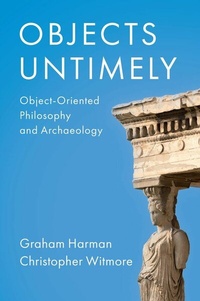
Objects Untimely
Description

Objects generate time; time does not generate or change objects. That is the central thesis of this book by the philosopher Graham Harman and the archaeologist Christopher Witmore, who defend radical positions in their respective fields.
Against a current and pervasive conviction that reality consists of an unceasing flux - a view associated in philosophy with New Materialism - object-oriented ontology asserts that objects of all varieties are the bedrock of reality from which time emerges. And against the narrative convictions of time as the course of historical events, the objects and encounters associated with archaeology push back against the very temporal delimitations which defined the field and its objects ever since its professionalization in the nineteenth century.
In a study ranging from the ruins of ancient Corinth, Mycenae, and Troy to debates over time from Aristotle and al-Ash'ari through Henri Bergson and Alfred North Whitehead, the authors draw on alternative conceptions of time as retroactive, percolating, topological, cyclical, and generational, as consisting of countercurrents or of a surface tension between objects and their own qualities. Objects Untimely invites us to reconsider the modern notion of objects as inert matter serving as a receptacle for human categories.
More details
Other editions
Additional editions
Persons
Christopher Witmore is Professor of Archaeology and Classics at Texas Tech University.
Content
List of Figures
Preface
1 Time and Objects, by Graham Harman and Christopher Witmore
2 The Antiquity of Time: Objects Greek, by Christopher Witmore
3 Discussion of Chapter Two
4 Objects as the Root of Time, by Graham Harman
5 Discussion of Chapter Four
A Note on Models of Time
Notes
References
Index
