

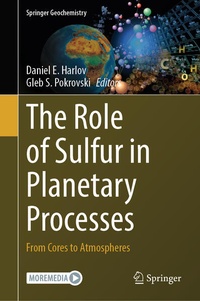
The Role of Sulfur in Planetary Processes
Description

This book compiles a compendium of the current knowledge on the distribution, speciation and behavior of sulfur in the atmosphere, surface, crust, mantle, and core of the Earth as well as the other bodies of the solar system, including the terrestrial planets, dwarf planets, asteroids, moons, and the gas giants. It brings together a diverse group of geoscientists with broad interests, knowledge, and expertise regarding the behavior of sulfur in a variety of natural processes. This diversity of knowledge and experience allowed them to contribute to a comprehensive and coherent series of review chapters, which outline and expand upon the basis of our current understanding regarding how sulfur contributes to the origin, evolution, and functioning of the Earth as well as the other bodies of the solar system.
With a plethora of oxidation states (from -2 to +6), a cosmic element abundance rank of ten, a fascinating redox-, pH-, and radical-dependent chemistry, a strong chemical affinity for many metals, and a large fractionation among its four stable isotopes, sulfur is a key player and a powerful tracer element in the various physical and chemical processes occurring in the atmosphere, surface, crust, mantle, and core of the Earth as well as in the other bodies of the solar system. On Earth, as a key component of aqueous fluids, sulfur is a powerful complexing agent for a series of metals, which allows for their transfer across the lithosphere and subsequent concentration as ore deposits. As sulfur dioxide and sulfate, sulfur can act as an oxidizing agent, whereas as hydrogen sulfide and polysulfides, it can act as a reducing agent and a strong binder for metals, over a wide range of pressures and temperatures in the crust, upper mantle, and during subduction processes. Sulfur controls the partitioning of a many metals between silicate melts, gaseous and aqueous fluids, and mineral phases, thereby playing a major role in the formation of magmatic-hydrothermal and metamorphic ore deposits that supply strategic metal resources to our society. In the atmospheres of both the terrestrial worlds and the gas giants, sulfur plays a diverse and important role shaping their physical, chemical and biological evolution.
More details
Other editions
Additional editions
Content
The Role of Sulfur in Planetary Processes.- Sulfide Minerals.- Sulfur in Non-Sulfide Minerals.- Sulfur in Hydrothermal Fluids.- Sulfur Isotope Fractionations in Aqueous and Gaseous Systems.- The Role of the Continental Sulfur Cycle in the Global Sulfur and Carbon Cycles.- Sulfur in the Earth's Atmosphere.- Biogeochemistry of Sulfur.
