Space Systems Failures
Description

In the 1960s and 1970s deep space missions were dispatched in pairs in case one was lost in launch or failed during its journey. Following the triumphs of the Viking landings on Mars in 1976 and both Voyagers spacecraft successfully surveying the outer giant planets of the Solar System, it was decided by NASA to cut costs and send out just a single probe.
Although Magellan successfully mapped Venus by radar, it suffered from problems during the flight. Then came the loss of Mars Observer, whose engine exploded as it was preparing to enter Mars' orbit because it was using technology designed for Earth's satellites and the engine was not suited to spending several months in space. Later came the high-profile losses of Mars Climate Observer and Mars Polar Lander - a consequence of the faster, better, cheaper philosophy introduced by Dan Goldin in 1993. Even the highly successful Galileo mission suffered a major setback when its high-gain antenna (also based on satellite mission suffered a major setback when its high-gain antenna (also based on satellite communication technology) failed to deploy fully, greatly diminishing the craft's radio transmission capabilities, forcing the ground crew to re-programme the on-board computer to enable it to fulfil its mission and provide stunning images of Jupiter and its moons.
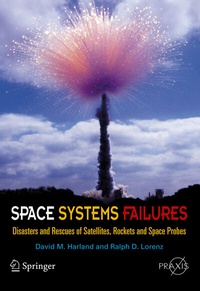
In Space Systems Failures , David Harland (here working with co-author Ralph Lorenz) describes the many quite fascinating tales of woe involving failures of rockets, satellites and deep space missions in his inimitable style, providing a unique insight into the trials and tribulations of exploration at the high frontier.
Reviews / Votes
From the reviews:
"Harland (space historian) and Lorenz (Univ. of Arizona, Tucson), using occasional flashes of humor, explore in depth the wide variety of causes of failure of space systems . . The material is very practical, punchy, and straightforward, presented in a refreshing writing style. The book contains many . illustrations, extensive references at the end of each chapter and a full 14-page index. . it is a must for scientists and engineers engaged in or planning a career in space systems. Summing Up: Recommended." (W. E. Howard, CHOICE, November, 2005)
"This book is the literary equivalent of the 'tell-all' TV documentary and should meet most of its readers' vicarious interests in what can go wrong in - or on the way to -space. . The book is pretty well encyclopaedic . . The book is illustrated with black-and-white photos and diagrams . . On balance, this book is well researched and referenced . . Anyone involved in the design, manufacturing and operation of spacecraft and launch vehicles should read this book . and learn." (satellite-evolution.com, May/June, 2007)
More details
Other editions
Additional editions