

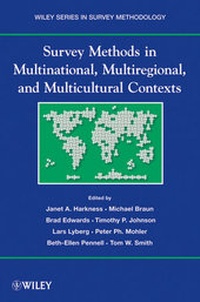
Survey Methods in Multicultural, Multinational, and Multiregional Contexts
Description

Reviews / Votes
"For now, we commend all the editors of this book forhaving compiled the tremendous amount of material received, editedand organized it in such a way that enables this unique andpioneering book advance the field of 3M." (BizIndia, 1 May 2012)More details
Other editions
Additional editions
Persons
Content
PREFACE.
PART I SETTING THE STAGE.
1 Comparative Survey Methodology (Janet A. Harkness, Michael Braun, Brad Edwards, Timothy P. Johnson, Lars Lyberg, Peter Ph. Mohler, Beth-Ellen Pennell, and Tom W. Smith).
2 Equivalence, Comparability, and Methodological Progress (Peter Ph. Mohler and Timothy P. Johnson).
PART II QUESTIONNAIRE DEVELOPMENT.
3 Designing Questionnaires for Multipopulation Research (Janet A. Harkness, Brad Edwards, Sue Ellen Hansen, Debra R. Miller, and Ana Villar).
4 Creating Questions and Protocols for an International Study of Ideas About Development and Family Life (Arland Thornton, Alexandra Achen, Jennifer S. Barber, Georgina Binstock, Wade M. Garrison, DirghaJ. Ghimire, Ronald Inglehart, Rukmalie Jayakody, Yang Jiang, Julie de Jong, Katherine King, Ron J. Lesthaeghe, Sohair Mehanna, Colter Mitchell, Mansoor Moaddel, Mary Beth Ofstedal, Norbert Schwarz, Guangzhou Wang, Yu Xie, Li-Shou Yang, Linda Ñ Young-DeMarco, andKathryn Yount).
5 Managing the Cognitive Pretesting of Multilingual Survey Instruments: A Case Study of Pretesting of the U.S. Census Bureau Bilingual Spanish/English Questionnaire (Patricia L. Goerman and Rachel A. Caspar).
6 Cognitive Interviewing in Non-English Languages: A Cross-Cultural Perspective (Yuling Pan, Ashley Landreth, Hyunjoo Park, Marjorie Hinsdale-Shouse, and Alisu Schoua-Glusberg).
PART III TRANSLATION, ADAPTATION, AND ASSESSMENT.
7 Translation, Adaptation, and Design (Janet A. Harkness, Ana Villar, and Brad Edwards).
8 Evaluation of a Multistep Survey Translation Process (Gordon B. Willis, Martha Stapleton Kudela, Kerry Levin, Alicia Norberg, Debra S. Stark, Barbara H. Forsyth, Pat Dean Brick, David Berrigan, Frances E. Thompson, Deirdre Lawrence, and Anne M. Hartman).
9 Developments in Translation Verification Procedures in Three Multilingual Assessments: A Plea for an Integrated Translation and Adaptation Monitoring Tool (Steve Dept, Andrea Ferrari, and Laura Wäyrynen).
PART IV CULTURE, COGNITION, AND RESPONSE.
10 Cognition, Communication, and Culture: Implications for the Survey Response Process (Norbert Schwarz, Daphna Oyserman, and Emilia Peytcheva).
11 Cultural Emphasis on Honor, Modesty, or Self-Enhancement: Implications for the Survey-Response Process (Ayse K. Uskul, Daphna Oyserman, and Norbert Schwarz).
12 Response Styles and Culture (Yongwei Yang, Janet A. Harkness, Tzu-Yun Chin, and Ana Villar).
PART V KEY PROCESS COMPONENTS AND QUALITY.
13 Quality Assurance and Quality Control in Cross-National Comparative Studies (Lars Lyberg and Diana Maria Stukel).
14 Sampling Designs for Cross-Cultural and Cross-National Survey Programs (Steven G. Heeringa and Colm Î 'Muircheartaigh).
15 Challenges in Cross-National Data Collection (Beth-Ellen Pennell, Janet A. Harkness, Rachel Levenstein, and Martine Quaglia).
16 A Survey Process Quality Perspective on Documentation (Peter Ph. Mohler, Sue Ellen Hansen, Beth-Ellen Pennell, Wendy Thomas, Joachim Wackerow, and Frost Hubbard).
17 Harmonizing Survey Data (Peter Granda, Christof Wolf, and Reto Hadorn).
PART VI NONRESPONSE.
18 The Use of Contact Data in Understanding Cross-National Differences in Unit Nonresponse (Annelies G. Blom, Annette Jackie, and Peter Lynn).
19 Item Nonresponse and Imputation of Annual Labor Income in Panel Surveys from a Cross-National Perspective (Joachim R. Frick and Markus M. Grabka).
PART VII ANALYZING DATA.
20 An Illustrative Review of Techniques for Detecting Inequivalences (Michael Braun and Timothy P. Johnson).
21 Analysis Models for Comparative Surveys (Joop J. Hox, Edith de Leeuw, andMatthieu J.S. Brinkhuis).
22 Using Polytomous Item Response Theory to Examine Differential Item and Test Functioning: The Case of Work Ethic (David J. Woehr and John P. Meriac).
23 Categorization Errors and Differences in the Quality of Questions in Comparative Surveys (Daniel Oberski, Willem E. Saris, and Jacques A. Hagenaars).
24 Making Methods Meet: Mixed Design in Cross-Cultural Research (Fons J.R. van de Vijver andAthanasios Chasiotis).
PART VIII GLOBAL SURVEY PROGRAMS.
25 The Globalization of Survey Research (Tom W. Smith).
26 Measurement Equivalence in Comparative Surveys: the European Social Survey (ESS)-From Design to Implementation and Beyond (Rory Fitzgerald and Roger Jowell).
27 The International Social Survey Programme: Annual Cross-National Surveys Since 1985 (Knut KalgraffSkjäk).
28 Longitudinal Data Collection in Continental Europe: Experiences from the Survey of Health, Ageing, and Retirement in Europe (SHARE) (Axel Börsch-Supan, Karsten Hank, Hendrik Jürges, and Mathis Schröder0.
29 Assessment Methods in IEA's TIMSS and PIRLS International Assessments of Mathematics, Science, and Reading (Ina V. S. Mullis and Michael O. Martin).
30 Enhancing Quality and Comparability in the Comparative Study of Electoral Systems (CSES) (David A. Howell).
31 The Gallup World Poll (Robert D. Tortora, Rajesh Srinivasan, and Neli Esipova).
REFERENCES.
SUBJECT INDEX.
