

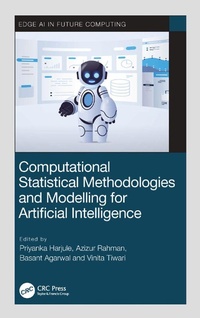
Computational Statistical Methodologies and Modeling for Artificial Intelligence
1st Edition
Published on 31. March 2023
388 pages
978-1-000-83107-8 (ISBN)
Description

This book covers computational statistics-based approaches for Artificial Intelligence. The aim of this book is to provide comprehensive coverage of the fundamentals through the applications of the different kinds of mathematical modelling and statistical techniques and describing their applications in different Artificial Intelligence systems. The primary users of this book will include researchers, academicians, postgraduate students, and specialists in the areas of data science, mathematical modelling, and Artificial Intelligence. It will also serve as a valuable resource for many others in the fields of electrical, computer, and optical engineering.
The key features of this book are:
Presents development of several real-world problem applications and experimental research in the field of computational statistics and mathematical modelling for Artificial Intelligence
Examines the evolution of fundamental research into industrialized research and the transformation of applied investigation into real-time applications
Examines the applications involving analytical and statistical solutions, and provides foundational and advanced concepts for beginners and industry professionals
Provides a dynamic perspective to the concept of computational statistics for analysis of data and applications in intelligent systems with an objective of ensuring sustainability issues for ease of different stakeholders in various fields
Integrates recent methodologies and challenges by employing mathematical modeling and statistical techniques for Artificial Intelligence
The key features of this book are:
Presents development of several real-world problem applications and experimental research in the field of computational statistics and mathematical modelling for Artificial Intelligence
Examines the evolution of fundamental research into industrialized research and the transformation of applied investigation into real-time applications
Examines the applications involving analytical and statistical solutions, and provides foundational and advanced concepts for beginners and industry professionals
Provides a dynamic perspective to the concept of computational statistics for analysis of data and applications in intelligent systems with an objective of ensuring sustainability issues for ease of different stakeholders in various fields
Integrates recent methodologies and challenges by employing mathematical modeling and statistical techniques for Artificial Intelligence
More details
Series
Edition
1. Auflage
Language
English
Place of publication
London
United Kingdom
Publishing group
Taylor & Francis Ltd
Target group
Professional and scholarly
Illustrations
54 Tables, black and white; 40 Line drawings, black and white; 125 Halftones, black and white; 165 Illustrations, black and white
ISBN-13
978-1-000-83107-8 (9781000831078)
Copyright in bibliographic data and cover images is held by Nielsen Book Services Limited or by the publishers or by their respective licensors: all rights reserved.
Schweitzer Classification
Other editions
Additional editions
Priyanka Harjule | Azizur Rahman | Basant Agarwal
Computational Statistical Methodologies and Modeling for Artificial Intelligence
Book
12/2024
1st Edition
CRC Press
€72.40
Shipment within 10-20 days
Priyanka Harjule | Azizur Rahman | Basant Agarwal
Computational Statistical Methodologies and Modeling for Artificial Intelligence
Book
03/2023
1st Edition
CRC Press
€234.20
Shipment within 10-20 days
Persons
Priyanka Harjule is currently working as an Assistant Professor at the Indian Institute of Information Technology Kota (IIIT-Kota), India. She holds a Ph.D. from the Department of Mathematics, MNIT Jaipur under the Technical Education Quality Improvement Programme (TEQIP-II) fellowship. She has worked on text classification problems with different machine learning classifiers. Her recent research work includes the analysis of survey data on online education using various statistical techniques. Her research interests include Special functions, Fractional calculus, Mathematical and Statistical Modelling, Machine learning, and Image Processing.
Azizur Rahman, PhD, is an applied statistician and data scientist with expertise in both developing and applying novel methodologies, models and technologies. He is the Leader of the "Statistics and Data Mining Research Group" at Charles Sturt University. Azizur earned his Ph.D. from UC and worked at several universities, including the University of Adelaide. He has more than 150 publications, including a few books. The Australian Federal and State Governments fund his research, and he serves on a range of editorial boards. His academic excellence has also been well recognised with several awards, including the best research award by the World Business Institute and research excellence and RED Achievement awards at CSU.
Basant Agarwal is an Assistant Professor at the Indian Institute of Information Technology Kota (IIIT-Kota), India. He holds a Ph.D. and M.Tech. from the Department of Computer Science and Engineering, Malaviya National Institute of Technology Jaipur, India. He has more than 9 years of experience in research and teaching. He has worked as a Postdoc Research Fellow at the Norwegian University of Science and Technology (NTNU), Norway, under the prestigious ERCIM (European Research Consortium for Informatics and Mathematics) fellowship in 2016. He has also worked as a Research Scientist at Temasek Laboratories, National University of Singapore (NUS), Singapore. His research interest is in Artificial Intelligence, Cyber-physical systems, Text mining, Natural Language Processing, Machine learning, Deep learning, Intelligent Systems, Expert Systems, and related areas.
Vinita Tiwari is currently is an Assistant Professor in the Department of Electronics and Communication, the Indian Institute of Information Technology Kota (IIIT-Kota). She received her B.Tech degree in Electronics and Communication Engineering from M.B.M Engineering collage, Jodhpur followed by a Master's and a Ph.D. degree in Communication Engineering and High-Speed Optical Communication respectively under the faculty development program of BITS-Pilani, Pilani Campus. She has almost fourteen years of experience in teaching and research. Her research interest includes high-speed optical link designs, advanced modulation techniques, Soliton communication, mathematical modeling, blockchain, etc.
Azizur Rahman, PhD, is an applied statistician and data scientist with expertise in both developing and applying novel methodologies, models and technologies. He is the Leader of the "Statistics and Data Mining Research Group" at Charles Sturt University. Azizur earned his Ph.D. from UC and worked at several universities, including the University of Adelaide. He has more than 150 publications, including a few books. The Australian Federal and State Governments fund his research, and he serves on a range of editorial boards. His academic excellence has also been well recognised with several awards, including the best research award by the World Business Institute and research excellence and RED Achievement awards at CSU.
Basant Agarwal is an Assistant Professor at the Indian Institute of Information Technology Kota (IIIT-Kota), India. He holds a Ph.D. and M.Tech. from the Department of Computer Science and Engineering, Malaviya National Institute of Technology Jaipur, India. He has more than 9 years of experience in research and teaching. He has worked as a Postdoc Research Fellow at the Norwegian University of Science and Technology (NTNU), Norway, under the prestigious ERCIM (European Research Consortium for Informatics and Mathematics) fellowship in 2016. He has also worked as a Research Scientist at Temasek Laboratories, National University of Singapore (NUS), Singapore. His research interest is in Artificial Intelligence, Cyber-physical systems, Text mining, Natural Language Processing, Machine learning, Deep learning, Intelligent Systems, Expert Systems, and related areas.
Vinita Tiwari is currently is an Assistant Professor in the Department of Electronics and Communication, the Indian Institute of Information Technology Kota (IIIT-Kota). She received her B.Tech degree in Electronics and Communication Engineering from M.B.M Engineering collage, Jodhpur followed by a Master's and a Ph.D. degree in Communication Engineering and High-Speed Optical Communication respectively under the faculty development program of BITS-Pilani, Pilani Campus. She has almost fourteen years of experience in teaching and research. Her research interest includes high-speed optical link designs, advanced modulation techniques, Soliton communication, mathematical modeling, blockchain, etc.
Content
1: A review of computational statistical and Artificial Intelligence methodologies. 2: An improved random forest for classification and regression using dynamic weighted schem. 3: Study of Computational Statistical methodologies for modelling the evolution of COVID-19 in India during the second wave. 4: Distracted Driver Detection using Image Segmentation and Transfer Learning.5: Review Analysis of Ride-Sharing Application Using Machine Learning Approaches - Bangladesh Perspective. 6: Nowcasting of selected imports and exports of Bangladesh: Comparison among traditional time series model and machine learning models.7: An Intelligent Interview bot for candidate assessment by using facial expression recognition and speech recognition System. 8: Analysis of Oversampling and Ensemble Learning Methods for Credit Card Fraud Detection. 9: Combining News with Time Series for Stock Trend Prediction. 10: Influencing project success outcomes by utilising advanced statistical techniques and AI during the Project Initiating Process.11: Computational Statistical Methods For Uncertainty Assessment In Geoscience. 12: A comparison of geocomputational models for validating geospatial distribution of water quality index. 13: Mathematical Modeling for Socio-Economic Development: A Case from Palestine.14: A computational study based on Tensor decomposition models applied to screen of autistic children: High order SVD, orthogonal iteration and discriminant analysis algorithms.15: Stress Level Detection using Smartphone Sensors.16: Antecedents and inhibitors for use of primary healthcare: A case study of Mohalla clinics in Delhi
