

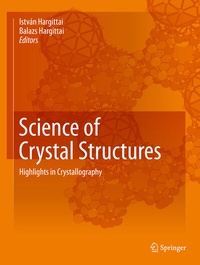
Science of Crystal Structures
Description

A volume which includes entries on quasicrystals, icosahedral packing, other packing considerations, extended structures, data treatment and data mining is presented by luminaries from the crystallography community. Several of the contributions are from the schools of such trend-setting crystallographers as J. Desmond Bernal and Aleksandr I. Kitaigorodskii. Internationally renowned scientists contributed such as Tom L. Blundell, Johann Jacob Burckhardt, John L. Finney, Jenny P. Glusker, Nobel laureate Herbert A. Hauptman, the 2014 Ewald-Prize winner A. Janner, Aminoff-Prize winner Isabella Karle, Nobel laureate Jerome Karle, Buckley-Prize winner Alan L. Mackay, Ewald-Prize winner David Sayre, Vladimir Shevchenko, and J. Fraser Stoddart. A few frontier topics dominate the selected material. Pioneers of the direct methods describe the phase problem and how it was solved, including the mathematical approach and the utilization of experience with gas-phase electron diffraction. The reviews by Herbert Hauptman, Jerome and Isabella Karle, and David Sayre reach to the present day in assessing the possibilities of X-ray crystallography. Another focus topic is the investigation of systems that are outside the so-called classical system of crystals. They include quasicrystals, imperfect and very small crystals, supramolecular species, crystal structures without lattice, clusters, nanomaterials among others. Application of synchrotron and cryoprotection techniques, the free-electron laser flash technique and others are mentioned in addition to X-ray crystallography. The relationship between structural and materials properties are examined and uncovered. The broader topics of the so-called generalized crystallography include polymers, clusters, polydisperse chain assemblies, and giant icosahedral fullerenes. There are some key contributions related to the structural investigation of biological macromolecules.
More details
Other editions
Additional editions
Persons
Istvan Hargittai, PhD, DSc, is Professor Emeritus (Active) of the Budapest University of Technology and Economics. He is a member of the Hungarian Academy of Sciences and the Academia Europaea (London) and foreign member of the Norwegian Academy of Science and Letters. He is Dr.h.c. of Moscow State University, the University of North Carolina and the Russian Academy of Sciences. He is the Editor-in-Chief of Structural Chemistry, an international research journal by Springer-Verlag.
Balazs Hargittai, PhD (University of Minnesota), is Professor of Chemistry of Saint Francis University, Loretto, Pennsylvania. He is also Associate Dean, School of Sciences and Director of the Office of Student Research of Saint Francis University. He was co-author of Candid Science V (Imperial College Press, London) and of Great Minds--Reflections of 111 Top Scientists (OUP, New York). He has been active in publishing and editorial activities in addition to his research and teaching.
