

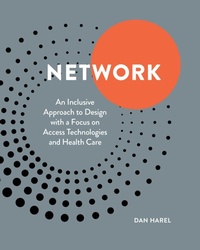
NETWORK
Description

Consider a simple proposition: Everything that has been created can be improved upon. No object, system, or idea should continue to exist if it does not successfully fulfill the needs it was created for. In NETWORK: An Inclusive Approach to Design with a Focus on Access Technologies and Health Care, Dan Harel demonstrates how a firm vision, genuine will, and hard work can lead to innovative and meaningful improvements in the way we live and interact with each other. When these attributes are accepted and practiced within an educational system, their impact could be tenfold.
NETWORK is not a to-do list or a recipe to be followed; rather, it offers suggestions, tools, and a flexible model for those engaged in solving problems. Readers are encouraged to explore the enclosed case studies through the lens of their own particular circumstances or needs. While these case studies are focused on solutions for accessibility and health-care challenges, the book overall is intended for anyone engaged in any form of problem-solving and in guiding others in the process and techniques for doing so successfully.
More details
Other editions
Additional editions

Person
Dan Harel's fascination with design began as a child's simple curiosity for the way things work and with a wonder for the way they look. Disassembling and reassembling instruments such as old radio sets and bicycles were among his earliest passions. In parallel, he discovered an artistic passion for shaping and making objects to visualize his thoughts.
A graduate of the Bezalel Academy of Arts and Design and Cranbrook Academy of Art, Harel founded his own personal design philosophy by recognizing it more as an attitude rather than merely a practical tool for addressing a challenge. Design, for him, became a continuous dialog, a never-ending path for user experience innovation and improvement.
These principles followed Harel in his myriad roles with Rochester's Eastman Kodak Company, where he led industrial design for commercialization projects as well as design research and development initiatives focused on digital imaging technologies for the company. He is the recipient of numerous US and international patents related to these topics. As an adjunct professor of industrial design at the Rochester Institute of Technology, Harel teaches advanced studio courses with focus on design thinking, user experience, and multidisciplinary collaborations. He is also the codeveloper and content provider for the RIT-Edx Design Thinking Fundamentals Course and leads the IdeaLab and Studio930 design consultancy at RIT's Simone Center for Student Innovation and Entrepreneurship. In 2016, Harel was awarded the Edline M. Chun Award for Outstanding Teaching and Service in the College of Art and Design.
Outside of design, he enjoys drawing, reading science fiction novels and history books, and drinking a nice strong cup of coffee.
Content
PART I. REASON, CONTEXT, STRATEGY, AND COMMUNITY CONNECTIONS
Chapter 1. Introduction: In Search of Meaningful Educational Value Through Design 1
Chapter 2. Connecting Talent with Needs-A Strategic Initiative: Effective Access Technology and Health Care Initiatives at RIT 7
Chapter 3. Network 24
PART II. THE ROLE OF THE DESIGN THINKING PROCESS IN ADDRESSING ACCESS TECHNOLOGY AND HEALTH-CARE CHALLENGES AT RIT
Chapter 4. Design, a Tool for Creating Solutions That Matter 47
Chapter 5. Design Versus Design Thinking: The Case Studies Understructure 60
PART III. CASE STUDY SOLUTIONS TO COMMUNITY CHALLENGES
Chapter 6. Case Studies-How Ideas Become Reality 89
6.0. Introduction to Case Studies 89
6.1. ThermApparel® 92
6.2. PuzzTub: An Inclusive Sensory Game 105
6.3. Arthroscopy Cable Organization System 122
6.4. ROAM (Removable Obstacle Avoidance Module) 138
6.5. SmartRug-LillyPads 156
6.6. Inclusive Gaming Controller 177
6.7. EZTP: An Automatic Toilet Paper Dispenser 189
6.8. Speculum Redesign: An Improved Design for Inspecting the Cervix 196
6.9. LEV (Lifting Ergonomic Vest) 216
6.10. Accessible Kitchen Knife and Cutting Board 230
6.11. Spinal Correction 250
6.12. Arches Sensory Puzzle 257
Conclusion 271
Acknowledgments 275
Feedback 277
Support and Funding Credits 281
Index 283
About the Author 285
