

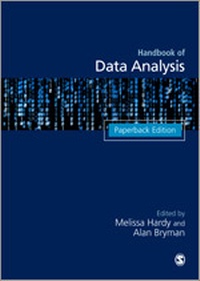
Handbook of Data Analysis
1st Edition
Published on 17. June 2009
728 pages
978-1-4462-0344-6 (ISBN)
Description

'This book provides an excellent reference guide to basic theoretical arguments, practical quantitative techniques and the methodologies that the majority of social science researchers are likely to require for postgraduate study and beyond' - Environment and Planning
'The book provides researchers with guidance in, and examples of, both quantitative and qualitative modes of analysis, written by leading practitioners in the field. The editors give a persuasive account of the commonalities of purpose that exist across both modes, as well as demonstrating a keen awareness of the different things that each offers the practising researcher' - Clive Seale, Brunel University
'With the appearance of this handbook, data analysts no longer have to consult dozens of disparate publications to carry out their work. The essential tools for an intelligent telling of the data story are offered here, in thirty chapters written by recognized experts. ' - Michael Lewis-Beck, F Wendell Miller Distinguished Professor of Political Science, University of Iowa
'This is an excellent guide to current issues in the analysis of social science data. I recommend it to anyone who is looking for authoritative introductions to the state of the art. Each chapter offers a comprehensive review and an extensive bibliography and will be invaluable to researchers wanting to update themselves about modern developments' - Professor Nigel Gilbert, Pro Vice-Chancellor and Professor of Sociology, University of Surrey
This is a book that will rapidly be recognized as the bible for social researchers. It provides a first-class, reliable guide to the basic issues in data analysis, such as the construction of variables, the characterization of distributions and the notions of inference. Scholars and students can turn to it for teaching and applied needs with confidence.
The book also seeks to enhance debate in the field by tackling more advanced topics such as models of change, causality, panel models and network analysis. Specialists will find much food for thought in these chapters.
A distinctive feature of the book is the breadth of coverage. No other book provides a better one-stop survey of the field of data analysis. In 30 specially commissioned chapters the editors aim to encourage readers to develop an appreciation of the range of analytic options available, so they can choose a research problem and then develop a suitable approach to data analysis.
'The book provides researchers with guidance in, and examples of, both quantitative and qualitative modes of analysis, written by leading practitioners in the field. The editors give a persuasive account of the commonalities of purpose that exist across both modes, as well as demonstrating a keen awareness of the different things that each offers the practising researcher' - Clive Seale, Brunel University
'With the appearance of this handbook, data analysts no longer have to consult dozens of disparate publications to carry out their work. The essential tools for an intelligent telling of the data story are offered here, in thirty chapters written by recognized experts. ' - Michael Lewis-Beck, F Wendell Miller Distinguished Professor of Political Science, University of Iowa
'This is an excellent guide to current issues in the analysis of social science data. I recommend it to anyone who is looking for authoritative introductions to the state of the art. Each chapter offers a comprehensive review and an extensive bibliography and will be invaluable to researchers wanting to update themselves about modern developments' - Professor Nigel Gilbert, Pro Vice-Chancellor and Professor of Sociology, University of Surrey
This is a book that will rapidly be recognized as the bible for social researchers. It provides a first-class, reliable guide to the basic issues in data analysis, such as the construction of variables, the characterization of distributions and the notions of inference. Scholars and students can turn to it for teaching and applied needs with confidence.
The book also seeks to enhance debate in the field by tackling more advanced topics such as models of change, causality, panel models and network analysis. Specialists will find much food for thought in these chapters.
A distinctive feature of the book is the breadth of coverage. No other book provides a better one-stop survey of the field of data analysis. In 30 specially commissioned chapters the editors aim to encourage readers to develop an appreciation of the range of analytic options available, so they can choose a research problem and then develop a suitable approach to data analysis.
All prices
More details
Edition
First Edition
Language
English
Place of publication
London
United Kingdom
Target group
College/higher education
ISBN-13
978-1-4462-0344-6 (9781446203446)
Copyright in bibliographic data and cover images is held by Nielsen Book Services Limited or by the publishers or by their respective licensors: all rights reserved.
Schweitzer Classification
Other editions
Additional editions
Melissa A. Hardy | Alan Bryman
Handbook of Data Analysis
Book
06/2009
1st Edition
SAGE Publications Ltd
€126.90
Shipment within 15-20 days
Persons
Melissa Hardy is a Distinguished Professor Emeritus of Sociology and Demography at Penn State University in University Park. She is an alumna of Albright College and Indiana University in Bloomington. Her research focused on aging and the life course, retirement and age-stratified transitions, self-assessed health, and political attitudes using longitudinal data and a range of quantitative techniques. Her published work appears in American Sociological Review, Social Forces, Journal of Health and Social Behavior, and Demography. She enjoyed teaching social statistics and general linear models to graduate and undergraduates students, using everyday experiences to help them understand the meaning of statistical concepts.
Alan Bryman is Professor of Organizational
and Social Research, School of Management, University
of Leicester, UK.
Alan Bryman is Professor of Organizational
and Social Research, School of Management, University
of Leicester, UK.
Content
Introduction: Common Threads among Techniques of Data Analysis - Melissa Hardy and Alan Bryman
PART ONE: FOUNDATIONS
Constructing Variables - Alan Bryman and Duncan Cramer
Summarizing Distributions - Melissa Hardy
Inference - Lawrence Hazelrigg
Strategies for Analysis of Incomplete Data - Mortaza Jamshidian
Feminist Issues in Data Analysis - Mary Maynard
Historical Analysis - Dennis Smith
PART TWO: THE GENERAL LINEAR MODEL AND EXTENSIONS
Multiple Regression Analysis - Ross M. Stolzenberg
Incorporating Categorical Information into Regression Models: The Utility of Dummy Variables - Melissa Hardy and John Reynolds
Analyzing Contingent Effects in Regression Models - James Jaccard and Tonya Dodge
Regression Models for Categorical Outcomes - J Scott Long and Simon Cheng
Log-Linear Analysis - Douglas L Anderton and Eric Cheney
PART THREE: LONGITUDINAL MODELS
Modeling Change - Nancy Brandon Tuma
Analyzing Panel Data: Fixed- and Random-Effects Models - Trond Petersen
Longitudinal Analysis for Continuous Outcomes: Random Effects Models and Latent Trajectory Models - Guang Guo and John Hipp
Event History Analysis - Paul Allison
Sequence Analysis and Optimal Matching Techniques for Social Science Data - Heather MacIndoe and Andrew Abbott
PART FOUR: NEW DEVELOPMENTS IN MODELING
Sample Selection Bias Models - Vincent Kang Fu, Christopher Winship and Robert D Mare
Structural Equation Modeling - Jodie B Ullman and Peter M Bentler
Multilevel Modelling - William Browne and Jon Rasbash
Causal Inference in Sociological Studies - Christopher Winship and Michael Sobel
The Analysis of Social Networks - Ronald L Breiger
PART FIVE: ANALYZING QUALITATIVE DATA
Tools for Qualitative Data Analysis - Raymond M Lee and Nigel G Fielding
Content Analysis - Roberto P Franzosi
Semiotics and Data Analysis - Peter K Manning
Conversation Analysis - Steven E Clayman and Virginia Teas Gill
Discourse Analysis - Jonathan Potter
Grounded Theory - Nick Pidgeon and Karen Henwood
The Uses of Narrative in Social Science Research - Barbara Czarniawska
Qualitative Research and the Postmodern Turn - Sara Delamont and Paul Atkinson
PART ONE: FOUNDATIONS
Constructing Variables - Alan Bryman and Duncan Cramer
Summarizing Distributions - Melissa Hardy
Inference - Lawrence Hazelrigg
Strategies for Analysis of Incomplete Data - Mortaza Jamshidian
Feminist Issues in Data Analysis - Mary Maynard
Historical Analysis - Dennis Smith
PART TWO: THE GENERAL LINEAR MODEL AND EXTENSIONS
Multiple Regression Analysis - Ross M. Stolzenberg
Incorporating Categorical Information into Regression Models: The Utility of Dummy Variables - Melissa Hardy and John Reynolds
Analyzing Contingent Effects in Regression Models - James Jaccard and Tonya Dodge
Regression Models for Categorical Outcomes - J Scott Long and Simon Cheng
Log-Linear Analysis - Douglas L Anderton and Eric Cheney
PART THREE: LONGITUDINAL MODELS
Modeling Change - Nancy Brandon Tuma
Analyzing Panel Data: Fixed- and Random-Effects Models - Trond Petersen
Longitudinal Analysis for Continuous Outcomes: Random Effects Models and Latent Trajectory Models - Guang Guo and John Hipp
Event History Analysis - Paul Allison
Sequence Analysis and Optimal Matching Techniques for Social Science Data - Heather MacIndoe and Andrew Abbott
PART FOUR: NEW DEVELOPMENTS IN MODELING
Sample Selection Bias Models - Vincent Kang Fu, Christopher Winship and Robert D Mare
Structural Equation Modeling - Jodie B Ullman and Peter M Bentler
Multilevel Modelling - William Browne and Jon Rasbash
Causal Inference in Sociological Studies - Christopher Winship and Michael Sobel
The Analysis of Social Networks - Ronald L Breiger
PART FIVE: ANALYZING QUALITATIVE DATA
Tools for Qualitative Data Analysis - Raymond M Lee and Nigel G Fielding
Content Analysis - Roberto P Franzosi
Semiotics and Data Analysis - Peter K Manning
Conversation Analysis - Steven E Clayman and Virginia Teas Gill
Discourse Analysis - Jonathan Potter
Grounded Theory - Nick Pidgeon and Karen Henwood
The Uses of Narrative in Social Science Research - Barbara Czarniawska
Qualitative Research and the Postmodern Turn - Sara Delamont and Paul Atkinson
