

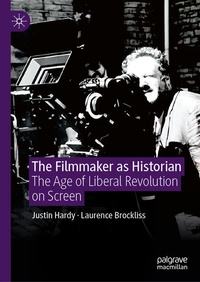
The Filmmaker as Historian
Description

This book examines the potential of audiovisual accounts of the past as a form of history making and dismisses the view of academic historians that history films are of no value. While this may be true of most, whether Hollywood features or television documentaries, this is not invariably so. As evidence, the book examines a mix of recent costume dramas and presenter-led documentaries dealing with episodes in the history of Britain, France and the United States between the American Revolution and the First World War. For the most part, the authors accept that the documentary is structurally the better of the two genres as a reliable vehicle for introducing past events in our modern audiovisual age. But they emphasize that the greatest potential lies in a hybrid genre which is a costume drama, but one where the filmmaker uses documentary techniques to balance confirmations of truth with dramatic narrative.
More details
Other editions
Additional editions
Persons
Justin Hardy is Senior Lecturer in Screen Writing at University College London, UK. He has directed over 100 films for BBC, Channel 4, PBS, and beyond, often combining drama and documentary. He has won 4 Royal Television Society Awards for historical films, and been nominated for Grierson, EMMY and BAFTA.
Laurence Brockliss is an Emeritus Professor of History at the University of Oxford, UK. He is the author, co-author and editor of some twenty books on different aspects of the history of education, science and medicine in early-modern France and Britain.
Content
Chapter 1. The Filmmaker and the Historian: The Potential for Collaboration.- Chapter 2. The American Revolution: Filmed History as Biopic.- Chapter 3. The French Revolution as Epic.- Chaper 4. Peterloo, Industrialization and the British Radical Tradition: Filming History from Below.- Chapter 5. Rights for All: Filming Slavery from the Black Perspective.- Chapter 6. The American Civil War: Filming a Divide Nation.- Chapter 7. Women's Rights and the British Suffragettes: Women Before and Behind the Camera.- Chapter 8. The Filmmaker as Historian: Present and Future.
