

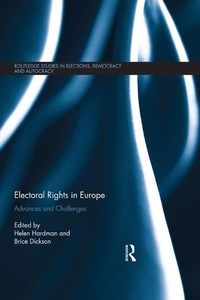
Electoral Rights in Europe
Advances and Challenges
Published on 26. June 2017
252 pages
978-1-315-47048-1 (ISBN)
Description

From the perspective of a number of different social science disciplines, this book explores the ways in which the election of politicians can be made more fair and credible by adopting a human rights approach to elections. It discusses existing international standards for the conduct of elections and presents case studies relating to jurisdictions within Europe, especially those emerging from conflict or from an authoritarian past, which demonstrate how problems occur and can be addressed.
Significant advances have been achieved through the Council of Europe's soft and hard law frameworks but the book demonstrates that much more needs to be done to ensure that these and other standards are fully adhered to and developed. This collection offers a fresh examination of electoral rights and practices - and their impact on the quality of democracy - by superimposing a human rights perspective on existing election theories derived from the literatures of law, political science and international relations.
This text will be of key interest to scholars, students and practitioners of electoral democracy and human rights, as well as those working in the areas of comparative politics and European politics.
Significant advances have been achieved through the Council of Europe's soft and hard law frameworks but the book demonstrates that much more needs to be done to ensure that these and other standards are fully adhered to and developed. This collection offers a fresh examination of electoral rights and practices - and their impact on the quality of democracy - by superimposing a human rights perspective on existing election theories derived from the literatures of law, political science and international relations.
This text will be of key interest to scholars, students and practitioners of electoral democracy and human rights, as well as those working in the areas of comparative politics and European politics.
More details
Series
Language
English
Place of publication
London
United Kingdom
Publishing group
Taylor & Francis Ltd
Target group
College/higher education
Illustrations
9 s/w Abbildungen, 7 s/w Tabellen, 9 s/w Zeichnungen
7 Tables, black and white; 9 Line drawings, black and white; 9 Illustrations, black and white
File size
3,26 MB
ISBN-13
978-1-315-47048-1 (9781315470481)
Copyright in bibliographic data and cover images is held by Nielsen Book Services Limited or by the publishers or by their respective licensors: all rights reserved.
Schweitzer Classification
Other editions
Additional editions
Book
01/2019
1st Edition
Routledge
€71.90
Shipment within 15-20 days
Book
05/2017
1st Edition
Routledge
€206.40
Shipment within 10-20 days
Persons
Helen Hardman is Lecturer in Transformation and European Integration, CEES, School of Social and Political Sciences, University of Glasgow, UK
Brice Dickson is Professor of International and Comparative Law at Queen's University Belfast, UK.
Brice Dickson is Professor of International and Comparative Law at Queen's University Belfast, UK.
Content
1. Introduction
Part I: Hard and Soft Law Human Rights Standards relating to Elections
2. The Contribution of the Parliamentary Assembly of the Council of Europe to Soft Law in Electoral Matters
3. Between Soft and Hard Law Standards: The Contribution of the Venice Commission in the Electoral Field
4. The Level of the Protection of the Right to Free Elections in the Practice of the European Court of Human Rights
Part II: National and Regional Case Studies
5. Voting Rights of Minorities and the Role of Ethnicity in Elections in the Post-Yugoslav Space
6. Prisoner Voting Saga: Reasons for Challenges
7. Electoral Rights in Russia: Mapping the Situation at the European Court of Human Rights
Part III: Comparative Perspectives
8. When Elections are Free but not Effective: Party Systems and Corruption
9. The Impact of Elections and Voter De-alignment on Human Rights
10. Electoral Finances, Human Rights and Fairness
11 Conclusions
Part I: Hard and Soft Law Human Rights Standards relating to Elections
2. The Contribution of the Parliamentary Assembly of the Council of Europe to Soft Law in Electoral Matters
3. Between Soft and Hard Law Standards: The Contribution of the Venice Commission in the Electoral Field
4. The Level of the Protection of the Right to Free Elections in the Practice of the European Court of Human Rights
Part II: National and Regional Case Studies
5. Voting Rights of Minorities and the Role of Ethnicity in Elections in the Post-Yugoslav Space
6. Prisoner Voting Saga: Reasons for Challenges
7. Electoral Rights in Russia: Mapping the Situation at the European Court of Human Rights
Part III: Comparative Perspectives
8. When Elections are Free but not Effective: Party Systems and Corruption
9. The Impact of Elections and Voter De-alignment on Human Rights
10. Electoral Finances, Human Rights and Fairness
11 Conclusions
