

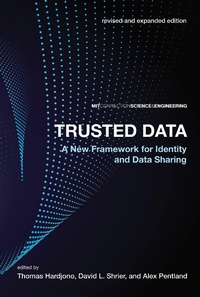
Trusted Data, revised and expanded edition
Description

Trusted Data describes a data architecture that places humans and their societal values at the center of the discussion. By involving people from all parts of the ecosystem of information, this new approach allows us to realize the benefits of data-driven algorithmic decision making while minimizing the risks and unintended consequences. It proposes a software architecture and legal framework for an Internet of Trusted Data that provides safe, secure access for everyone and protects against bias, unfairness, and other unintended effects. This approach addresses issues of data privacy, security, ownership, and trust by allowing insights to be extracted from data held by different people, companies, or governments without collecting, holding, or revealing the underlying data. The software architecture, called Open Algorithms, or OPAL, sends algorithms to databases rather than copying or sharing data. The data is protected by existing firewalls; only encrypted results are shared. Data never leaves its repository. A higher security architecture, ENIGMA, built on OPAL, is fully encrypted.
Contributors Michiel Bakker, Yves-Alexandre de Montjoye, Daniel Greenwood, Thomas Hardjoni, Jake Kendall, Cameron Kerry, Bruno Lepri, Alexander Lipton, Takeo Nishikata, Alejandro Noriega-Campero, Nuria Oliver, Alex Pentland, David L. Shrier, Jacopo Staiano, Guy Zyskind
An MIT Connection Science and Engineering Book
More details
Other editions
Additional editions
Persons
David L. Shrier holds a dual appointment as a Lecturer at the MIT Media Lab and an Associate Fellow at the Saïd Business School at the University of Oxford. He is coeditor of New Solutions for Cybersecurity (MIT Press).
Alex Pentland holds a triple appointment at MIT in the Media Lab (SA+P), School of Engineering, and Sloan School of Management. He directs MIT's Connection Science initiative, the Human Dynamics Laboratory, and the MIT Media Lab Entrepreneurship Program. He is the author of Honest Signals: How They Shape Our World and coeditor of New Solutions for Cybersecurity (both published by the MIT Press). One of the most-cited computer scientists in the world, with international awards in the Arts, Sciences, and Engineering, he was chosen by Newsweek as one of the 100 Americans likely to shape this century.
Content
- Intro
- Title Page
- Copyright Page
- Table of Contents
- I: Architecture
- 1. Trust in Digital Societies
- 2. Towards an Internet of Trusted Data
- 3. Core Identities for Future Transaction Systems
- 4. MIT Open Algorithms
- 5. Building a Data-Rich Society
- II: Policy
- 6. The New Deal on Data
- 7. The Rise of Decentralized Personal Data Markets
- 8. Enabling Humanitarian Use of Mobile Phone Data
- 9. Living Labs for Trusted Data
- III: Current
- 10. Active Fairness in Algorithmic Decision-Making
- 11. Beyond GDPR: Employing AI to Make Personal Data Useful to Consumers
- 12. Social Capital Accounting
- 13. Tradecoin: Towards a More Stable Digital Currency
- Appendix A: Personal Data: The Emergence of a New Asset Class
- Appendix B: A World That Counts: Mobilising the Data Revolution for Sustainable Development
- Contributor Biographies
- Index
