

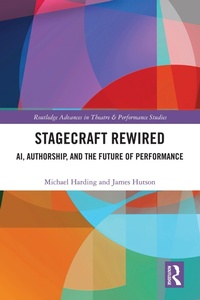
Stagecraft Rewired
AI, Authorship, and the Future of Performance
Will be published approx. on 10. July 2026
304 pages
978-1-040-86184-4 (ISBN)
Description

Stagecraft Rewired explores how artificial intelligence and intelligent systems can be seamlessly integrated into contemporary theatre while preserving artistic agency, ethical responsibility, and historical awareness.
The book offers a comprehensive journey from conceptual foundations to real-world applications. It includes critical analysis, case studies, production workflows, and pedagogical models, providing readers with clear frameworks for ethical tool use and practical strategies for rehearsal and production. The volume also addresses key topics such as authorship, collaboration, accessibility, and accountability in technology-mediated performance. By situating AI within a historical lineage of adaptation and creative recombination, the book reframes intelligent systems as an extension of traditional theatrical methods rather than a disruption. Readers will benefit from actionable guidance on institutional governance, teaching models that emphasize transparency, and forward-looking principles for navigating the future of stagecraft.
This book is an invaluable resource for theatre practitioners, educators, students, arts administrators, and cultural policy-makers interested in the intersection of technology and performance.
The book offers a comprehensive journey from conceptual foundations to real-world applications. It includes critical analysis, case studies, production workflows, and pedagogical models, providing readers with clear frameworks for ethical tool use and practical strategies for rehearsal and production. The volume also addresses key topics such as authorship, collaboration, accessibility, and accountability in technology-mediated performance. By situating AI within a historical lineage of adaptation and creative recombination, the book reframes intelligent systems as an extension of traditional theatrical methods rather than a disruption. Readers will benefit from actionable guidance on institutional governance, teaching models that emphasize transparency, and forward-looking principles for navigating the future of stagecraft.
This book is an invaluable resource for theatre practitioners, educators, students, arts administrators, and cultural policy-makers interested in the intersection of technology and performance.
More details
Series
Language
English
Place of publication
London
United Kingdom
Publishing group
Taylor & Francis Ltd
Target group
Professional and scholarly
Product notice
Reflowable
Illustrations
14 Tables, black and white; 12 Halftones, black and white; 12 Illustrations, black and white
File size
2,58 MB
ISBN-13
978-1-040-86184-4 (9781040861844)
Copyright in bibliographic data and cover images is held by Nielsen Book Services Limited or by the publishers or by their respective licensors: all rights reserved.
Schweitzer Classification
Other editions
Additional editions
Book
approx. 07/2026
1st Edition
Routledge
€191.50
Not yet published
Persons
Michael Harding is an American academic and professor who works as the department head of Performing Arts and Lindenwood University in Saint Charles, USA.
James Hutson is currently a professor and department head of art history, AI, and visual culture at Lindenwood University in Saint Charles, USA.
James Hutson is currently a professor and department head of art history, AI, and visual culture at Lindenwood University in Saint Charles, USA.
Content
About the Authors
Acknowledgments
List of Figures
List of Tables
Preface
How to Use This Book
Part I - Thesis, Evidence, and Context
1. Introduction: The Stage at a Threshold
2. Eight Short Cases
3. Global Contrasts
Part II - Workflows Across the Production Lifecycle
4. Pre-Production
5. Rehearsal and Performance
6. Post-Production and Audiences
Part III - Skills, Pedagogy, and Career Preparation
7. Skills Map for Theatre Careers
8. Studios, Labs, and Portfolios
9. Course and Program Templates
Part IV - Law, Governance, and Ethics
10. Authorship, Ownership, and Copyright
11. Compliance in Practice
12. Ethics and Responsibility
Part V - A Longitudinal Production Case
13. From Greenlight to Strike
Part VI - Tooling, Infrastructure, and Implementation
14. Selecting and Running Tools
15. Adoption Guides for Schools and Companies
Part VII - Futures and Research Agenda
16. Near-Term Scenarios and Strategic Foresight
17. Open Questions and Next Steps
Appendix A. Studio Drills
Appendix B. Lab Modules and Instructor Notes
Index
Index
Acknowledgments
List of Figures
List of Tables
Preface
How to Use This Book
Part I - Thesis, Evidence, and Context
1. Introduction: The Stage at a Threshold
2. Eight Short Cases
3. Global Contrasts
Part II - Workflows Across the Production Lifecycle
4. Pre-Production
5. Rehearsal and Performance
6. Post-Production and Audiences
Part III - Skills, Pedagogy, and Career Preparation
7. Skills Map for Theatre Careers
8. Studios, Labs, and Portfolios
9. Course and Program Templates
Part IV - Law, Governance, and Ethics
10. Authorship, Ownership, and Copyright
11. Compliance in Practice
12. Ethics and Responsibility
Part V - A Longitudinal Production Case
13. From Greenlight to Strike
Part VI - Tooling, Infrastructure, and Implementation
14. Selecting and Running Tools
15. Adoption Guides for Schools and Companies
Part VII - Futures and Research Agenda
16. Near-Term Scenarios and Strategic Foresight
17. Open Questions and Next Steps
Appendix A. Studio Drills
Appendix B. Lab Modules and Instructor Notes
Index
Index
