

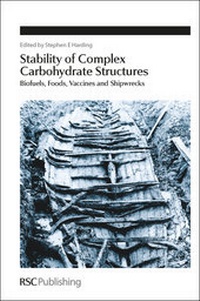
Stability of Complex Carbohydrate Structures
Biofuels, Foods, Vaccines and Shipwrecks
1st Edition
Published on 31. October 2012
250 pages
978-1-84973-564-3 (ISBN)
Description

Complex carbohydrates such as high molecular weight polysaccharides like starch and cellulose, are well known for their importance in foodstuffs, paper and wood, but their importance extends far beyond that into the biopharmaceutical, healthcare, oil and printing industries. This book, based on a discussion meeting organised by RSC Biotechnology and Carbohydrate Groups, brings together leading experts from the polysaccharide and glycoconjugate communities to review, discuss and assess in detail one specific topic, namely the importance of the stability and degradation of carbohydrate structures. Coverage includes applications as diverse as food, biopharmaceuticals, vaccines, biofuels and preservation of Viking boats. Providing essential reading for anyone interested in these structures and the diversity of their applications, it will appeal to a broad, multidisciplinary group from industry, academia and research institutions.
More details
Series
Edition
1. Auflage
Language
English
Place of publication
Cambridge
United Kingdom
Target group
Professional and scholarly
ISBN-13
978-1-84973-564-3 (9781849735643)
DOI
10.1039/9781849735643
Copyright in bibliographic data and cover images is held by Nielsen Book Services Limited or by the publishers or by their respective licensors: all rights reserved.
Schweitzer Classification
Other editions
Additional editions
Stephen E. Harding
Stability of Complex Carbohydrate Structures
Biofuels, Foods, Vaccines and Shipwrecks
Book
12/2012
Royal Society of Chemistry
€155.50
Shipment within 3-4 weeks
Person
Stephen Harding has been director of the National Centre for Macromolecular Hydrodynamics for the last 24 years, a period which has seen hydrodynamic methods (analytical ultracentrifugation, light scattering, viscometry etc.) come from almost oblivion to flourish as tools for biomolecular characterisation. He has published over 350 research papers and 9 books in the field of biomolecular hydrodynamics and applied biochemistry. In recognition of his discoveries he received a junior medal from the Royal Society of Chemistry in 1991 and a DSc from the University of Oxford in 2002. In 2010 he gave the prestigious annual Pfizer lecture at the University of Connecticut and in 2012 he was awarded by King Harald V den Kongelige Norske Fortjenstorden - the Royal Norwegian Order of Merit (Knight of the 1st class) - the highest award to a foreign non Head of State. His current focus is on biopolymer stability in response to bioprocessing, of particular interest to the Biopharma industry where he now draws much of his support.
Content
Carbohydrates: First cousins of Water;
Enzymic degradation of cell wall polysaccharides;
Dietary Fibre: Functional Components and Mechanisms of Action in the Gastrointestinal Tract;
Enzymatic treatment of polysaccharides;
Stability of polysaccharide encapsulates;
Polysaccharide and glycoconjugate vaccines;
Mucin turnover;
Some advances in hydrodynamic stability probes;
Stability of chitosan and pectin as nasal and intestinal mucoadhesives;
Cellulose crystallinity: perspectives from spectroscopy and diffraction;
Cellulose;
Cellulose de-construction: what can be learned from molecular modeling and dissolution experiments?;
Lignin;
Observations on bacterial degradation of historical wood timbers found in near anaerobic waterlogged environments;
Subject Index
Enzymic degradation of cell wall polysaccharides;
Dietary Fibre: Functional Components and Mechanisms of Action in the Gastrointestinal Tract;
Enzymatic treatment of polysaccharides;
Stability of polysaccharide encapsulates;
Polysaccharide and glycoconjugate vaccines;
Mucin turnover;
Some advances in hydrodynamic stability probes;
Stability of chitosan and pectin as nasal and intestinal mucoadhesives;
Cellulose crystallinity: perspectives from spectroscopy and diffraction;
Cellulose;
Cellulose de-construction: what can be learned from molecular modeling and dissolution experiments?;
Lignin;
Observations on bacterial degradation of historical wood timbers found in near anaerobic waterlogged environments;
Subject Index
