

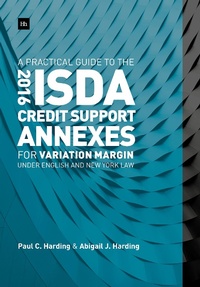
A Practical Guide to the 2016 ISDA Credit Support Annexes For Variation Margin under English and New York Law
1st Edition
Published on 19. February 2018
238 pages
978-0-85719-676-7 (ISBN)
Description

In the aftermath of the global financial crisis many regulatory reforms were made. One of these was more frequent revaluation of OTC derivatives risk exposure and related margining. Regulators now expect this to be addressed every business day.
Variation margin relates to collateral used to cover changes in OTC derivatives mark to market risk exposure and such collateral is normally cash in major currencies and/or highly rated government bonds.
In April 2016 the International Swaps and Derivatives Association, Inc. (ISDA) published two Credit Support Annexes For Variation Margin under English and New York Law in readiness for new regulations which started to be implemented in the USA in September 2016 and in the European Union early in 2017.
A Practical Guide to the 2016 ISDA® Credit Support Annexes For Variation Margin under English and New York Law is the essential book for all who need to know about the new detailed regulations for margining in the European Union and the USA and most of all need to understand the contents of these two credit support annexes so that they can negotiate them safely and confidently.
The book is written by two of the world's leading commentators on the subject, Paul C. Harding and Abigail J. Harding, and its coverage is comprehensive.
This first edition principally offers readers a detailed guide to these two credit support annexes through a clause-by-clause commentary on each of them. This commentary is written in clear English for a good, swift understanding of the implications of each provision.
The full texts of each Credit Support Annex are reproduced in the appendices with the kind permission of ISDA.
As well as the commentary mentioned above, the book also contains chapters on the causes of the global financial crisis and the detailed regulatory response to them and the most recent developments in the OTC derivatives markets including ways the "too big to fail" problem has been addressed, MiFID II and the implications of BREXIT as far as they are currently known.
This one-stop book is principally aimed at lawyers and paralegals who need to negotiate these two new credit support annexes. Other professionals in the European and US OTC derivatives markets will also find this book useful. These could include traders, credit officers and regulators as well as academics specialising in collateralisation. Such professionals may work for commercial or investment banks, law firms, treasury units, collateral departments, central banks, pension funds and fund managers. Such is the broad potential appeal of this must-have book which caters for the novice and seasoned negotiator alike.
Variation margin relates to collateral used to cover changes in OTC derivatives mark to market risk exposure and such collateral is normally cash in major currencies and/or highly rated government bonds.
In April 2016 the International Swaps and Derivatives Association, Inc. (ISDA) published two Credit Support Annexes For Variation Margin under English and New York Law in readiness for new regulations which started to be implemented in the USA in September 2016 and in the European Union early in 2017.
A Practical Guide to the 2016 ISDA® Credit Support Annexes For Variation Margin under English and New York Law is the essential book for all who need to know about the new detailed regulations for margining in the European Union and the USA and most of all need to understand the contents of these two credit support annexes so that they can negotiate them safely and confidently.
The book is written by two of the world's leading commentators on the subject, Paul C. Harding and Abigail J. Harding, and its coverage is comprehensive.
This first edition principally offers readers a detailed guide to these two credit support annexes through a clause-by-clause commentary on each of them. This commentary is written in clear English for a good, swift understanding of the implications of each provision.
The full texts of each Credit Support Annex are reproduced in the appendices with the kind permission of ISDA.
As well as the commentary mentioned above, the book also contains chapters on the causes of the global financial crisis and the detailed regulatory response to them and the most recent developments in the OTC derivatives markets including ways the "too big to fail" problem has been addressed, MiFID II and the implications of BREXIT as far as they are currently known.
This one-stop book is principally aimed at lawyers and paralegals who need to negotiate these two new credit support annexes. Other professionals in the European and US OTC derivatives markets will also find this book useful. These could include traders, credit officers and regulators as well as academics specialising in collateralisation. Such professionals may work for commercial or investment banks, law firms, treasury units, collateral departments, central banks, pension funds and fund managers. Such is the broad potential appeal of this must-have book which caters for the novice and seasoned negotiator alike.
More details
Persons
Paul C. Harding is a graduate of the University of London, and has worked in several UK and foreign banks in London, in credit, marketing and documentation roles. Since 1990 he has been involved with derivatives documentation. He was a well-known negotiator in the City of London with Barclays Capital Securities Limited and Hill Samuel Bank Limited, where he was Head of Treasury Documentation.
In February 1997 he founded Derivatives Documentation Limited, a derivatives consultancy and project management company, based in the City of London and providing negotiation, recruitment and in-house training services in derivatives documentation (website: www.derivsdocu.com). Its clients include many of the world's leading banks. Since 2000 the company has also done considerable repo documentation training.
In November 2001 Paul's book Mastering the ISDA Master Agreement was published by Financial Times-Prentice Hall. This was followed by his Mastering Collateral Management and Documentation, written in conjunction with Christian Johnson, which was published by Financial Times-Prentice Hall, in November 2002. His book on the 2002 ISDA Master Agreement was published in December 2003 also by Financial Times-Prentice Hall, and in 2004 the first edition of A Practical Guide to using Repo Master Agreements by Paul Harding and Christian Johnson was published by Euromoney Books.
Content
- Intro
- Contents
- Authors' Foreword
- About the Authors
- Acknowledgements
- Paul Harding
- Abigail Harding
- Both authors
- Chapter 1 - The new regulatory scene for OTC derivatives and collateral
- Causes of the global financial crisis 2007-2009
- The crisis in the USA
- Deregulation
- Securitisation of mortgages
- The Fed raised borrowing rates
- The Insolvency of Lehman Brothers
- What else did the US government do?
- Overhaul of US financial services legislation
- The European credit crisis
- The UK banking crisis
- 2009 G20 Pittsburgh Summit
- BCBS and IOSCO Margin requirements for non-centrally cleared derivatives
- Requirement 2
- Requirement 4
- Actual implementation deadlines for VM and IM under US and EU regulation
- USA
- CFTC Margin Rules
- General matters regarding CFTC Margin Rules
- Eligible collateral
- Ineligible securities
- Haircuts
- Collateral Segregation
- Collateral Valuation
- Netting Arrangements
- Eligible Master Netting Agreements
- Uncleared Swaps can only be netted within the same portfolio
- Legacy Swaps
- Divergence from International Standards
- Ongoing compliance obligations
- Cross Border application of the CFTC Rules
- EU
- Variation Margin (VM)
- Initial Margin (IM)
- Margin eligibility
- Haircuts
- Minimum Transfer Amount ("MTA")
- Operational processes
- Legal agreements
- Exemptions
- Product exemptions
- Exemption for non-netting jurisdictions
- Delays and forbearance
- Self-Disclosure Letter
- ISDA 2016 Variation Margin Protocol
- Adherence and matching questionnaires
- Elections under the VM Protocol
- Amend
- Replicate and Amend
- New CSA
- Adherents to the VM Protocol
- Other key issues
- Extraterritoriality
- Substituted compliance
- Chapter 2 - The 2016 ISDA Credit Support Annex For Variation Margin (VM) under English Law
- Introduction
- Paragraph by paragraph analysis
- Footnotes
- Dating of the VM CSA and identification of the parties
- Preamble
- Paragraph 1. Interpretation
- Paragraph 2. Credit Support Obligations
- Paragraph 3. Transfers, Calculations and Exchanges
- Paragraph 4. Dispute Resolution
- Paragraph 5. Transfer of Title, No Security Interest, Distributions and Interest Amount (VM)
- Paragraph 6. Default
- Paragraph 7. Representation
- Paragraph 8. Expenses
- Paragraph 9. Miscellaneous
- Paragraph 10. Definitions
- Glossary of terms in Paragraph 10
- Paragraph 11. Elections and Variables
- Base Currency
- Eligible Currency
- Covered Transactions
- Exposure
- Delivery Amount (VM)/Return Amount (VM)
- Eligible Credit Support (VM)
- Legally Ineligible Credit Support (VM)
- Credit Support Eligibility Conditions (VM)
- Valuation Percentage
- FX Haircut Percentage
- Minimum Transfer Amount
- Rounding
- Transfers, Regular Settlement Day
- Valuation Agent
- Valuation Date and Valuation Date Location
- Valuation Time
- Notification Time
- Exchange Date
- Dispute Resolution
- Distributions and Interest Amount (VM)
- Transfer of Interest Payment (VM) or application of Interest Amount (VM)
- Alternative to Interest Amount (VM)
- Other provisions
- Potentially Negotiated Terms
- Principal differences between the 1995 English Law CSA and 2016 English Law VM CSA
- Definitions
- Independent Amounts
- Threshold
- Covered Transactions
- Valuation Date
- Close-out Amount updates
- Settlement Timings
- Interest Rate provisions
- Scope of Annex / Credit Support Offsets / Other CSAs
- Legal Ineligibility provisions
- Chapter 3 - The 2016 ISDA Credit Support Annex For Variation Margin (VM) under New York Law
- Introduction
- Commentary on the New York Law CSA For Variation Margin
- Preamble
- Paragraph 1. Interpretation
- Paragraph 2. Security Interest
- Paragraph 3. Credit Support Obligations
- Paragraph 4. Conditions Precedent, Transfer Timing, Calculations and Substitutions
- Paragraph 5. Dispute Resolution
- Paragraph 6. Holding and Using Posted Collateral (VM)
- Paragraph 7. Events of Default
- Paragraph 8. Certain Rights and Remedies
- Paragraph 9. Representations
- Paragraph 10. Expenses
- Paragraph 11. Miscellaneous
- Paragraph 12. Definitions
- Glossary of terms in Paragraph 12
- Paragraph 13. Elections and Variables
- ISDA Elections and Fallbacks
- Chapter 4 - Important developments since the global financial crisis
- ISDA Margin Survey 2017
- Collateral squeeze risk
- Too big to fail
- Basel III
- Living wills for banks
- EU Bank Recovery and Resolution Directive ("BRRD")
- ISDA initiatives
- Legal opinions
- US Federal Reserve Bank Rules to help unwind big banks
- UK Independent Banking Commission report and ringfencing
- Central clearing counterparties ("CCPs")
- MiFID 2
- US Treasury Report: Core Principles for Regulating the United States Financial System
- Recalibration of derivatives regulation
- Margin requirements for uncleared swaps
- Cross border Application and Scope
- Substituted Compliance
- Swap Dealer De Minimis Threshold
- Support of Central Clearing
- EMIR Review
- Brexit
- European Union (Withdrawal) Bill
- Bank of England concerns over Brexit and derivatives
- ISDA Master Agreement and collateral issues
- Impossibility under the 1992 ISDA Master Agreement and Force Majeure Event under the 2002 ISDA Master Agreement
- Illegality Termination Event under the ISDA Master Agreements
- Collateral
- The UK's track record in EU derivatives regulation and its possible influence for equivalence recognition
- Bibliography
- Appendices
- Appendix 1 - EMIR Margin Rules for Uncleared OTC Derivatives Implementation and Proposed Implementation
