

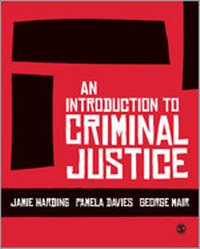
An Introduction to Criminal Justice
1st Edition
Published on 13. January 2017
504 pages
978-1-5264-1188-4 (ISBN)
Description

A contemporary guide to the criminal justice process, the broad scope of this book means it will be a trusted companion throughout a Criminology and/or Criminal Justice degree. The contents of An Introduction to Criminal Justice include:
23 chapters spanning all that's involved with, and fully contextualising, the criminal justice process: the agencies, institutions and processes and procedures that deal with victims, offenders and offending
A detailed timeline of criminal justice since 1945
Consideration of victims and witnesses, complaints and misconduct
A comprehensive review of policing, prosecution, the courts, imprisonment and community sanctions
A focus on community safety, crime prevention and youth justice
A review of the effectiveness of the criminal justice process
Exploration of global and international dimensions as well as the futures of criminal justice
Lots of helpful extras including further reading suggestions, case studies, self-study questions and a glossary of terms.
The accompanying website to An Introduction to Criminal Justice has:
A podcast interview with a police officer
Practice essay questions
Multiple choice questions
Suggested website resources to explore
Videos.
23 chapters spanning all that's involved with, and fully contextualising, the criminal justice process: the agencies, institutions and processes and procedures that deal with victims, offenders and offending
A detailed timeline of criminal justice since 1945
Consideration of victims and witnesses, complaints and misconduct
A comprehensive review of policing, prosecution, the courts, imprisonment and community sanctions
A focus on community safety, crime prevention and youth justice
A review of the effectiveness of the criminal justice process
Exploration of global and international dimensions as well as the futures of criminal justice
Lots of helpful extras including further reading suggestions, case studies, self-study questions and a glossary of terms.
The accompanying website to An Introduction to Criminal Justice has:
A podcast interview with a police officer
Practice essay questions
Multiple choice questions
Suggested website resources to explore
Videos.
Reviews / Votes
This is a splendid introduction to criminal justice in England and Wales, with substantial but accessible chapters written by many of the leading authors in their fields. Never ducking important critical questions of injustice, power and inequality, the book takes seriously the wide range of issues and influences shaping the context of contemporary criminal justice while containing many extra features, including a website containing a diverse array of additional materials, to support students' learning and really whet their appetites for further enquiry. -- Peter Squires This is an excellent text for students studying introductory criminal justice modules. It provides a comprehensive and interesting set of chapters written by leading experts in the field. The coverage of the topic is diverse, well written and up to date. A very useful book as a reference guide and module resource. -- Louise Westmarland This introductory text for students is refreshing in its outlook, with a mixture of up and coming scholars as well as established authors as contributors, time-lines to show rapid developments over the past thirty years in particular, and a unique combination of critical reflections on legal, policy, practice and theoretical developments, with case studies, annotated reading suggestions, discussion points and exercises to guide readers. Key developments are described in their socio-political context, all of which adds to a book which is compelling in scope and persuasive in argument. -- Loraine Gelsthorpe To write an introduction to criminal justice which is coherent and accessible while recognising the complexity and sheer messiness of its subject-matter is a considerable challenge, to which the editors and contributors have risen admirably. The 23 chapters build up a rich picture of a diverse set of practices and their recent history and help the reader to situate current developments and controversies in a wider context. -- Tony WardAll prices
More details
Edition
First Edition
Language
English
Place of publication
London
United Kingdom
Target group
College/higher education
ISBN-13
978-1-5264-1188-4 (9781526411884)
Copyright in bibliographic data and cover images is held by Nielsen Book Services Limited or by the publishers or by their respective licensors: all rights reserved.
Schweitzer Classification
Other editions
Additional editions
Jamie Harding | Pamela Davies | George Mair
An Introduction to Criminal Justice
Book
01/2017
1st Edition
SAGE Publications Inc
€71.98
Article exhausted; check for reprint
Jamie Harding | Pamela Davies | George Mair
An Introduction to Criminal Justice
Book
01/2017
1st Edition
SAGE Publications Inc
€194.60
Shipment within 10-20 days
Persons
Jamie Harding received his PhD from the Department of Sociology and Social Policy at the University of Newcastle upon Tyne. He has been employed at Northumbria University since 1995, first as a lecturer in Housing Studies and more recently as a Senior Lecturer in Research Methods in the Department of Social Sciences. Before moving into higher education he worked for a number of social housing organisations.
Jamie's main area of interest is qualitative and quantitative research methods, which he teaches at undergraduate, postgraduate and doctoral level. He also lectures on criminal justice - an area where he has edited a textbook - and homelessness, a subject on which he has written two monographs. He is programme leader for the Police Constable Degree Apprenticeship, which is run in partnership with Northumbria Police.
Jamie is married with two adult children and two grandchildren. He enjoys running and was delighted to win the highly prestigious Claremont Road Runners summer club handicap race in 2021.
Professor Pamela Davies' research interests coalesce around gender, crime, harm, victimization and justice. Combining her interest in victimology and social harm with a critical/feminist infused approach she has explored a range of contemporary social problems - both visible and hidden. Her early research explored female offending and the inter-play between women's offending patterns and experiences of victimization. More recently she has examined tensions around social and environmental justice adopting a case study approach. She has lead a number of research projects and evaluations of multi-agency innovations that tackle gendered forms of harm including interpersonal violence, domestic abuse, the policing of serial perpetrators and support for victims. The ways in which gender mediates our life experiences continues to provoke new areas of inquiry and she is currently working with colleagues on 'gendering green criminology'.
Pam has published widely on the subject of victimization and social harm and on how gender connects to matters of community safety, public protection and well-being. Her most recent books are Crime and Power authored with Tanya Wyatt and Victimology Research Policy and Activism edited with Jacki Tapley. She is the series editor of the Palgrave Macmillan 'Victims and Victimology' book series (with Associate Professor Tyrone Kirchengast, University of New South Wales, Sydney). George Mair is Professor of Criminal Justice and Head of the Department of Social Science at Liverpool Hope. Previously (1995-2012), he was Professor of Criminal Justice in the School of Law at Liverpool John Moores University; and prior to that (1979-1995) he was a member of the Home Office Research and Planning Unit, latterly as Principal Research Officer leading a team carrying out research and policy-advice on community penalties. He has been a member of the Merseyside Probation Board (2001-2007), and a member of the Liverpool Crime and Disorder Reduction Partnership (1999-2006).
Jamie's main area of interest is qualitative and quantitative research methods, which he teaches at undergraduate, postgraduate and doctoral level. He also lectures on criminal justice - an area where he has edited a textbook - and homelessness, a subject on which he has written two monographs. He is programme leader for the Police Constable Degree Apprenticeship, which is run in partnership with Northumbria Police.
Jamie is married with two adult children and two grandchildren. He enjoys running and was delighted to win the highly prestigious Claremont Road Runners summer club handicap race in 2021.
Professor Pamela Davies' research interests coalesce around gender, crime, harm, victimization and justice. Combining her interest in victimology and social harm with a critical/feminist infused approach she has explored a range of contemporary social problems - both visible and hidden. Her early research explored female offending and the inter-play between women's offending patterns and experiences of victimization. More recently she has examined tensions around social and environmental justice adopting a case study approach. She has lead a number of research projects and evaluations of multi-agency innovations that tackle gendered forms of harm including interpersonal violence, domestic abuse, the policing of serial perpetrators and support for victims. The ways in which gender mediates our life experiences continues to provoke new areas of inquiry and she is currently working with colleagues on 'gendering green criminology'.
Pam has published widely on the subject of victimization and social harm and on how gender connects to matters of community safety, public protection and well-being. Her most recent books are Crime and Power authored with Tanya Wyatt and Victimology Research Policy and Activism edited with Jacki Tapley. She is the series editor of the Palgrave Macmillan 'Victims and Victimology' book series (with Associate Professor Tyrone Kirchengast, University of New South Wales, Sydney). George Mair is Professor of Criminal Justice and Head of the Department of Social Science at Liverpool Hope. Previously (1995-2012), he was Professor of Criminal Justice in the School of Law at Liverpool John Moores University; and prior to that (1979-1995) he was a member of the Home Office Research and Planning Unit, latterly as Principal Research Officer leading a team carrying out research and policy-advice on community penalties. He has been a member of the Merseyside Probation Board (2001-2007), and a member of the Liverpool Crime and Disorder Reduction Partnership (1999-2006).
Content
1 Introduction - Pamela Davies, George Mair, Jamie Harding
Part One: The Criminal Justice Process in Context - George Mair, Jamie Harding, Pamela Davies
2 Criminal Justice Since 1945: a brief history - George Mair
3 Definitions and the Counting of Crime - Ian Mahoney
4 Purposes of the Criminal Justice Process - Joanne Clough
5 Characteristics of Offenders - Hannah Bows
6 Diversity and the Criminal Justice Process - Colin Webster
7 Media Representations of Criminal Justice - Ian Marsh
8 Government, Governance and Criminal Justice - Tim Newburn
9 Researching Criminal Justice - Mike Hough
Part Two: The Criminal Justice Process - Jamie Harding, Pamela Davies, George Mair
10 Community Safety and Crime Prevention - Esther Van Ginneken
11 Policing - Matt Jones and Kelly Stockdale
12 Policing as Part of a Multi-Agency Approach - Tanya Wyatt and Mary Laing
13 Prosecution and the Alternatives - Alison Howey
14 Criminal Courts - Bankole Cole and Timi Osidipe
15 Community Sentences - George Mair
16 Imprisonment - Charlotte Bilby
17 Parole and Release from Prison - Harriet Pierpoint
18 Youth Justice - Tim Bateman
19 Dealing with Complaints and Misconduct - Jamie Harding
20 Supporting Victims and Witnesses - Ian Cook and Pamela Davies
Part Three: Key Issues in Criminal Justice - Pamela Davies, George Mair, Jamie Harding
21 Does the Criminal Justice Process Work? - Mike Rowe
22 Globalisation and International Criminal Justice - Matthew Hall
23 Criminal Justice Futures - George Mair, Jamie Harding, Pamela Davies
Glossary
Index
Part One: The Criminal Justice Process in Context - George Mair, Jamie Harding, Pamela Davies
2 Criminal Justice Since 1945: a brief history - George Mair
3 Definitions and the Counting of Crime - Ian Mahoney
4 Purposes of the Criminal Justice Process - Joanne Clough
5 Characteristics of Offenders - Hannah Bows
6 Diversity and the Criminal Justice Process - Colin Webster
7 Media Representations of Criminal Justice - Ian Marsh
8 Government, Governance and Criminal Justice - Tim Newburn
9 Researching Criminal Justice - Mike Hough
Part Two: The Criminal Justice Process - Jamie Harding, Pamela Davies, George Mair
10 Community Safety and Crime Prevention - Esther Van Ginneken
11 Policing - Matt Jones and Kelly Stockdale
12 Policing as Part of a Multi-Agency Approach - Tanya Wyatt and Mary Laing
13 Prosecution and the Alternatives - Alison Howey
14 Criminal Courts - Bankole Cole and Timi Osidipe
15 Community Sentences - George Mair
16 Imprisonment - Charlotte Bilby
17 Parole and Release from Prison - Harriet Pierpoint
18 Youth Justice - Tim Bateman
19 Dealing with Complaints and Misconduct - Jamie Harding
20 Supporting Victims and Witnesses - Ian Cook and Pamela Davies
Part Three: Key Issues in Criminal Justice - Pamela Davies, George Mair, Jamie Harding
21 Does the Criminal Justice Process Work? - Mike Rowe
22 Globalisation and International Criminal Justice - Matthew Hall
23 Criminal Justice Futures - George Mair, Jamie Harding, Pamela Davies
Glossary
Index
