

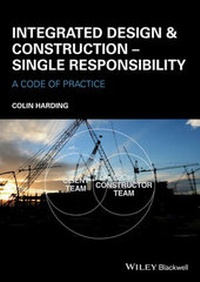
Integrated Design and Construction - Single Responsibility
Description

More details
Other editions
Additional editions
Person
Content
Background
The late Victorian and Edwardian era preceding the First World War was undoubtedly the golden age of traditional Design and Build. Then, architects provided total single point responsibility, while representing the client, by accepting full responsibility for their design, as well as for the quality and workmanship of the finished product.
The professional master builders of the time, their general foremen and highly skilled craftsmen, like architects, had a total understanding of good design and traditional best practice building construction methods. They trained and directly employed craftsmen in all trades, including, at the end of the 19th century, those in the emerging technologies of electrical and heating engineering.
There were no formal partnering contracts or middlemen, just a basic fixed price order or, in the case of private dwellings, a sale contract with the reputation of the builder, as well as the architect at stake. Design liability and defects were not a serious issue because designs were based on well-tested empirical principles. More importantly, the design and construction team, who invariably worked together regularly, guarded their reputations jealously. If a problem was reported, it was investigated and attended to promptly without fuss or rancour. The whole system relied on mutual trust and respect between clients, architects and builders working together, underpinned by simple, straightforward legal agreements.
The industry that re-grouped after the First World War in the 1920s would be fundamentally changed as the process and then the industry gradually started to fragment. The post-war emergence of the steel frame and in situ reinforced concrete as 'the modern' standard construction systems meant that architects could now design buildings of any shape or size without the restrictions imposed by the traditional structural materials with their old empirical rules. This led to the growth of 'structural engineering' practices that took over responsibility for an important part of the building's design from the architects. It also began to erode the role of the general foreman (site manager) who had traditionally contributed technical expertise across the entire range of craft skills.
Independent quantity surveying practices started to emerge, transferring effective control of a project's cost to an independent third party. As the number of independent consultants involved in the design and supervision of construction continued to grow, so did the number of misunderstandings, errors and consequent conflicts.
By the end of the Second World War, the problems created by the fragmentation of the construction industry were recognised by Government. The Banwell Report (1964) on 'The Placing and Management of Contracts in the Building and Civil Engineering Industry' first made the now familiar recommendations on collaboration between designers and contractors, but in practice, it had little impact. The steady fragmentation of the design process continued through the 20th century with the gradual growth of independent design consultancies such as fire engineering, acoustics, interior design, landscaping, planning, building control and the whole range of sustainability, 'eco' and other environment-related consultants. Architects passed down much of their design responsibility to these consultants. More seriously, as design management developed, responsibility for more and more sections of a project's design was being transferred by architects to principal contractors through nominated and named sub-contractors and suppliers.
Consequently, conflict and litigation, particularly over design liability versus workmanship and 'fitness for purpose', were steadily increasing. Construction law emerged as a separate recognised discipline in 1983, with the establishment of the Society of Construction Law.
Following the United Kingdom's 1991/1992 recession, Sir Michael Latham was appointed to carry out a joint 'Government/Industry Review of Procurement and Contractual Arrangements in the UK Construction Industry', leading to the publication in 1994 of 'Constructing the Team'. Its principal recommendation of 'partnering' between client, designer and contractor was soon forgotten and in hindsight, somewhat idealistic. Nevertheless, the Latham review raised awareness that alternatives to the traditional fragmented procurement and management systems were available, so that the use of Design and Build forms started to increase and continued to grow in the private sector through the 1990s and 2000s. During the same period, the amendment and customisation of the old standard contract forms became commonplace, and a growing range of alternative procurement systems with their own contracts emerged.
During the Channel Tunnel construction project in 1988-1994, the analysis by the DETR of the construction of two identical office buildings at each side of the Channel designed by the same UK architects demonstrated that the fragmentation of design and construction of the UK contractual system contributed significantly towards excessive waste and low profitability of the system in the United Kingdom, in particular that the UK side employed twice the number of management personnel on their project than the French. (Ref 1)
In 1997, Sir John Egan was appointed to carry out yet another review of the construction industry's management systems. From his earlier experience of modernising the failing British car industry, Egan's principle recommendations set out in his report 'Rethinking Construction' (1998) were to apply Lean Management techniques to the construction process, which would streamline the management structure of the industry. Sir John envisaged that the consequently lean, totally integrated design, production and supply chain management structure would improve efficiency, quality and reliability, thereby reducing overall cost to the client, while improving margins for the supply chain. From his experience, he recognised that higher profit margins created investment, training and innovation, leading to lower costs and improved quality.
However, Lean Management techniques were not applied effectively, and 'integration' was softened to 'partnering', which was specifically restricted to the consultants and largest contractors of Virtual Construction. Risk avoidance led to basic risk dumping to the trade contractors and sub-contractors, rather than lean thinking leading to system improvement, and so improved productivity. In some cases, responsibility for the design of most structural elements, including foundations, structural frame, floors, roofs and cladding started to be transferred at tender stage to the trade contractors by designating them as 'contractor designed'.
The most significant result from 'Rethinking Construction' was the creation of separate frameworks for larger contractors, architects, cost consultants, engineers and specialist service providers, effectively creating an oligopoly for the most attractive public sector work, pushing risk down to the smaller contractors, specialists and sub-contractors and subjecting them to (the Treasury's description) 'rigorous competition', reminiscent of former adversarial malpractices of previous decades.
The establishment of these public sector frameworks marked the final division of the construction industry into two distinct, highly fragmented parts as the following:
- Virtual Construction, consisting of the fee-generating design and supervisory consultants with the largest contractors and service providers.
- The much larger yet subservient Real Construction, the contractors, sub-contractors and specialists who actually do the real building work on site.
The Virtual versus Real Construction dichotomy exacerbated the fundamental flaw of the ageing multi-responsibility design and construction management systems - the contractual separation of design from pre- and on-site construction. This is the division that has created the construction industry's 'Management Equation from Hell,' where the principal contractors who sign the contract with the client have no authority over the design, specification or value of their own products, yet bear total responsibility for those product's quality and performance.
That same fragmentation spurred a parallel proliferation of increasingly complex contract forms, habitually amended by clients and funders' lawyers. Ironically, some of the most complex and confusing contracts are those designed to promote partnering and collaboration, including the legal protocol that comes with the otherwise essential modern design tool of BIM. Adversarial drafting leads to adversarial management practices (Ref 2).
A leading UK construction barrister wrote in April 2013 - "Half the business of buildings is about building the blessed thing. The other half is about the bumf that I make a living from and half our industry loves too - it's the contractual playground" (Ref 3). This 'contractual playground', together with the over-manning and consequent duplication of roles, creates the inefficiencies and conflicts that make the United Kingdom one of the most expensive countries in which to build.
The only way to prevent even further growth of this debilitating 'great legal game' is to re-integrate the two sides of the industry...
