

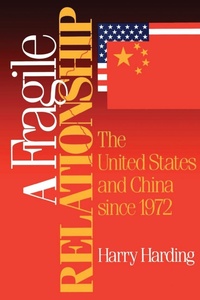
A Fragile Relationship
The United States and China Since 1972
1st Edition
Published on 26. July 2000
480 pages
978-0-8157-9147-8 (ISBN)
Description

President Nixon's historic trip to China in February 1972 marked the beginning of a new era in Sino-American relations. For the first time since 1949, the two countries established high-level official contacts and transformed their relationship from confrontation to collaboration. Over the subsequent twenty years, however, U.S.-China relations have experienced repeated cycles of progress, stalemate, and crisis, with the events in Tiananmen Square in June 1989 the most recent and disruptive example. Paradoxically, although relations between the two countries are vastly more extensive today than they were twenty years ago, they remain highly fragile.
In this eagerly awaited book, China expert Harry Harding offers the first comprehensive look at Sino-American relations from 1972 to the present. He traces the evolution of U.S.-China relations, and assesses American policy toward Peking in the post- Tiananmen era.
Harding analyzes the changing contexts for the Sino-American relationship, particularly the rapidly evolving international environment, changes in American economic and political life, and the dramatic domestic developments in both China and Taiwan. He discusses the principal substantive issues in U.S.-China relations, including the way in which the two countries have addressed their differences over Taiwan and human rights, and how they have approached the blend of common and competitive interests in their economic and strategic relationships. He also addresses the shifting political base for Sino-American relations within each country, including the development of each society's perceptions of the other, and the emergence and dissolution of rival political coalitions supporting and opposing the relationship.
Harding concludes that a return to the Sino-American strategic alignment of the 1970s, or even to the economic partnership of the 1980s, is less likely in the 1990s than continued tension or even confrontation over such issues as
More details
Edition
1. Auflage
Language
English
Place of publication
Basingstoke
United States
Publishing group
Bloomsbury Publishing Plc
ISBN-13
978-0-8157-9147-8 (9780815791478)
Copyright in bibliographic data and cover images is held by Nielsen Book Services Limited or by the publishers or by their respective licensors: all rights reserved.
Schweitzer Classification
Other editions
Additional editions
Book
02/1992
Brookings Institution
€57.00
Article exhausted; check different version
Person
By Harry Harding
Content
- Cover
- Contents
- 1. Overview
- Twenty Years' Evolution
- Changing Contexts
- Substantive Issues
- The Shifting Political Base
- Prospects and Recommendations
- 2. Breakthrough
- Hostility
- Rapprochement
- Complications
- Unofficial Relations
- Ambivalence
- 3. Normalization
- Continued Stalemate
- Progress toward Normalization
- Congress Revisits Taiwan
- An Expanding Strategic Relationship
- The Growth of Economic and Cultural Ties
- The Sino-American Honeymoon
- 4. Estrangement
- Reagan and Taiwan
- China's Independent Foreign Policy
- Growing Pains
- Disenchantment
- 5. Reconciliation
- Back on Track
- Economic and Cultural Ties
- Taiwan
- Strategic Relations
- American Euphoria
- 6. Storm Clouds
- The Decline of the Anti-Soviet Rationale
- Growing Divergence on Strategic Issues
- Economic and Cultural Problems
- Human Rights
- Forebodings
- 7. Crisis
- Crisis in Tiananmen
- The Bush Administration's Response
- The Congressional Response
- The Chinese Response
- Mutual Disillusionment
- 8. Deadlock
- Washington's Year-End Initiative
- The First Debate over China's Most-Favored-Nation Status
- The Persian Gulf Crisis
- The Second Debate over China's Most-Favored-Nation Status
- The Second Bush Strategy
- The Broader Relationship
- The Mood
- 9. Prospects
- A Renewed Strategic Alignment
- Diverse Relations with a Fragmented China
- A Renewed Partnership in China's Reform
- A Second Period of Confrontation
- A Strained Relationship
- Conclusion
- 10. Redesigning American China Policy
- Security
- Commerce
- Human Rights
- Taiwan and Hong Kong
- Academic and Cultural Exchanges
- The Global Agenda
- A New Relationship with China
- Appendixes
- A. Tables and Figure
- B. The Shanghai Communiqué
- C. Documents on the Normalization of U.S.-China Relations
- D. Documents on U.S. Arms Sales to Taiwan
- Notes
- Index
- A
- B
- C
- D
- E
- F
- G
- H
- I
- J
- K
- L
- M
- N
- O
- P
- Q
- R
- S
- T
- U
- V
- W
- X
- Y
- Z
