

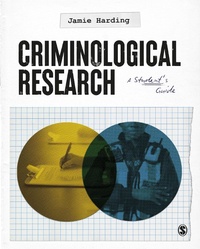
Criminological Research
A Student's Guide
1st Edition
Published on 12. March 2022
384 pages
978-1-5297-3774-5 (ISBN)
Description

The ultimate new guide to your criminological research project, this introductory textbook supports you through your research journey, providing all the knowledge and skills you need to conduct your own research in criminology, and confidently evaluate published work. It is packed with a wide range of relevant examples supported by helpful discussions on their complexities and ethical implications, giving you a comprehensive understanding of how to research crime.
Key features include:
A complete look at the research process, from the first steps of deciding your research question to writing up your results, all illustrated with engaging criminological examples
'What is the mistake?' exercises to help you avoid the most common errors
A dedicated chapter on key ethical issues
Step-by-step guides to analysing both quantitative and qualitative data
Follow research processes with ease with this accessible textbook and gain the confidence to conduct sound and credible research every step of the way.
Key features include:
A complete look at the research process, from the first steps of deciding your research question to writing up your results, all illustrated with engaging criminological examples
'What is the mistake?' exercises to help you avoid the most common errors
A dedicated chapter on key ethical issues
Step-by-step guides to analysing both quantitative and qualitative data
Follow research processes with ease with this accessible textbook and gain the confidence to conduct sound and credible research every step of the way.
Reviews / Votes
Dr Jamie Harding provides a brilliant Student Guide of Criminological Research that highlights the importance of ethically informed and methodological rigorous criminological research, and encourages intellectual curiosity and critical reflection. Using concrete examples from 'real life' research and an accessible structure that leads the reader step-by-step through the various stages of qualitative and quantitative research, the guide thoroughly prepares and empowers students to conduct their own studies. This is an invaluable resource for students and those teaching criminological methods -- Dr Laura NaeglerMore details
Edition
1. Auflage
Language
English
Place of publication
London
United Kingdom
Publishing group
Sage Publications Ltd (Digital)
Target group
College/higher education
Product notice
Reflowable
ISBN-13
978-1-5297-3774-5 (9781529737745)
Copyright in bibliographic data and cover images is held by Nielsen Book Services Limited or by the publishers or by their respective licensors: all rights reserved.
Schweitzer Classification
Other editions
Additional editions
Book
04/2022
1st Edition
SAGE Publications Ltd
€71.00
Shipment within 15-20 days
Book
04/2022
1st Edition
SAGE Publications Ltd
€130.50
Shipment within 15-20 days
Person
Jamie Harding received his PhD from the Department of Sociology and Social Policy at the University of Newcastle upon Tyne. He has been employed at Northumbria University since 1995, first as a lecturer in Housing Studies and more recently as a Senior Lecturer in Research Methods in the Department of Social Sciences. Before moving into higher education he worked for a number of social housing organisations.
Jamie's main area of interest is qualitative and quantitative research methods, which he teaches at undergraduate, postgraduate and doctoral level. He also lectures on criminal justice - an area where he has edited a textbook - and homelessness, a subject on which he has written two monographs. He is programme leader for the Police Constable Degree Apprenticeship, which is run in partnership with Northumbria Police.
Jamie is married with two adult children and two grandchildren. He enjoys running and was delighted to win the highly prestigious Claremont Road Runners summer club handicap race in 2021.
Jamie's main area of interest is qualitative and quantitative research methods, which he teaches at undergraduate, postgraduate and doctoral level. He also lectures on criminal justice - an area where he has edited a textbook - and homelessness, a subject on which he has written two monographs. He is programme leader for the Police Constable Degree Apprenticeship, which is run in partnership with Northumbria Police.
Jamie is married with two adult children and two grandchildren. He enjoys running and was delighted to win the highly prestigious Claremont Road Runners summer club handicap race in 2021.
Content
Chapter 1: Introduction
Part 1
Chapter 2: Key Methodological Approaches
Chapter 3: Conducting a Literature Review
Chapter 4: Identifying a Research Questions
Chapter 5: Research Designs
Chapter 6: Ethical Issues
Chapter 7: Populations and Samples
Part 2: Data Collection
Chapter 8: Collecting Data Through Surveys
Chapter 9: Qualitative Methods of Data Collection
Chapter 10: Alternatives to Empirical Data Collection
Part 3: Data Analysis and Producing Your Output
Chapter 11: Quantitative Data Analysis
Chapter 12: Qualitative Data Analysis
Chapter 13: Writing About Research
Chapter 14: Epilogue
Part 1
Chapter 2: Key Methodological Approaches
Chapter 3: Conducting a Literature Review
Chapter 4: Identifying a Research Questions
Chapter 5: Research Designs
Chapter 6: Ethical Issues
Chapter 7: Populations and Samples
Part 2: Data Collection
Chapter 8: Collecting Data Through Surveys
Chapter 9: Qualitative Methods of Data Collection
Chapter 10: Alternatives to Empirical Data Collection
Part 3: Data Analysis and Producing Your Output
Chapter 11: Quantitative Data Analysis
Chapter 12: Qualitative Data Analysis
Chapter 13: Writing About Research
Chapter 14: Epilogue
