

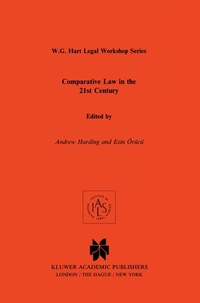
Comparative Law in the 21st Century
Published on 1. June 2002
338 pages
978-90-411-7167-2 (ISBN)
Description

As society becomes more global and multicultural, many lawyers find themselves researching and applying principles and rules from several legal traditions. In Europe especially, the gradual convergence of civil law and common law that has been under way for decades is now gaining depth and breadth from aspects of Islamic, Asian, and African legal cultures, and we are all the better for it.
So it is time to take stock of where the discipline of comparative law stands and where it is going, a task ably undertaken in the sixteen insightful essays in this book. The originals of these papers were delivered at the 2000 W.G. Hart Legal Workshop at the Institute of Legal Studies of the University of London. They may be read here as not merely comparative law studies, but penetrating theses about what comparative law is actually about, or what it is for.
The general discussion tends to fall into three major areas:
- comparative public law, focusing on the growing scrutiny worldwide on constitutionalism, human rights, and administrative accountability;
- transmigration of legal ideas and institutions, emphasising the need to look at similarities and differences from an `importation' perspective as well as from the once-exclusive 'exportation' perspective; and
- the European dimension, in which the need for the study of economic and social background and the role of law in the political process have come to the fore.
Comparative Law in the 21st Century confronts all these looming issues from a vantage point that reveals the broad contours of law as practised and studied today and tomorrow, highlighting fast-moving trends that were unsuspected as little as two decades ago.
So it is time to take stock of where the discipline of comparative law stands and where it is going, a task ably undertaken in the sixteen insightful essays in this book. The originals of these papers were delivered at the 2000 W.G. Hart Legal Workshop at the Institute of Legal Studies of the University of London. They may be read here as not merely comparative law studies, but penetrating theses about what comparative law is actually about, or what it is for.
The general discussion tends to fall into three major areas:
- comparative public law, focusing on the growing scrutiny worldwide on constitutionalism, human rights, and administrative accountability;
- transmigration of legal ideas and institutions, emphasising the need to look at similarities and differences from an `importation' perspective as well as from the once-exclusive 'exportation' perspective; and
- the European dimension, in which the need for the study of economic and social background and the role of law in the political process have come to the fore.
Comparative Law in the 21st Century confronts all these looming issues from a vantage point that reveals the broad contours of law as practised and studied today and tomorrow, highlighting fast-moving trends that were unsuspected as little as two decades ago.
More details
Other editions
Additional editions
Andrew Harding
Comparative Law in the 21st Century
Book
06/2002
1st Edition
Kluwer Law International
€107.00
Shipment within 10-20 days
Content
- Cover
- Half Title Page
- Title Page
- Copyright Page
- Table of Contents
- PREFACE
- Chapter 1 UNDE VENIT, QUO TENDIT COMPARATIVE LAW?
- 1. UNDE VENIT COMPARATIVE LAW?
- 1.1. Comparative Law as We Know It
- 1.2. Comparative Law at the End of the 20th Century
- 1.3. Reciprocal Influence
- 2. QUO TENDIT COMPARATIVE LAW?
- Chapter 2 LEGAL TRANSPLANTS AND BEYOND: OF DISCIPLINES AND METAPHORS
- 1. INTRODUCTION
- 2. COMPETING APPROACHES TO THE STUDY OF LEGAL TRANSFERS
- 3. THE SIGNIFICANCE OF LEGAL TRANSPLANTS
- 4. LEGAL TRANSPLANTS AS A METAPHOR
- Chapter 3 SEEKING SIMILARITY, APPRECIATING DIFFERENCE: COMPARATIVE LAW AND COMMUNITIES
- 1. INTRODUCTION
- 2. COMPARATIVE LAW AND LEGAL INTERPRETATION
- 3. THE AUTHORITY OF COMPARATIVE LAW
- 4. COMPARATIVE LAW AND THE REGIONS OF THE SOCIAL
- 5. REGULATING NON-INSTRUMENTAL RELATIONS OF COMMUNITY
- 5.1. Community of Values or Beliefs
- 5.2. Traditional Community
- 5.3. Affective Community
- 6. CONCLUSION
- Chapter 4 TRANSMIGRATION AND TRANSFERABILITY OF COMMERCIAL LAW IN A GLOBALIZED WORLD
- 1. INTRODUCTION
- 2. HARMONIZATION
- 3. TRANSPLANT THEORIES
- 4. UNIVERSAL SECURITY IN ENGLAND, FRANCE AND QUEBEC
- 5. PREDICTING THE OUTCOMES OF TRANSPLANTS
- 5.1. Misunderstandings
- 5.2. Ignorance
- 5.3. Commercial Law as Culture
- 5.4. Predictions, Commercial Lawyers and the Academy
- 5.5. The Complexity of Transplants
- 6. CONCLUSION
- Chapter 5 WHY (STILL) NO TRUST IN FRENCH LAW?
- 1. AN OUTLINE OF THE FIDUCIE
- 2. THE FIDUCIE, ABSOLUTE OWNERSHIP AND THE FRENCH EPISTEMIC TRADITION
- 3. SURVEILLANCE OF OWNERSHIP, GOVERNMENTALITY AND THE PROBLEM OF TRUST IN FRENCH LAW
- 4. WIDER HORIZONS: GLOBALIZATION, PROFESSIONAL OPPORTUNITIES AND THE FIDUCIE
- 5. CONCLUSION
- Chapter 6 LEGAL TRANSPLANTS: PRINCIPLES AND PRAGMATISM IN COMPARATIVE FAMILY LAW
- 1. INTRODUCTION
- 2. THE CONCEPT OF LEGAL TRANSPLANTS IN COMPARATIVE LEGAL STUDIES
- 2.1. The Terminological/Jurisprudential Debate
- 2.2. Conditions under which Legal Transplants take Place
- 3. FAMILY LAW IN COMPARATIVE PERSPECTIVE: PRAGMATISM, LEGAL TRANSPLANTS AND LEGAL REFORM
- 3.1. Divorce: Common Grounds and the Concept of Fault
- 3.2. Matrimonial Property
- 3.3. Criteria used in Determining Child Custody
- 3.4. The 'Welfare Principle' or 'Best Interests of the Child Test' in Family Law
- 4. THEORETICAL, CULTURAL AND JURISPRUDENTIAL PERSPECTIVES
- 5. CONCLUSION: BACK TO THE FUTURE?
- Chapter 7 CONTINENTAL PRINCIPLES IN ENGLISH PUBLIC LAW
- 1. INTRODUCTION
- 2. LEGITIMATE EXPECTATIONS
- 3. PROPORTIONALITY
- 4. TOWARDS AN EXPLANATION
- 5. CONCLUSION
- Chapter 8 ON SUCCESSFUL LEGAL TRANSPLANTS IN A FUTURE IUS COMMUNE EUROPAEUM
- 1. INTRODUCTION
- 2. IUS COMMUNE AND LEGAL TRANSPLANTS: TOWARD A MIX OF NATIONAL MENTALITY AND EUROPEAN UNIFORMITY
- 3. LEGAL BORROWING AND THE CONSISTENCY OF A LEGAL SYSTEM
- 4. THE SUCCESS OF LEGAL TRANSPLANTS AS EXPLAINED BY THEIR ENVIRONMENT
- 5. INTERNAL FACTORS INVOLVED IN THE SUCCESS OF LEGAL TRANSPLANTS: PATH DEPENDENCE AND AREAS OF EUROPEAN PRIVATE LAW
- 6. A EUROPEAN IUS COMMUNE THROUGH THE USE OF LEGAL TRANSPLANTS?
- Chapter 9 COMPARATIVE LAW IN A REGIONALLY INTEGRATED EUROPE
- 1. COMPARATIVE LAW TO BE RE-DEFINED AND ITS METHODOLOGY TO BE DIFFERENTIATED
- 2. THE BRIGHT SIDE AND THE DARK SIDE OF HARMONIZATION AND THE 'STRATEGIC' IMPORTANCE OF COMPARATIVE LAW IN A EUROPEAN CONTEXT
- 3. THE ISSUE OF CODIFICATION OF EUROPEAN COMMUNITY LAW
- 4. THE ISSUE OF LEGITIMACY OF AN EMERGING IUS COMMUNE EUROPAEUM
- 5. 'BOTTOM-UP' AND 'TOP-DOWN' HARMONIZATION
- 6. SUBJECTS OF APPLIED COMPARATIVE LAW
- Chapter 10 THE CONTRIBUTION OF COMPARATIVE LAW TO THE HARMONIZATION OF EUROPEAN PRIVATE LAW
- 1. LOOKING FOR A ROLE FOR COMPARATIVE LAW IN EUROPEAN LEGAL
- HARMONIZATION
- 2. WHAT IS LEGAL CULTURE?
- 3. LEGAL CULTURE AND THE HARMONIZATION PROCESS
- 4. TAKING HARMONIZATION SERIOUSLY: A REVIEW OF SOME BASIC ISSUES
- 4.1. Obstacles
- 4.2. The Arguments for a Common European Private Law
- 4.3. Method of Production
- Chapter 11 HUNDRED HEADLESS EUROPE: COMPARISON, CONSTITUTION AND CULTURE
- 1. INTRODUCTION
- 2. COMPARISON
- 3. CONSTITUTION/SOVEREIGNTY
- 4. CONSTITUTION/DEMOCRACY
- 5. CONSTITUTION
- 6. EUROPE
- Chapter 12 OPPOSITIONS AND FRAGMENTATIONS: IN SEARCH OF A FORMULA FOR COMPARATIVE ANALYSIS?
- 1. INTRODUCTION
- 2. THE ROUTE TO A COMPARATIVE METHOD?
- 3. COMPARISON BY OPPOSITIONS
- 3.1. Model A: Mixed Economy Welfare State
- 3.2. Model B: Mixed Economy 'Public Choice' Model
- 4. MICHEL FOUCAULT: TWO 'HISTORIES OF THE PRESENT'
- 5. CONCLUSION
- Chapter 13 COMPARING PUBLIC LAW
- 1. INTRODUCTION
- 1.1. The Activity
- 1.2. The External Environment
- 2. INSTITUTIONAL SETTING
- 2.1. The Power of History and Routine
- 2.2. Common Values?
- 2.3. Features of the Public Law Institutional Setting
- 3. CONCLUSION
- Chapter 14 COMPARATIVE PUBLIC LAW: SOME LESSONS FROM SOUTH EAST ASIA
- 1. SOUTH EAST ASIA RAS BEEN NEGLECTED BY COMPARATIVE LAW
- 2. COMPARATIVE PUBLIC LAWYERS SHOULD BE JOINED IN THE COMPARATIVE LAW CONVERSATION
- 3. PUBLIC LAW IS DEVELOPING RAPIDLY IN SOUTH EAST ASIA
- 4. THE RULE OF LAW IS NOT IN DECLINE
- 4. REGIONALISTS AND COMPARATISTS SHOULD TALK TO EACH OTHER
- 5. COMPARATIVE LAW IS THEORY AND PRACTICE
- 6. SOUTH EAST ASIAN LEGAL SCHOLARSHIP: A BRIEF HISTORY OF TIMELESSNESS
- 7. CONCLUSIONS
- Chapter 15 THE IMPORTATION OF LAW: A NEW COMPARATIVE PERSPECTIVE AND THE HUNGARIAN CONSTITUTIONAL COURT
- 1. INTRODUCTION
- 2. THE 20TH CENTURY: THE EXPORTER'S PERSPECTIVE
- 3. THE 21ST CENTURY: THE PERSPECTIVE OF IMPORTATION
- 3.1. Reversing the Perspective of Comparison
- 3.2. Law Importation in Hungarian Constitutional Adjudication
- 4. CONCLUSION
- Chapter 16 SOUTH AFRICA: A WORLD IN ONE COUNTRY ON THE LONG ROAD TO REALITY
- 1. INTRODUCTION
- 2. ESSENTIAL POSITIVIST AND HISTORICAL CHARACTER OF THE PRE-REFORM SYSTEM
- 3. TRANS MIGRATIONS AND TRANSFERS IN THE PRE-REFORM ERA
- 3.1. Open to Ideas but Alert to Differences: the Property Example
- 3.2. Significance of English Law Methodology
- 4. ACTIVE NORMATIVE CHARACTER OF REFORMED SYSTEM
- 5. ROLE OF COMPARATIVE LAW IN THE REFORMED SYSTEM
- 6. THE LAND REFORM CONTEXT
- 7. THE BILL OF RIGHTS - A CARTE BLANCHE FOR COMPARATIVE LAW?
- 8. CONCLUSION - 'TRANSMIGRATION AND TRANSFERABILITY' IN TWENTY-FIRST CENTURY SOUTH AFRICA
- A SHORT BIBLIOGRAPHY OF COMPARATIVE LAW
- INDEX
- Back Cover
