

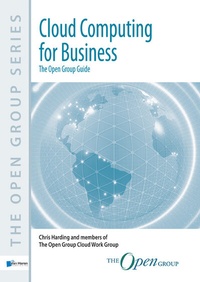
Cloud Computing for Business -The Open Group Guide
Published on 11. June 2020
249 pages
978-90-8753-658-9 (ISBN)
Description

The Open Groups long awaited guidance on Cloud is now published!
Cloud Computing is the major evolution today in computing. It describes how the internet has enabled organizations to access computing resources as a commodity and when needed in much the same way as households access household utilities.
For Enterprises with complex and expensive IT systems, the idea of paying on demand for someone else to provide IT services is attractive. This authoritative guide is specifically designed for business managers to understand the benefits that can be achieved; including
Improved timeliness and agility
Resource optimisation
Control and reduction of costs
More innovation
Increased security
Decreased exposure to risk
Demonstration of compliance
Improved quality of support
Improved business continuity resource
The authoritative title, published by the globally respected Open Group, gives Managers reliable and independent guidance that will help to support decisions and actions in this key operational area.
More details
Other editions
Additional editions
Van Haren Publishing
Cloud Computing for Business: The Open Group Guide
Book
08/2011
Van Haren Publishing BV
€66.50
Shipment within 10-15 days
Content
- Intro
- Preface
- About The Open Group
- Trademarks
- Acknowledgements
- Referenced documents
- Chapter 1 What is cloud?
- 1.1 NIST definition of cloud computing
- 1.2 Essential characteristics
- 1.2.1 On-demand self-service
- 1.2.2 Broad network access
- 1.2.3 Resource pooling
- 1.2.4 Rapid elasticity
- 1.2.5 Measured service
- 1.3 Service models
- 1.3.1 Cloud infrastructure as a service (IaaS)
- 1.3.2 Cloud platform as a service (PaaS)
- 1.3.3 Cloud software as a service (SaaS)
- 1.4 Deployment models
- 1.4.1 Private cloud
- 1.4.2 Public cloud
- 1.4.3 Community cloud
- 1.4.4 Hybrid cloud
- 1.5 Extending the NIST model to business processes
- 1.6 Comparison with traditional environments
- 1.7 Providing and using cloud services
- 1.7.1 Providing cloud services
- 1.7.2 Providing added services
- 1.7.3 Developing added services
- 1.7.4 Using cloud services
- 1.8 The impact of cloud computing
- 1.8.1 New business paradigm
- 1.8.2 Cloud ecosystems
- Chapter 2 Why cloud?
- 2.1 Agility
- 2.1.1 Changing business processes
- 2.1.2 Development and testing
- 2.1.3 Resource scaling
- 2.1.4 Reduced need for training
- 2.2 Productivity
- 2.2.1 Collaborative working
- 2.2.2 Shared logic
- 2.3 Quality
- 2.3.1 Better usage information
- 2.3.2 Better manageability
- 2.3.3 Better quality of IT provision
- 2.3.4 Better business continuity
- 2.3.5 Better carbon footprint
- 2.4 Cost
- 2.4.1 Server consolidation
- 2.4.2 Thin clients
- 2.4.3 Community cost sharing
- 2.4.4 Replacing CAPEX with OPEX
- 2.5 New business opportunities
- 2.5.1 Cloud service provision
- 2.5.2 Added service provision
- Chapter 3 Establishing your cloud vision
- 3.1 Understanding the business context
- 3.1.1 Basic situation
- 3.1.2 Business goals
- 3.1.3 Risk-reward balance
- 3.1.4 Impact on products and services
- 3.1.5 Business processes
- 3.1.6 Scope and complexity
- 3.1.7 Collaboration versus information restriction
- 3.2 Three example cloud projects
- 3.2.1 Konsort-Prinz
- 3.2.2 Sam Pan Engineering
- 3.2.3 ViWi
- 3.3 Assessing cloud suitability - the cloud buyer's decisiontree
- 3.3.1 Assessment considerations
- 3.3.2 Question 1: Is your business situation vertical?
- 3.3.3 Question 2: Are the processes differentiating?
- 3.3.4 Question 3: Are there impediments to outsourcing?
- 3.3.5 Question 4: Are there impediments to cloud adoption?
- 3.3.6 Question 5: Is the primary business driver cloud-compatible?
- 3.3.7 Question 6: Will the solution be a platform?
- 3.3.8 Question 7: Is the application insulated from changes to the businessprocess?
- 3.3.9 Question 8: Is the differentiation IT-based?
- 3.3.10 Question 9: Are the hardware, operating system, and application custommade?
- 3.3.11 Question 10: Are the hardware and operating system custom-made orspecialized?
- 3.4 The example project visions
- 3.4.1 Konsort-Prinz
- 3.4.2 Sam Pan Engineering
- 3.4.3 ViWi
- Chapter 4 Buying cloud services
- 4.1 Determining fit
- 4.1.1 Workload and cost models
- 4.1.2 Workload factors
- 4.1.3 Workload allocations
- 4.1.4 Pay-as-you-go versus ownership
- 4.1.5 Modeling resources and costs
- 4.1.6 Example workload and cost models - Konsort-Prinz
- 4.1.7 Example workload and cost models - ViWi
- 4.1.8 Using the models
- 4.2 Establishing requirements
- 4.2.1 Service functionality
- 4.2.2 Back-up
- 4.2.3 Bulk data transfer
- 4.2.4 Supplier choice
- 4.2.5 Availability
- 4.2.6 Reliability
- 4.2.7 Recoverability
- 4.2.8 Responsiveness
- 4.2.9 Throughput
- 4.2.10 Configurability
- 4.2.11 Reporting
- 4.2.12 Fault management
- 4.2.13 End user access control
- 4.2.14 Provider access control
- 4.2.15 Resource partitioning
- 4.2.16 Logging
- 4.2.17 Threat management
- 4.2.18 Compliance with regulations
- 4.3 Selection
- 4.3.1 Exit strategy
- 4.3.2 Contract terms
- 4.3.3 Negotiation
- 4.3.4 Choosing the service
- 4.4 Monitoring
- 4.4.1 Workload and cost
- 4.4.2 Conformance to requirements
- Chapter 5 Understanding cloud risk
- 5.1 Risk management
- 5.1.1 Risk assessment
- 5.1.2 Risk communication
- 5.2 Cloud mission risks
- 5.2.1 Financial
- 5.2.2 Organization and culture
- 5.2.3 Service integration
- 5.2.4 Compliance
- 5.2.5 Business continuity management
- 5.2.6 System quality
- 5.2.7 External service
- 5.3 System quality risk factors
- 5.3.1 Functionality
- 5.3.2 Performance
- 5.3.3 Manageability
- 5.3.4 Security
- 5.3.5 User satisfaction
- 5.4 Continuing risk assessment
- 5.4.1 Solution architecture development
- 5.4.2 Cloud service selection and procurement
- 5.4.3 Solution operation
- Chapter 6 Building ROI from cloud computing
- 6.1 Productivity: more business with less IT
- 6.1.1 Resource utilization
- 6.1.2 Usage-based pricing
- 6.1.3 Specialization and scale
- 6.2 Speed: getting there more quickly
- 6.2.1 Time to deployment
- 6.2.2 Lifetime cost models
- 6.2.3 IT asset management
- 6.3 Size: breaking new ground
- 6.3.1 Entering new markets
- 6.3.2 High-value services
- 6.3.3 The long tail
- 6.3.4 Becoming a cloud provider
- 6.4 Quality: improved margin from better service
- 6.4.1 Competitive pressure
- 6.4.2 The importance of quality
- 6.5 Comparing ROI of cloud and traditional IT solutions
- 6.5.1 Basis of ROI calculations
- 6.5.2 Konsort-Prinz
- 6.5.3 Sam Pan Engineering
- 6.5.4 ViWi
- 6.6 Measuring and tracking ROI
- 6.6.1 Utilization
- 6.6.2 Time compression
- 6.6.3 Scale
- 6.6.4 Quality
- 6.6.5 Examples
- 6.6.6 Konsort-Prinz
- 6.6.7 Sam Pan Engineering
- 6.6.8 ViWi
- Chapter 7 The challenge
- Appendix A Cloud computing in use
- A1 Cross-industry use-cases
- A2 Financial services use-cases
- A3 Government use-cases
- A4 Telecommunications operator use-cases
- A5 Media and entertainment use-cases
- A6 Health services use-cases
- A7 Pharmaceuticals use-cases
- A8 Distribution use-cases
- A9 Energy and utilities use-cases
- A10 Higher education use-cases
- A11 Use-case actors
- A12 Use-case benefits
- Appendix B Glossary
- Index
