

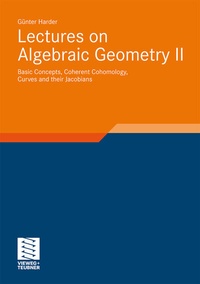
Lectures on Algebraic Geometry II
Basic Concepts, Coherent Cohomology, Curves and their Jacobians
Published on 21. April 2011
XIII, 365 pages
978-3-8348-8159-5 (ISBN)
Description

Prof. Dr. Günter Harder, Max-Planck-Institute for Mathematics, Bonn
More details
Other editions
Additional editions
Günter Harder
Lectures on Algebraic Geometry II
Basic Concepts, Coherent Cohomology, Curves and their Jacobians
Book
10/2014
Vieweg+Teubner Verlag
€160.49
Shipment within 10-15 days
Günter Harder
Lectures on Algebraic Geometry II
Basic Concepts, Coherent Cohomology, Curves and their Jacobians
Book
04/2011
Vieweg+Teubner Verlag
€160.49
Shipment within 10-15 days
Persons
Content
1 - Preface [Seite 5]
2 - Contents [Seite 7]
3 - Introduction [Seite 12]
4 - 6 Basic Concepts of the Theory of Schemes [Seite 14]
4.1 - 6.1 Affine Schemes [Seite 14]
4.1.1 - 6.1.1 Localization [Seite 14]
4.1.2 - 6.1.2 The Spectrum of a Ring [Seite 15]
4.1.3 - 6.1.3 The Zariski Topology on Spec(A) [Seite 19]
4.1.4 - 6.1.4 The Structure Sheaf on Spec(A) [Seite 21]
4.1.5 - 6.1.5 Quasicoherent Sheaves [Seite 24]
4.1.6 - 6.1.6 Schemes as Locally Ringed Spaces [Seite 25]
4.1.6.1 - Closed Subschemes [Seite 27]
4.1.6.2 - Sections [Seite 28]
4.1.6.3 - A remark [Seite 28]
4.2 - 6.2 Schemes [Seite 29]
4.2.1 - 6.2.1 The Definition of a Scheme [Seite 29]
4.2.1.1 - The gluing [Seite 29]
4.2.1.2 - Closed subschemes again [Seite 30]
4.2.1.3 - Annihilators, supports and intersections [Seite 31]
4.2.2 - 6.2.2 Functorial properties [Seite 31]
4.2.2.1 - Affine morphisms [Seite 32]
4.2.2.2 - Sections again [Seite 32]
4.2.3 - 6.2.3 Construction of Quasi-coherent Sheaves [Seite 32]
4.2.3.1 - Vector bundles [Seite 33]
4.2.3.2 - Vector Bundles Attached to Locally Free Modules [Seite 33]
4.2.4 - 6.2.4 Vector bundles and GLn-torsors. [Seite 34]
4.2.5 - 6.2.5 Schemes over a base scheme S. [Seite 35]
4.2.5.1 - Some notions of finiteness [Seite 35]
4.2.5.2 - Fibered products [Seite 36]
4.2.5.3 - Base change [Seite 41]
4.2.6 - 6.2.6 Points, T-valued Points and Geometric Points [Seite 41]
4.2.6.1 - Closed Points and Geometric Points on varieties [Seite 45]
4.2.7 - 6.2.7 Flat Morphisms [Seite 47]
4.2.7.1 - The Concept of Flatness [Seite 48]
4.2.7.2 - Representability of functors [Seite 51]
4.2.8 - 6.2.8 Theory of descend [Seite 53]
4.2.8.1 - Effectiveness for affine descend data [Seite 56]
4.2.9 - 6.2.9 Galois descend [Seite 57]
4.2.9.1 - A geometric interpretation [Seite 60]
4.2.9.2 - Descend for general schemes of finite type [Seite 61]
4.2.10 - 6.2.10 Forms of schemes [Seite 61]
4.2.11 - 6.2.11 An outlook to more general concepts [Seite 64]
5 - 7 Some Commutative Algebra [Seite 67]
5.1 - 7.1 Finite A-Algebras [Seite 67]
5.1.1 - 7.1.1 Rings With Finiteness Conditions [Seite 70]
5.1.2 - 7.1.2 Dimension theory for finitely generated k-algebras [Seite 71]
5.2 - 7.2 Minimal prime ideals and decomposition into irreducibles [Seite 73]
5.2.1 - 7.2.1 A.ne schemes over k and change of scalars [Seite 77]
5.2.1.1 - What is dim(Z1 n Z2)? [Seite 82]
5.2.2 - 7.2.2 Local Irreducibility [Seite 83]
5.2.2.1 - The connected component of the identity of an affine group scheme G/k [Seite 84]
5.3 - 7.3 Low Dimensional Rings [Seite 85]
5.4 - 7.4 Flat morphisms [Seite 92]
5.4.1 - 7.4.1 Finiteness Properties of Tor [Seite 92]
5.4.2 - 7.4.2 Construction of flat families [Seite 94]
5.4.3 - 7.4.3 Dominant morphisms [Seite 96]
5.4.3.1 - Birational morphisms [Seite 100]
5.4.3.2 - The Artin-Rees Theorem [Seite 101]
5.4.4 - 7.4.4 Formal Schemes and Infinitesimal Schemes [Seite 102]
5.5 - 7.5 Smooth Points [Seite 103]
5.5.1 - 7.5.1 Generic Smoothness [Seite 109]
5.5.1.1 - The singular locus [Seite 109]
5.5.2 - 7.5.2 Relative Differentials [Seite 111]
5.5.3 - 7.5.3 Examples [Seite 114]
5.5.4 - 7.5.4 Normal schemes and smoothness in codimension one [Seite 121]
5.5.4.1 - Regular local rings [Seite 122]
5.5.5 - 7.5.5 Vector fields, derivations and infinitesimal automorphisms [Seite 123]
5.5.5.1 - Automorphisms [Seite 126]
5.5.6 - 7.5.6 Group schemes [Seite 126]
5.5.7 - 7.5.7 The groups schemes Ga,Gm and µn [Seite 128]
5.5.8 - 7.5.8 Actions of group schemes [Seite 129]
6 - 8 Projective Schemes [Seite 132]
6.1 - 8.1 Geometric Constructions [Seite 132]
6.1.1 - 8.1.1 The Projective Space pnA [Seite 132]
6.1.1.1 - Homogenous coordinates [Seite 134]
6.1.2 - 8.1.2 Closed subschemes [Seite 136]
6.1.3 - 8.1.3 Projective Morphisms and Projective Schemes [Seite 137]
6.1.3.1 - Locally Free Sheaves on pn [Seite 140]
6.1.3.2 - Opn (d) as Sheaf of Meromorphic Functions [Seite 142]
6.1.3.3 - The Relative Differentials and the Tangent Bundle of pnS [Seite 143]
6.1.4 - 8.1.4 Seperated and Proper Morphisms [Seite 145]
6.1.5 - 8.1.5 The Valuative Criteria [Seite 147]
6.1.5.1 - The Valuative Criterion for the Projective Space [Seite 147]
6.1.6 - 8.1.6 The Construction Proj(R) [Seite 148]
6.1.6.1 - A special case of a finiteness result [Seite 150]
6.1.7 - 8.1.7 Ample and Very Ample Sheaves [Seite 151]
6.2 - 8.2 Cohomology of Quasicoherent Sheaves [Seite 157]
6.2.1 - 8.2.1 Cech cohomology [Seite 159]
6.2.2 - 8.2.2 The Künneth-formulae [Seite 161]
6.2.3 - 8.2.3 The cohomology of the sheaves Opn (r) [Seite 162]
6.3 - 8.3 Cohomology of Coherent Sheaves [Seite 164]
6.3.1 - 8.3.1 The coherence theorem for proper morphisms [Seite 169]
6.3.2 - Digression: Blowing up and contracting [Seite 170]
6.4 - 8.4 Base Change [Seite 175]
6.4.1 - 8.4.1 Flat families and intersection numbers [Seite 182]
6.4.1.1 - The Theorem of Bertini [Seite 190]
6.4.2 - 8.4.2 The hyperplane section and intersection numbers of line bundles [Seite 191]
7 - 9 Curves and the Theorem of Riemann-Roch [Seite 194]
7.1 - 9.1 Some basic notions [Seite 194]
7.2 - 9.2 The local rings at closed points [Seite 196]
7.2.1 - 9.2.1 The structure of OC,p [Seite 197]
7.2.2 - 9.2.2 Base change [Seite 197]
7.3 - 9.3 Curves and their function fields [Seite 199]
7.3.1 - 9.3.1 Ramification and the different ideal [Seite 201]
7.4 - 9.4 Line bundles and Divisors [Seite 204]
7.4.1 - 9.4.1 Divisors on curves [Seite 206]
7.4.2 - 9.4.2 Properties of the degree [Seite 208]
7.4.2.1 - Line bundles on non smooth curves have a degree [Seite 208]
7.4.2.2 - Base change for divisors and line bundles [Seite 209]
7.4.3 - 9.4.3 Vector bundles over a curve [Seite 209]
7.4.3.1 - Vector bundles on p1 [Seite 210]
7.5 - 9.5 The Theorem of Riemann-Roch [Seite 212]
7.5.1 - 9.5.1 Differentials and Residues [Seite 214]
7.5.2 - 9.5.2 The special case C = p1/k [Seite 218]
7.5.3 - 9.5.3 Back to the general case [Seite 222]
7.5.4 - 9.5.4 Riemann-Roch for vector bundles and for coherent sheaves. [Seite 229]
7.5.4.1 - The structure of K'(C) [Seite 231]
7.6 - 9.6 Applications of the Riemann-Roch Theorem [Seite 232]
7.6.1 - 9.6.1 Curves of low genus [Seite 232]
7.6.2 - 9.6.2 The moduli space [Seite 234]
7.6.3 - 9.6.3 Curves of higher genus [Seite 245]
7.6.3.1 - The "moduli space" of curves of genus g [Seite 249]
7.7 - 9.7 The Grothendieck-Riemann-Roch Theorem [Seite 250]
7.7.1 - 9.7.1 A special case of the Grothendieck -Riemann-Roch theorem [Seite 251]
7.7.2 - 9.7.2 Some geometric considerations [Seite 252]
7.7.3 - 9.7.3 The Chow ring [Seite 255]
7.7.3.1 - Base extension of the Chow ring [Seite 258]
7.7.4 - 9.7.4 The formulation of the Grothendieck-Riemann-Roch Theorem [Seite 260]
7.7.5 - 9.7.5 Some special cases of the Grothendieck-Riemann-Roch-Theorem [Seite 263]
7.7.6 - 9.7.6 Back to the case p2 : X = C × C -. C [Seite 264]
7.7.7 - 9.7.7 Curves over finite fi [Seite 9.7.7 Curves over finite fi]
elds. - 268 [Seite 268]
7.7.7.1 - Elementary properties of the .-function. [Seite 269]
7.7.7.2 - The Riemann hypothesis. [Seite 272]
8 - 10 The Picard functor for curves and their Jacobians [Seite 276]
8.1 - 10.1 The construction of the Jacobian [Seite 276]
8.1.1 - 10.1.1 Generalities and heuristics : [Seite 276]
8.1.1.1 - Rigidification of PIC [Seite 278]
8.1.2 - 10.1.2 General properties of the functor PIC [Seite 280]
8.1.2.1 - The locus of triviality [Seite 280]
8.1.3 - 10.1.3 Infinitesimal properties [Seite 283]
8.1.3.1 - Differentiating a line bundle along a vector field [Seite 285]
8.1.3.2 - The theorem of the cube. [Seite 285]
8.1.4 - 10.1.4 The basic principles of the construction of the Picard scheme of a curve. [Seite 289]
8.1.5 - 10.1.5 Symmetric powers [Seite 290]
8.1.6 - 10.1.6 The actual construction of the Picard scheme of a curve. [Seite 295]
8.1.6.1 - The gluing [Seite 302]
8.1.7 - 10.1.7 The local representability of PICgC/k [Seite 305]
8.2 - 10.2 The Picard functor on X and on J [Seite 308]
8.2.1 - 10.2.1 Construction of line bundles on X and on J [Seite 308]
8.2.1.1 - The homomorphisms fM [Seite 309]
8.2.2 - 10.2.2 The projectivity of X and J [Seite 312]
8.2.2.1 - The morphisms fM are homomorphisms of functors [Seite 313]
8.2.3 - 10.2.3 Maps from the curve C to X, local representability of PICX/k , and the self duality of the Jacobian [Seite 314]
8.2.4 - 10.2.4 The self duality of the Jacobian [Seite 321]
8.2.5 - 10.2.5 General abelian varieties [Seite 322]
8.3 - 10.3 The ring of endomorphisms End(J) and the l -adic modules [Seite 325]
8.4 - 10.4 Étale Cohomology [Seite 345]
8.4.1 - 10.4.1 Étale cohomology groups [Seite 346]
8.4.1.1 - Galois cohomology [Seite 347]
8.4.1.2 - The geometric étale cohomology groups. [Seite 349]
8.4.2 - 10.4.2 Schemes over finite fields [Seite 355]
8.4.2.1 - The global case [Seite 357]
8.4.2.2 - The degenerating family of elliptic curves [Seite 361]
9 - Bibliography [Seite 368]
10 - Index [Seite 373]
2 - Contents [Seite 7]
3 - Introduction [Seite 12]
4 - 6 Basic Concepts of the Theory of Schemes [Seite 14]
4.1 - 6.1 Affine Schemes [Seite 14]
4.1.1 - 6.1.1 Localization [Seite 14]
4.1.2 - 6.1.2 The Spectrum of a Ring [Seite 15]
4.1.3 - 6.1.3 The Zariski Topology on Spec(A) [Seite 19]
4.1.4 - 6.1.4 The Structure Sheaf on Spec(A) [Seite 21]
4.1.5 - 6.1.5 Quasicoherent Sheaves [Seite 24]
4.1.6 - 6.1.6 Schemes as Locally Ringed Spaces [Seite 25]
4.1.6.1 - Closed Subschemes [Seite 27]
4.1.6.2 - Sections [Seite 28]
4.1.6.3 - A remark [Seite 28]
4.2 - 6.2 Schemes [Seite 29]
4.2.1 - 6.2.1 The Definition of a Scheme [Seite 29]
4.2.1.1 - The gluing [Seite 29]
4.2.1.2 - Closed subschemes again [Seite 30]
4.2.1.3 - Annihilators, supports and intersections [Seite 31]
4.2.2 - 6.2.2 Functorial properties [Seite 31]
4.2.2.1 - Affine morphisms [Seite 32]
4.2.2.2 - Sections again [Seite 32]
4.2.3 - 6.2.3 Construction of Quasi-coherent Sheaves [Seite 32]
4.2.3.1 - Vector bundles [Seite 33]
4.2.3.2 - Vector Bundles Attached to Locally Free Modules [Seite 33]
4.2.4 - 6.2.4 Vector bundles and GLn-torsors. [Seite 34]
4.2.5 - 6.2.5 Schemes over a base scheme S. [Seite 35]
4.2.5.1 - Some notions of finiteness [Seite 35]
4.2.5.2 - Fibered products [Seite 36]
4.2.5.3 - Base change [Seite 41]
4.2.6 - 6.2.6 Points, T-valued Points and Geometric Points [Seite 41]
4.2.6.1 - Closed Points and Geometric Points on varieties [Seite 45]
4.2.7 - 6.2.7 Flat Morphisms [Seite 47]
4.2.7.1 - The Concept of Flatness [Seite 48]
4.2.7.2 - Representability of functors [Seite 51]
4.2.8 - 6.2.8 Theory of descend [Seite 53]
4.2.8.1 - Effectiveness for affine descend data [Seite 56]
4.2.9 - 6.2.9 Galois descend [Seite 57]
4.2.9.1 - A geometric interpretation [Seite 60]
4.2.9.2 - Descend for general schemes of finite type [Seite 61]
4.2.10 - 6.2.10 Forms of schemes [Seite 61]
4.2.11 - 6.2.11 An outlook to more general concepts [Seite 64]
5 - 7 Some Commutative Algebra [Seite 67]
5.1 - 7.1 Finite A-Algebras [Seite 67]
5.1.1 - 7.1.1 Rings With Finiteness Conditions [Seite 70]
5.1.2 - 7.1.2 Dimension theory for finitely generated k-algebras [Seite 71]
5.2 - 7.2 Minimal prime ideals and decomposition into irreducibles [Seite 73]
5.2.1 - 7.2.1 A.ne schemes over k and change of scalars [Seite 77]
5.2.1.1 - What is dim(Z1 n Z2)? [Seite 82]
5.2.2 - 7.2.2 Local Irreducibility [Seite 83]
5.2.2.1 - The connected component of the identity of an affine group scheme G/k [Seite 84]
5.3 - 7.3 Low Dimensional Rings [Seite 85]
5.4 - 7.4 Flat morphisms [Seite 92]
5.4.1 - 7.4.1 Finiteness Properties of Tor [Seite 92]
5.4.2 - 7.4.2 Construction of flat families [Seite 94]
5.4.3 - 7.4.3 Dominant morphisms [Seite 96]
5.4.3.1 - Birational morphisms [Seite 100]
5.4.3.2 - The Artin-Rees Theorem [Seite 101]
5.4.4 - 7.4.4 Formal Schemes and Infinitesimal Schemes [Seite 102]
5.5 - 7.5 Smooth Points [Seite 103]
5.5.1 - 7.5.1 Generic Smoothness [Seite 109]
5.5.1.1 - The singular locus [Seite 109]
5.5.2 - 7.5.2 Relative Differentials [Seite 111]
5.5.3 - 7.5.3 Examples [Seite 114]
5.5.4 - 7.5.4 Normal schemes and smoothness in codimension one [Seite 121]
5.5.4.1 - Regular local rings [Seite 122]
5.5.5 - 7.5.5 Vector fields, derivations and infinitesimal automorphisms [Seite 123]
5.5.5.1 - Automorphisms [Seite 126]
5.5.6 - 7.5.6 Group schemes [Seite 126]
5.5.7 - 7.5.7 The groups schemes Ga,Gm and µn [Seite 128]
5.5.8 - 7.5.8 Actions of group schemes [Seite 129]
6 - 8 Projective Schemes [Seite 132]
6.1 - 8.1 Geometric Constructions [Seite 132]
6.1.1 - 8.1.1 The Projective Space pnA [Seite 132]
6.1.1.1 - Homogenous coordinates [Seite 134]
6.1.2 - 8.1.2 Closed subschemes [Seite 136]
6.1.3 - 8.1.3 Projective Morphisms and Projective Schemes [Seite 137]
6.1.3.1 - Locally Free Sheaves on pn [Seite 140]
6.1.3.2 - Opn (d) as Sheaf of Meromorphic Functions [Seite 142]
6.1.3.3 - The Relative Differentials and the Tangent Bundle of pnS [Seite 143]
6.1.4 - 8.1.4 Seperated and Proper Morphisms [Seite 145]
6.1.5 - 8.1.5 The Valuative Criteria [Seite 147]
6.1.5.1 - The Valuative Criterion for the Projective Space [Seite 147]
6.1.6 - 8.1.6 The Construction Proj(R) [Seite 148]
6.1.6.1 - A special case of a finiteness result [Seite 150]
6.1.7 - 8.1.7 Ample and Very Ample Sheaves [Seite 151]
6.2 - 8.2 Cohomology of Quasicoherent Sheaves [Seite 157]
6.2.1 - 8.2.1 Cech cohomology [Seite 159]
6.2.2 - 8.2.2 The Künneth-formulae [Seite 161]
6.2.3 - 8.2.3 The cohomology of the sheaves Opn (r) [Seite 162]
6.3 - 8.3 Cohomology of Coherent Sheaves [Seite 164]
6.3.1 - 8.3.1 The coherence theorem for proper morphisms [Seite 169]
6.3.2 - Digression: Blowing up and contracting [Seite 170]
6.4 - 8.4 Base Change [Seite 175]
6.4.1 - 8.4.1 Flat families and intersection numbers [Seite 182]
6.4.1.1 - The Theorem of Bertini [Seite 190]
6.4.2 - 8.4.2 The hyperplane section and intersection numbers of line bundles [Seite 191]
7 - 9 Curves and the Theorem of Riemann-Roch [Seite 194]
7.1 - 9.1 Some basic notions [Seite 194]
7.2 - 9.2 The local rings at closed points [Seite 196]
7.2.1 - 9.2.1 The structure of OC,p [Seite 197]
7.2.2 - 9.2.2 Base change [Seite 197]
7.3 - 9.3 Curves and their function fields [Seite 199]
7.3.1 - 9.3.1 Ramification and the different ideal [Seite 201]
7.4 - 9.4 Line bundles and Divisors [Seite 204]
7.4.1 - 9.4.1 Divisors on curves [Seite 206]
7.4.2 - 9.4.2 Properties of the degree [Seite 208]
7.4.2.1 - Line bundles on non smooth curves have a degree [Seite 208]
7.4.2.2 - Base change for divisors and line bundles [Seite 209]
7.4.3 - 9.4.3 Vector bundles over a curve [Seite 209]
7.4.3.1 - Vector bundles on p1 [Seite 210]
7.5 - 9.5 The Theorem of Riemann-Roch [Seite 212]
7.5.1 - 9.5.1 Differentials and Residues [Seite 214]
7.5.2 - 9.5.2 The special case C = p1/k [Seite 218]
7.5.3 - 9.5.3 Back to the general case [Seite 222]
7.5.4 - 9.5.4 Riemann-Roch for vector bundles and for coherent sheaves. [Seite 229]
7.5.4.1 - The structure of K'(C) [Seite 231]
7.6 - 9.6 Applications of the Riemann-Roch Theorem [Seite 232]
7.6.1 - 9.6.1 Curves of low genus [Seite 232]
7.6.2 - 9.6.2 The moduli space [Seite 234]
7.6.3 - 9.6.3 Curves of higher genus [Seite 245]
7.6.3.1 - The "moduli space" of curves of genus g [Seite 249]
7.7 - 9.7 The Grothendieck-Riemann-Roch Theorem [Seite 250]
7.7.1 - 9.7.1 A special case of the Grothendieck -Riemann-Roch theorem [Seite 251]
7.7.2 - 9.7.2 Some geometric considerations [Seite 252]
7.7.3 - 9.7.3 The Chow ring [Seite 255]
7.7.3.1 - Base extension of the Chow ring [Seite 258]
7.7.4 - 9.7.4 The formulation of the Grothendieck-Riemann-Roch Theorem [Seite 260]
7.7.5 - 9.7.5 Some special cases of the Grothendieck-Riemann-Roch-Theorem [Seite 263]
7.7.6 - 9.7.6 Back to the case p2 : X = C × C -. C [Seite 264]
7.7.7 - 9.7.7 Curves over finite fi [Seite 9.7.7 Curves over finite fi]
elds. - 268 [Seite 268]
7.7.7.1 - Elementary properties of the .-function. [Seite 269]
7.7.7.2 - The Riemann hypothesis. [Seite 272]
8 - 10 The Picard functor for curves and their Jacobians [Seite 276]
8.1 - 10.1 The construction of the Jacobian [Seite 276]
8.1.1 - 10.1.1 Generalities and heuristics : [Seite 276]
8.1.1.1 - Rigidification of PIC [Seite 278]
8.1.2 - 10.1.2 General properties of the functor PIC [Seite 280]
8.1.2.1 - The locus of triviality [Seite 280]
8.1.3 - 10.1.3 Infinitesimal properties [Seite 283]
8.1.3.1 - Differentiating a line bundle along a vector field [Seite 285]
8.1.3.2 - The theorem of the cube. [Seite 285]
8.1.4 - 10.1.4 The basic principles of the construction of the Picard scheme of a curve. [Seite 289]
8.1.5 - 10.1.5 Symmetric powers [Seite 290]
8.1.6 - 10.1.6 The actual construction of the Picard scheme of a curve. [Seite 295]
8.1.6.1 - The gluing [Seite 302]
8.1.7 - 10.1.7 The local representability of PICgC/k [Seite 305]
8.2 - 10.2 The Picard functor on X and on J [Seite 308]
8.2.1 - 10.2.1 Construction of line bundles on X and on J [Seite 308]
8.2.1.1 - The homomorphisms fM [Seite 309]
8.2.2 - 10.2.2 The projectivity of X and J [Seite 312]
8.2.2.1 - The morphisms fM are homomorphisms of functors [Seite 313]
8.2.3 - 10.2.3 Maps from the curve C to X, local representability of PICX/k , and the self duality of the Jacobian [Seite 314]
8.2.4 - 10.2.4 The self duality of the Jacobian [Seite 321]
8.2.5 - 10.2.5 General abelian varieties [Seite 322]
8.3 - 10.3 The ring of endomorphisms End(J) and the l -adic modules [Seite 325]
8.4 - 10.4 Étale Cohomology [Seite 345]
8.4.1 - 10.4.1 Étale cohomology groups [Seite 346]
8.4.1.1 - Galois cohomology [Seite 347]
8.4.1.2 - The geometric étale cohomology groups. [Seite 349]
8.4.2 - 10.4.2 Schemes over finite fields [Seite 355]
8.4.2.1 - The global case [Seite 357]
8.4.2.2 - The degenerating family of elliptic curves [Seite 361]
9 - Bibliography [Seite 368]
10 - Index [Seite 373]
