

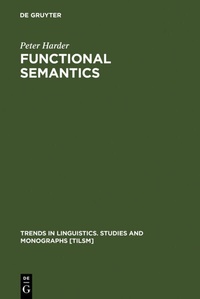
Functional Semantics
A Theory of Meaning, Structure and Tense in English
1st Edition
Published on 14. December 2010
XV, 586 pages
978-3-11-081875-8 (ISBN)
Description

No detailed description available for "Functional Semantics".
More details
Other editions
Additional editions
Book
01/1996
1st Edition
De Gruyter Mouton
€259.00
Article exhausted; check different version
Book
12/1995
1st Edition
De Gruyter Mouton
€179.95
Shipment within 7-9 days
Content
- Intro
- Preface
- Part One: Meaning
- 1. Introduction
- 2. Meaning and the pursuit of knowledge: the world behind the word
- 2.1. Introduction
- 2.2. Plato on language and ideas
- 2.3. Aristotle: words and categories
- 2.4. Language and metaphysics in Plato and Aristotle
- 2.5. From classical to modern ontology: logic and the "linguistic turn
- 2.6. The rise and fall of logical reconstruction
- 2.7. Logical and linguistic semantics
- 3. Meaning and cognition
- 3.1. Introduction
- 3.2. The "classical" computational approach
- 3.3. Language and meaning in the "classical" view
- 3.4. Intentionality, mental content and rules
- 3.5. Intentionality and information
- 3.6. The second cognitive revolution: cognitive linguistics and connectionism
- 3.7. Pan-cognitivism: turning behaviourism on its head
- 3.8. Continuity and differentiation: a delicate balance
- 3.9. Cognition: the differentiation and interrelation of skills
- 3.10. Problems with the word "conceptual" as used in cognitive linguistics
- 3.11. Conclusion: conceptual meaning - and why it is not enough
- 4. Meaning in a functional perspective
- 4.1. Introduction
- 4.2. The intellectual history of the functional perspective on language
- 4.3. What is "function" (if anything)?
- 4.4. Types of functional contexts
- 4.5. A functional account of language and meaning
- 4.6. Meaning and representation: procedural semantics
- 4.7. Concepts and conceptual linguistic meaning in the procedural perspective
- 4.8. Searle on representation and interaction
- 5. Semantics and pragmatics in a functional theory of meaning
- 5.1. Introduction
- 5.2. Pragmatics, truth, and Plato
- 5.3. Coded functions and utterance function
- 5.4. The principle of sense
- 5.5. Relevance versus sense: translating interaction into information
- 5.6. Final remarks
- Part Two: Structure
- 1. Introduction
- 2. The functional basis of linguistic structure
- 2.1. Introduction
- 2.2. The ontology of levels
- 2.3. Component-based and function-based structure
- 2.4. Saussurean structuralism: a functional reconstruction
- 2.5. Structure and substance - arbitrariness and motivation
- 2.6. American structuralism: the Bloomfield-Chomsky tradition
- 2.7. Autonomy in generative thinking: the Pygmalion effect revisited
- 2.8. Generative autonomy: empty or absurd?
- 2.9. Underlying structure I: significant generalizations and the naming fallacy
- 2.10. Underlying structure II: distribution vs semantics
- 2.11. Autonomy: final remarks
- 3. Clause structure in a functional semantics
- 3.1. Introduction
- 3.2. On content and expression in syntax
- 3.3. The nature of content elements
- 3.4. Scope and layered clause structure
- 3.5. Process and product in syntactic description The clause as recipe for interpretive action
- 3.6. The nature of syntax: cognitive and evolutionary perspectives
- 3.7. The relation between expression and content syntax
- 3.8. Differences in relation to standard Functional Grammar
- 3.9. Semantic clause structure and grammatical universals
- 4. Conceptual meaning in a functional clause structure
- 4.1. Introduction
- 4.2. Language structure in Cognitive Grammar
- 4.3. Cognitive Grammar and the distinction between clause meaning and interpretation
- 4.4. Conceptualization embedded in interaction: the top-down aspect of syntactic structure
- 4.5. A closer look at non-conceptual meaning
- 4.6. Two forms of incompleteness: functional and conceptual dependence
- 4.7. Relations between functional and conceptual aspects of "element" meanings
- 4.8. Dependence and the division of labour between coded and uncoded meaning
- 4.9. Scope, function and semantic relations: the multidimensionality of semantic structure
- 5. Summary: function, structure, and autonomy
- Part Three: Tense
- 1. Introduction
- 2. The meanings of tenses
- 2.1. Some central positions and concepts
- 2.2. Individual content elements: the deictic tenses
- 2.3. The future
- 2.4. The perfect
- 2.5. The place of tense meanings in the general theory of semantic clause structure
- 3. Tense & Co: time reference in the simple clause
- 3.1. Introduction
- 3.2. Logical vs. functional operators
- 3.3. Time-referential formulae as emerging from meaning plus structure
- 3.4. Reference time: a family resemblance concept
- 3.5. Tense time, adverbial time and topic time
- 3.6. Adverbials in complex tenses
- 4. Beyond the simple clause
- 4.1. Tense in subclauses: general remarks
- 4.2. Indirect speech
- 4.3. Tense in conditionals
- 4.4. Functional content syntax and "normal" syntax
- 4.5. Tense and discourse
- 5. Conclusion
- 5.1. Overview
- 5.2. Meaning
- 5.3. Structure
- 5.4. Survey of times
- 5.5. Conceptualization embedded in interaction
- 5.6. Semantics and pragmatics
- Notes
- References
- Index of names
- Index of subjects
