

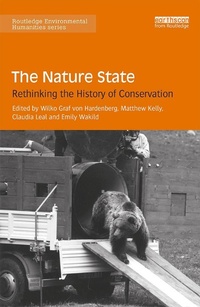
The Nature State
Rethinking the History of Conservation
Published on 14. July 2017
244 pages
978-1-351-76464-3 (ISBN)
Description

This volume brings together case studies from around the globe (including China, Latin America, the Philippines, Namibia, India and Europe) to explore the history of nature conservation in the twentieth century. It seeks to highlight the state, a central actor in these efforts, which is often taken for granted, and establishes a novel concept - the nature state - as a means for exploring the historical formation of that portion of the state dedicated to managing and protecting nature.
Following the Industrial Revolution and post-war exponential increase in human population and consumption, conservation in myriad forms has been one particularly visible way in which the government and its agencies have tried to control, manage or produce nature for reasons other than raw exploitation. Using an interdisciplinary approach and including case studies from across the globe, this edited collection brings together geographers, sociologists, anthropologists and historians in order to examine the degree to which sociopolitical regimes facilitate and shape the emergence and development of nature states.
This innovative work marks an early intervention in the tentative turn towards the state in environmental history and will be of great interest to students and practitioners of environmental history, social anthropology and conservation studies.
Following the Industrial Revolution and post-war exponential increase in human population and consumption, conservation in myriad forms has been one particularly visible way in which the government and its agencies have tried to control, manage or produce nature for reasons other than raw exploitation. Using an interdisciplinary approach and including case studies from across the globe, this edited collection brings together geographers, sociologists, anthropologists and historians in order to examine the degree to which sociopolitical regimes facilitate and shape the emergence and development of nature states.
This innovative work marks an early intervention in the tentative turn towards the state in environmental history and will be of great interest to students and practitioners of environmental history, social anthropology and conservation studies.
Reviews / Votes
"This book offers a bold new concept, the "nature state," intended to take its place beside useful terms such as the welfare state or patrimonial state. Building on fresh case studies from every inhabited continent, the volume explores the tangled links between states and the natural world in illuminating ways."J.R. McNeill, Georgetown University
"Environmental history takes an important and imaginative stride forward with the concept of a ''nature state'' introduced here through a rich collection of unusual and varied examples. This innovative approach to theorizing state control over the natural environment in the 20thcentury will serve as a productive model for future scholarship on this exciting theme."
Jane Carruthers, University of South Africa
"[T]he contents of The Nature State are wide-ranging in topic and diverse in space. A quick list will illustrate the case studies from every inhabited continent: national parks in the Philippines, Namibia, southern India, Colombia and Brazil, science and conservation in Patagonia, China's tropical rainforests and in the Danube Delta. A rich haul indeed, all well written, balanced and interesting...The book will be useful as a teaching tool and, no doubt, the type of discussion at the ESEH panel will be replicated in the classroom and beyond." Jane Carruthers, International Consortium of Enviromental History Organizations, July 2017
More details
Series
Language
English
Place of publication
London
United Kingdom
Publishing group
Taylor & Francis Ltd
Target group
College/higher education
Illustrations
3 s/w Photographien bzw. Rasterbilder, 2 s/w Zeichnungen
2 Line drawings, black and white; 3 Halftones, black and white
File size
20,38 MB
ISBN-13
978-1-351-76464-3 (9781351764643)
Copyright in bibliographic data and cover images is held by Nielsen Book Services Limited or by the publishers or by their respective licensors: all rights reserved.
Schweitzer Classification
Other editions
Additional editions
Wilko Hardenberg | Matthew Kelly | Claudia Leal
The Nature State
Rethinking the History of Conservation
Book
01/2019
1st Edition
Routledge
€71.40
Shipment within 15-20 days
Wilko Hardenberg | Matthew Kelly | Claudia Leal
The Nature State
Rethinking the History of Conservation
Book
06/2017
Routledge
€206.40
Shipment within 10-20 days
Persons
Wilko Graf von Hardenberg is a Senior Research Scholar at the Max Planck Institute for the History of Science in Berlin, Germany, where he coordinates the working group 'Art of Judgement'. He holds a PhD in geography from the University of Cambridge, UK, and has worked at the University of Wisconsin-Madison, USA, the Rachel Carson Center, Munich, Germany, and the University of Trento, Italy.
Matthew Kelly teaches history at Northumbria University, UK, where he is helping to establish the environmental humanities as a broad area of research and teaching within the university. He was an Associate Professor at the University of Southampton, UK, and a Fellow of the Rachel Carson Center, Munich, Germany.
Claudia Leal holds a PhD in geography from the University of California at Berkeley, USA, and is Associate Professor in the Department of History at Universidad de los Andes in Bogota, Colombia. She was a Fellow of the Rachel Carson Center, Munich, Germany, and Co-president of the Latin American and Caribbean Society for Environmental History.
Emily Wakild teaches Latin American and Environmental History at Boise State University in Idaho, USA. Her current projects include a primer on teaching environmental history and a monograph on the social and ecological regions of Amazonia and Patagonia.
Matthew Kelly teaches history at Northumbria University, UK, where he is helping to establish the environmental humanities as a broad area of research and teaching within the university. He was an Associate Professor at the University of Southampton, UK, and a Fellow of the Rachel Carson Center, Munich, Germany.
Claudia Leal holds a PhD in geography from the University of California at Berkeley, USA, and is Associate Professor in the Department of History at Universidad de los Andes in Bogota, Colombia. She was a Fellow of the Rachel Carson Center, Munich, Germany, and Co-president of the Latin American and Caribbean Society for Environmental History.
Emily Wakild teaches Latin American and Environmental History at Boise State University in Idaho, USA. Her current projects include a primer on teaching environmental history and a monograph on the social and ecological regions of Amazonia and Patagonia.
Content
Introduction
1.The Export of the American National Park Idea in an Age of Empire: The Philippines, 1898 1940
Ian Tyrrell
2.Protecting Patagonia: Science, Conservation and the Pre-History of the Nature State on a South American Frontier, 1903-1934
Emily Wakild
3.Another way to preserve: hunting bans, biosecurity, and the brown bear in Italy, 1930-1960
Wilko Graf von Hardenberg
4. Conservation Politics in the Madras Presidency: Maintaining the Lord Wenlock Downs of the Nilgiris Grasslands, South India, as a National Park,1930-1950
Siddhartha Krishnan
5.Negotiating the Nature State Beyond the Parks: Conservation in 20th Century North-Central Namibia
Emmanuel Kreike
6. Conventional thinking and the fragile birth of the Nature State in post-war Britain.
Matthew Kelly
7. Behind the Scenes and Out in the Open: Making Colombian National Parks in the 1960s and 70s
Claudia Leal
8. Ordering the Borderland:Settlement and Removal in the Iguacu National Park, Brazil, 1940s-1970s
Frederico Freitas
9. Discovering China's Tropical Rainforests: Shifting Approaches to People and Nature in the late Twentieth Century
Michael Hathaway
10. Nature, State, and Conservation in the Danube Delta: Turning Fishermen into Outlaws
Stefan Dorondel and Veronica Mitroi
1.The Export of the American National Park Idea in an Age of Empire: The Philippines, 1898 1940
Ian Tyrrell
2.Protecting Patagonia: Science, Conservation and the Pre-History of the Nature State on a South American Frontier, 1903-1934
Emily Wakild
3.Another way to preserve: hunting bans, biosecurity, and the brown bear in Italy, 1930-1960
Wilko Graf von Hardenberg
4. Conservation Politics in the Madras Presidency: Maintaining the Lord Wenlock Downs of the Nilgiris Grasslands, South India, as a National Park,1930-1950
Siddhartha Krishnan
5.Negotiating the Nature State Beyond the Parks: Conservation in 20th Century North-Central Namibia
Emmanuel Kreike
6. Conventional thinking and the fragile birth of the Nature State in post-war Britain.
Matthew Kelly
7. Behind the Scenes and Out in the Open: Making Colombian National Parks in the 1960s and 70s
Claudia Leal
8. Ordering the Borderland:Settlement and Removal in the Iguacu National Park, Brazil, 1940s-1970s
Frederico Freitas
9. Discovering China's Tropical Rainforests: Shifting Approaches to People and Nature in the late Twentieth Century
Michael Hathaway
10. Nature, State, and Conservation in the Danube Delta: Turning Fishermen into Outlaws
Stefan Dorondel and Veronica Mitroi
