

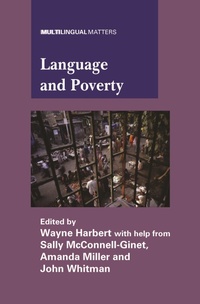
Language and Poverty
1st Edition
Published on 9. December 2008
184 pages
978-1-84769-120-0 (ISBN)
Description

This book explores the bidirectional relationship between language and poverty, from the perspectives of linguistics, language policy and planning, economics, anthropology, and sociology. On the one hand, poverty affects language survival; in modern times the fundamental determinants of language shift and language death are economic. On the other hand, the languages people speak, or don't speak, can influence their economic status in substantial ways, limiting or facilitating access to jobs and education and full participation in the functions of the society. The issues encompassed by the twin themes of the volume have assumed growing significance in an era of increasing globalization and accelerating change in economies, technologies and traditional social structures. They are of practical concern to people in a wide range of disciplines and professions, including politicians, educators, social workers, language planners, and others who work and live in multilingual contexts.
Reviews / Votes
This is a fascinating volume. As far as I know, it is the first comprehensive collection on this important subject. The authors are well known experts in their disciplines and are able to contribute numerous important insights on the complex interactions between language choices, material poverty and economic disruption. -- James Crawford, President, Institute for Language and Education Policy, USA. Language and Poverty is a wonderful resource for anyone interested in the current discourse on the ways in which poverty threatens some languages, preserves others, and most importantly, how language can eliminate poverty. The wide breadth of topics covered in the book makes it suitable for linguists interested in lauguage documentation and interdisciplinary research, as well as specialists from outside of linguistics who are interested in the ways language influences economics and culture.The vast array of geographic locations, languages, analyses of poverty, and case studies featured in Lallguage and Poverty, gives this collection an incredibly wide appeal, and should make it an indispensible guide on this emerging area of research. -- Rener L. Kemp, University of Georgia * Journal of Sociolinguistics 15/1, 2011: 135-148 *More details
Series
Language
English
Place of publication
Bristol
United Kingdom
Publishing group
Channel View Publications Ltd
Target group
Professional and scholarly
Edition type
Digital original
ISBN-13
978-1-84769-120-0 (9781847691200)
Copyright in bibliographic data and cover images is held by Nielsen Book Services Limited or by the publishers or by their respective licensors: all rights reserved.
Schweitzer Classification
Other editions
Additional editions
Wayne Harbert | Sally McConnell-Ginet | Amanda Miller
Language and Poverty
Book
12/2008
Multilingual Matters
€148.49
Article exhausted; check different version
Wayne Harbert | Sally McConnell-Ginet | Amanda Miller
Language and Poverty
Book
12/2008
Multilingual Matters
€42.20
Shipment within 10-20 days
Persons
Wayne Harbert is Professor of Linguistics, Cornell University. In addition to his research on the Germanic languages, he teaches Welsh and Scottish Gaelic, as well as courses on minority languages and linguistics.
Sally McConnell-Ginet, Professor Emerita of Linguistics at Cornell University, has taught and done research in formal semantics/pragmatics and in language and gender. She is Past President of the Linguistic Society of America.
Amanda Miller, Assistant Professor of Linguistics at Cornell University, works on the phonetics and phonology of endangered Southern African Khoesan languages. She undertakes linguistic field work in Namibia, Botswana and South Africa.
John Whitman, Professor and Chair of Linguistics at Cornell University, works on syntactic variation and language change. His research includes work with endangered minority languages of Japan (RyA>>kyA>>an), Korea (Kyeongsang-do dialect), and the Peoplea??s Republic of China (Tibetan, Bai).
Sally McConnell-Ginet, Professor Emerita of Linguistics at Cornell University, has taught and done research in formal semantics/pragmatics and in language and gender. She is Past President of the Linguistic Society of America.
Amanda Miller, Assistant Professor of Linguistics at Cornell University, works on the phonetics and phonology of endangered Southern African Khoesan languages. She undertakes linguistic field work in Namibia, Botswana and South Africa.
John Whitman, Professor and Chair of Linguistics at Cornell University, works on syntactic variation and language change. His research includes work with endangered minority languages of Japan (RyA>>kyA>>an), Korea (Kyeongsang-do dialect), and the Peoplea??s Republic of China (Tibetan, Bai).
Content
Chapter 1. Introduction - Wayne Harbert, Sally McConnell-Ginet, Amanda Miller and John Whitman
Section I: Poverty as a Factor in Language Maintenance and Language Death
Chapter 2. Poverty as a Factor in Language Maintenance and Language Death: Some Case Studies from Africa - Herman Batibo
Chapter 3. Language Diversity and Poverty in Africa - Matthias Brenzinger
Section II: Language as a Determinant of Access to Resources
Chapter 4. The Impact of the Hegemony of English on Access to and Quality of Education with Special Reference to South Africa - Neville Alexander
Chapter 5. Econolinguistics in the USA - John Baugh
Chapter 6. Where in the World is US Spanish? - Ofelia Garcia and Leah Mason
Chapter 7. Perpetuating Inequality: Language Disadvantage and Capability Deprivation of Tribal Mother Tongue Speakers in India - Ajit Mohanty
Section III: Language and Poverty: A Cross-disciplinary Perspective
Chapter 8. Biodiversity, Linguistic Diversity and Poverty: Some Global Patterns and Missing Links - Suzanne Romaine
Chapter 9. Language and Poverty: Measurement, Determinants and Policy Responses - Francois Vaillancourt
Chapter 10. Losing their Names: Native Languages, Identity and the State - Peter Whiteley
Section IV: Language, Poverty and the Role of the Linguist
Chapter 11. The Role of the Linguist in Language Maintenance and Revitalization: Documentation, Training and Materials Development - Lenore Grenoble, Keren Rice and Norvin Richards
Chapter 12. Preserving Digital Language Materials: Some Considerations - Helen Aristar-Dry
Conclusion
Section I: Poverty as a Factor in Language Maintenance and Language Death
Chapter 2. Poverty as a Factor in Language Maintenance and Language Death: Some Case Studies from Africa - Herman Batibo
Chapter 3. Language Diversity and Poverty in Africa - Matthias Brenzinger
Section II: Language as a Determinant of Access to Resources
Chapter 4. The Impact of the Hegemony of English on Access to and Quality of Education with Special Reference to South Africa - Neville Alexander
Chapter 5. Econolinguistics in the USA - John Baugh
Chapter 6. Where in the World is US Spanish? - Ofelia Garcia and Leah Mason
Chapter 7. Perpetuating Inequality: Language Disadvantage and Capability Deprivation of Tribal Mother Tongue Speakers in India - Ajit Mohanty
Section III: Language and Poverty: A Cross-disciplinary Perspective
Chapter 8. Biodiversity, Linguistic Diversity and Poverty: Some Global Patterns and Missing Links - Suzanne Romaine
Chapter 9. Language and Poverty: Measurement, Determinants and Policy Responses - Francois Vaillancourt
Chapter 10. Losing their Names: Native Languages, Identity and the State - Peter Whiteley
Section IV: Language, Poverty and the Role of the Linguist
Chapter 11. The Role of the Linguist in Language Maintenance and Revitalization: Documentation, Training and Materials Development - Lenore Grenoble, Keren Rice and Norvin Richards
Chapter 12. Preserving Digital Language Materials: Some Considerations - Helen Aristar-Dry
Conclusion
