

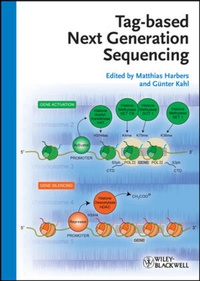
Tag-based Next Generation Sequencing
1st Edition
Published on 19. October 2011
XXVI, 582 pages
978-3-527-64477-3 (ISBN)
Description

Tag-based approaches were originally designed to increase the throughput of capillary sequencing, where concatemers of short sequences were first used in expression profiling. New Next Generation Sequencing methods largely extended the use of tag-based approaches as the tag lengths perfectly match with the short read length of highly parallel sequencing reactions. Tag-based approaches will maintain their important role in life and biomedical science, because longer read lengths are often not required to obtain meaningful data for many applications. Whereas genome re-sequencing and de novo sequencing will benefit from ever more powerful sequencing methods, analytical applications can be performed by tag-based approaches, where the focus shifts from 'sequencing power' to better means of data analysis and visualization for common users. Today Next Generation Sequence data require powerful bioinformatics expertise that has to be converted into easy-to-use data analysis tools. The book's intention is to give an overview on recently developed tag-based approaches along with means of their data analysis together with introductions to Next-Generation Sequencing Methods, protocols and user guides to be an entry for scientists to tag-based approaches for Next Generation Sequencing.
More details
Other editions
Additional editions
Matthias Harbers | Guenter Kahl
Tag-based Next Generation Sequencing
Software
01/2012
Wiley-VCH
€256.09
No shipping information available
Matthias Harbers | Günter Kahl
Tag-based Next Generation Sequencing
Book
12/2011
1st Edition
Wiley-Blackwell
€199.00
Article exhausted; check different version
Persons
Matthias Harbers works in the Japanese biotechnology industry and holds a position as Senior Visiting Scientist at the RIKEN Omics Science Center in Yokohama, Japan. After gaining his PhD at the University Hamburg (Germany), he worked at the Karolinska Institute in Stockholm (Sweden) and the Institut de Génétique et de Biologie Moléculaire et Cellulaire in Strasbourg (France).
Main research areas are:
-Transcriptome analysis
-Preparation of genomic resources
-Biomarker discovery
Matthias Harbers contributed to advanced scientific publications in high-ranking journals such as Science, PNAS, Nature Genetics, Nature Methods, Journal of Biological Chemistry, Nucleic Acids Research, Genome Research, and Genes and Development among others.
Günter Kahl is Professor for Plant Molecular Biology at Frankfurt University, Germany. After his PhD in plant biochemistry, he spent two years with Joe Varner, MSU, East Lansing, and James Bonner, CalTech, Pasadena, USA.
Main research areas:
-Sequencing and analysis of fungal, plant and animal genomes
-Transcriptome analysis in pro- and eukaryotic organisms
-Technology development
Günter Kahl cooperates with a series of research institutions throughout Europe, in Japan, the USA, Israel, India, and Latin America. He served in expert missions for IAEA, FAO, and UNESCO in many countries, and is presently Chief Scientific Officer in the SME GenXPro GmbH at the Frankfurt Innovation Center Biotechnology.
Main research areas are:
-Transcriptome analysis
-Preparation of genomic resources
-Biomarker discovery
Matthias Harbers contributed to advanced scientific publications in high-ranking journals such as Science, PNAS, Nature Genetics, Nature Methods, Journal of Biological Chemistry, Nucleic Acids Research, Genome Research, and Genes and Development among others.
Günter Kahl is Professor for Plant Molecular Biology at Frankfurt University, Germany. After his PhD in plant biochemistry, he spent two years with Joe Varner, MSU, East Lansing, and James Bonner, CalTech, Pasadena, USA.
Main research areas:
-Sequencing and analysis of fungal, plant and animal genomes
-Transcriptome analysis in pro- and eukaryotic organisms
-Technology development
Günter Kahl cooperates with a series of research institutions throughout Europe, in Japan, the USA, Israel, India, and Latin America. He served in expert missions for IAEA, FAO, and UNESCO in many countries, and is presently Chief Scientific Officer in the SME GenXPro GmbH at the Frankfurt Innovation Center Biotechnology.
Content
TAG-BASED NUCLEIC ACID ANALYSIS
DeepSuperSAGE: High-throughput transcriptome sequencing with now- and next-generation sequencing technologies (Hideo Matsumura, Carlos Molina, Detlev H. Krüger, Ryohei Terauchi and Günter Kahl)
DeepCAGE: Genome-wide mapping of transcription start sites (Matthias Harbers, Mitch Dushay and Piero Carninci)
Definition of promotome-transcriptome architecture using CAGEscan (Nicolas Bertin, Charles Plessy, Piero Carninci and Matthias Harbers)
RACE: New applications of an old method to connect exons (Charles Plessy)
RNA-PET: Full-Length transcript analysis using 5' and 3' paired-end-tag next generation sequencing (Xiaoan Ruan and Yijun Ruan)
Stranded RNA-Seq: Strand specific shotgun sequencing of RNA (Alistair R.R. Forrest)
Differential RNA sequencing (dRNA-seq): Deep-sequencing based analysis of primary transcriptomes (Anne Borries, Jörg Vogel and Cynthia M. Sharma)
Identification and expression profiling of small RNA populations using high-throughput sequencing (Javier Armisen, W. Robert Shaw and Eric A. Miska)
Genome-wide mapping of protein-DNA interactions by ChIP-seq (Joshua W.K. Ho, Artyom A. Alekseyenko, Mitzi I. Kuroda and Peter J. Park)
Analysis of protein-RNA interactions with single-nucleotide resolution using iCLIP and next generation sequencing (Julian König, Nicholas J. McGlincy and Jernej Ule)
Massively parallel tag sequencing unveils the complexity of marine protistan communities in oxygen-depleted habitats (Virginia Edgcomb and Thorsten Stoeck)
Chromatin interaction analysis using paired-end-tag sequencing (ChIA-PET) (Xiaoan Ruan and Yijun Ruan)
Tag-seq: Next-generation tag sequencing for gene expression profiling (Sorana Morrissy, Yongjun Zhao, Allen Delaney, Jennifer Asano, Noreen Dhalla, Irene Li, Helen McDonald, Pawan Pandoh, Anna-Liisa Prabhu, Angela Tam, Martin Hirst and Marco Marra)
Isolation of active regulatory elements from eukaryotic chromatin using FAIRE (Formaldehyde Assisted Isolation of Regulatory Elements) (Paul G. Giresi and Jason D. Lieb)
Identification of nucleotide variation in genomes using next generation sequencing (Hendrik-Jan Megens and Martien A.M. Groenen)
Ditag genome scanning - A restriction-based paired-end sequencing approach for genome structrual analysis (Jun Chen, Yeong C. Kim and San Ming Wang)
Next-generation sequencing of BAC clones for next-generation physical mapping (Robert Bogden, Keith Stormo, Jason Dobry, Amy Mraz, Quanzhou Tao, Michiel van Eijk, Jan van Oeveren, Marcel Prins, Jon Wittendorp and Mark van Haaren)
HELP-tagging: Tag-based genome-wide cytosine methylation profiling (Masako Suzuki and John M. Greally)
Second-generation sequencing library preparation: In vitro tagmentation via transposome insertion (Fraz Syed)
NEXT-GENERATION TAG-BASED SEQUENCING
Moving towards third-generation sequencing technologies (Karolina Janitz and Michal Janitz)
Beyond tags to full-length transcripts (Mohammed Mohiuddin, Stephen Hutchison and Thomas Jarvie)
Helicos single-molecule sequencing for accurate tag-based RNA quantitation (John F. Thompson, Tal Raz and Patrice M. Milos)
Total RNA-Seq: Complete analysis of the transcriptome using illumina SBS sequencing (Shujun Luo, Geoffrey P. Smith, Irina Khrebtukova and Gary P. Schroth)
BIOINFORMATICS FOR TAG-BASED TECHNOLOGIES
Computational infrastructure and basic data analysis for next-generation sequencing (David Sexton)
The CLC bio integrated platform for handling and analysis of tag sequencing data (Roald Forsberg, Søren Mønsted and Anne-Mette Krabbe Hein)
Multi-dimensional context of sequence tags: Biological data integration (Thomas Werner and Korbinian Grote)
Experimental design and quality control of next-generation sequencing experiments (Peter A.C. 't Hoen, Matthew S. Hestand, Judith M. Boer, Yuching Lai, Maarten van Iterson, Michiel van Galen, Henk P. Buermans and Johan T. den Dunnen)
UTGB toolkit for personalized genome browsers (Taro L. Saito, Jun Yoshimura, Budrul Ahsan, Atsushi Sasaki, Reginal
DeepSuperSAGE: High-throughput transcriptome sequencing with now- and next-generation sequencing technologies (Hideo Matsumura, Carlos Molina, Detlev H. Krüger, Ryohei Terauchi and Günter Kahl)
DeepCAGE: Genome-wide mapping of transcription start sites (Matthias Harbers, Mitch Dushay and Piero Carninci)
Definition of promotome-transcriptome architecture using CAGEscan (Nicolas Bertin, Charles Plessy, Piero Carninci and Matthias Harbers)
RACE: New applications of an old method to connect exons (Charles Plessy)
RNA-PET: Full-Length transcript analysis using 5' and 3' paired-end-tag next generation sequencing (Xiaoan Ruan and Yijun Ruan)
Stranded RNA-Seq: Strand specific shotgun sequencing of RNA (Alistair R.R. Forrest)
Differential RNA sequencing (dRNA-seq): Deep-sequencing based analysis of primary transcriptomes (Anne Borries, Jörg Vogel and Cynthia M. Sharma)
Identification and expression profiling of small RNA populations using high-throughput sequencing (Javier Armisen, W. Robert Shaw and Eric A. Miska)
Genome-wide mapping of protein-DNA interactions by ChIP-seq (Joshua W.K. Ho, Artyom A. Alekseyenko, Mitzi I. Kuroda and Peter J. Park)
Analysis of protein-RNA interactions with single-nucleotide resolution using iCLIP and next generation sequencing (Julian König, Nicholas J. McGlincy and Jernej Ule)
Massively parallel tag sequencing unveils the complexity of marine protistan communities in oxygen-depleted habitats (Virginia Edgcomb and Thorsten Stoeck)
Chromatin interaction analysis using paired-end-tag sequencing (ChIA-PET) (Xiaoan Ruan and Yijun Ruan)
Tag-seq: Next-generation tag sequencing for gene expression profiling (Sorana Morrissy, Yongjun Zhao, Allen Delaney, Jennifer Asano, Noreen Dhalla, Irene Li, Helen McDonald, Pawan Pandoh, Anna-Liisa Prabhu, Angela Tam, Martin Hirst and Marco Marra)
Isolation of active regulatory elements from eukaryotic chromatin using FAIRE (Formaldehyde Assisted Isolation of Regulatory Elements) (Paul G. Giresi and Jason D. Lieb)
Identification of nucleotide variation in genomes using next generation sequencing (Hendrik-Jan Megens and Martien A.M. Groenen)
Ditag genome scanning - A restriction-based paired-end sequencing approach for genome structrual analysis (Jun Chen, Yeong C. Kim and San Ming Wang)
Next-generation sequencing of BAC clones for next-generation physical mapping (Robert Bogden, Keith Stormo, Jason Dobry, Amy Mraz, Quanzhou Tao, Michiel van Eijk, Jan van Oeveren, Marcel Prins, Jon Wittendorp and Mark van Haaren)
HELP-tagging: Tag-based genome-wide cytosine methylation profiling (Masako Suzuki and John M. Greally)
Second-generation sequencing library preparation: In vitro tagmentation via transposome insertion (Fraz Syed)
NEXT-GENERATION TAG-BASED SEQUENCING
Moving towards third-generation sequencing technologies (Karolina Janitz and Michal Janitz)
Beyond tags to full-length transcripts (Mohammed Mohiuddin, Stephen Hutchison and Thomas Jarvie)
Helicos single-molecule sequencing for accurate tag-based RNA quantitation (John F. Thompson, Tal Raz and Patrice M. Milos)
Total RNA-Seq: Complete analysis of the transcriptome using illumina SBS sequencing (Shujun Luo, Geoffrey P. Smith, Irina Khrebtukova and Gary P. Schroth)
BIOINFORMATICS FOR TAG-BASED TECHNOLOGIES
Computational infrastructure and basic data analysis for next-generation sequencing (David Sexton)
The CLC bio integrated platform for handling and analysis of tag sequencing data (Roald Forsberg, Søren Mønsted and Anne-Mette Krabbe Hein)
Multi-dimensional context of sequence tags: Biological data integration (Thomas Werner and Korbinian Grote)
Experimental design and quality control of next-generation sequencing experiments (Peter A.C. 't Hoen, Matthew S. Hestand, Judith M. Boer, Yuching Lai, Maarten van Iterson, Michiel van Galen, Henk P. Buermans and Johan T. den Dunnen)
UTGB toolkit for personalized genome browsers (Taro L. Saito, Jun Yoshimura, Budrul Ahsan, Atsushi Sasaki, Reginal
