

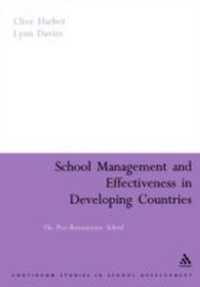
School Management and Effectiveness in Developing Countries
The Post-Bureaucratic School
1st Edition
Published on 8. December 2005
200 pages
978-1-84714-251-1 (ISBN)
Description

This book is quite different from existing 'Western' books on school effectiveness. It describes and analyses the way in which schools operate in developing countries and also tries to explain why they are as they are. Examining them at three levels - the macro, the meso and the micro - the authors use a theoretical framework that they have termed 'post-bureaucracy.'
The book has four interlinked sections. First the authors examine the existing economic and theoretical contexts around school effectiveness, including an analysis of the causes of economic crisis and its impact on school management. In the second section the analysis of schools as bureaucratic facades is proposed. The reality of school life, from which any theory of school effectiveness must derive, is illustrated by an ethnographic account of the job of the headteacher in developing countries. The third section explores different ways to understand this reality, operating on three levels: global relationships, national and community cultures, and individual agency. In the final section Haber and Davies draw these levels and realities together. They argue for the democratization of schools as the only way forward for effective education fordevelopment.
The book has four interlinked sections. First the authors examine the existing economic and theoretical contexts around school effectiveness, including an analysis of the causes of economic crisis and its impact on school management. In the second section the analysis of schools as bureaucratic facades is proposed. The reality of school life, from which any theory of school effectiveness must derive, is illustrated by an ethnographic account of the job of the headteacher in developing countries. The third section explores different ways to understand this reality, operating on three levels: global relationships, national and community cultures, and individual agency. In the final section Haber and Davies draw these levels and realities together. They argue for the democratization of schools as the only way forward for effective education fordevelopment.
More details
Edition
1. Auflage
Language
English
Place of publication
London
United Kingdom
Publishing group
Bloomsbury Publishing PLC
ISBN-13
978-1-84714-251-1 (9781847142511)
Copyright in bibliographic data and cover images is held by Nielsen Book Services Limited or by the publishers or by their respective licensors: all rights reserved.
Schweitzer Classification
Other editions
Additional editions
Clive Harber | Lynn Davies
School Management and Effectiveness in Developing Countries
The Post-Bureaucratic School
Book
12/2005
Continuum International Publishing Group Ltd.
€56.80
Shipment within 15-20 days
Persons
Clive Harber is Emeritus Professor of International Education at the University of Birmingham, UK, and Honorary Professor of Education at the University of KwaZulu Natal, South Africa.
Content
Series Editor's Foreword
Introduction: Heading South
Part One: the State of the Field
1. Education in the context of developing countries
2. School effectiveness and ineffectiveness
Part Two: Contextual realities for school management
3. School as an organization
4. "Leadeship"
Part Three: Explaining school management - levels of understanding
5. Macro Level
6. Meso level
7. Micro level
Part Four: Towards Post-Bureaucracy
8. Need for flexible schools
9. Democracy and the post-bureaucratic school
Conclusion: School management and development: goals and own goals
References
Indexes
Introduction: Heading South
Part One: the State of the Field
1. Education in the context of developing countries
2. School effectiveness and ineffectiveness
Part Two: Contextual realities for school management
3. School as an organization
4. "Leadeship"
Part Three: Explaining school management - levels of understanding
5. Macro Level
6. Meso level
7. Micro level
Part Four: Towards Post-Bureaucracy
8. Need for flexible schools
9. Democracy and the post-bureaucratic school
Conclusion: School management and development: goals and own goals
References
Indexes
