

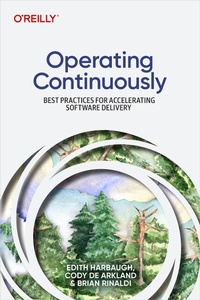
Operating Continuously
Description

Continuous delivery doesn''t stop with deployment. Modern software teams rely on an emerging set of best practices postdeployment to continuously improve their software. With this practical guide, CTOs, software architects, and senior engineering leaders will learn what these practices are and how to apply them to their existing operations.
Author John Kodumal, cofounder and CTO at LaunchDarkly, provides actionable insights into setting up and maintaining a smooth operational process postdeployment. You''ll learn new approaches to releasing software, controlling systems at runtime, and measuring the impact of change. Armed with this knowledge, you can easily anticipate the next planning and building phase, feeding back into the software development lifecycle.
This book helps you:
- Understand why mature incident management processes are an essential part of the CI/CD story
- Use the tools and processes necessary to measure the impact of change to production systems
- Learn how to use canary launches and feature flags to release faster with less risk
- Set up effective incident management systems to reduce the impact of broken changes
- Explore an emerging class of techniques that extend the practice beyond deployment
- Use experimentation and impact analysis to continuously improve
More details
Other editions
Additional editions
Content
- Cover
- Copyright
- Table of Contents
- Preface
- Who Will Benefit from Reading This Book?
- Navigating and Using This Book
- Conventions Used in This Book
- O'Reilly Online Learning
- How to Contact Us
- Acknowledgments
- Introduction
- It's Never Been Just About Dev and Ops
- The Steps Need a Refresh
- The Steps Happen in Parallel
- Chapter 1. Deploy
- Redefining Release and Deploy
- What Deploy and Release Used to Mean
- What Deploy and Release Mean Now
- Small and Frequent & Large and Infrequent
- Deploy Can Be Decoupled from Release
- Merge Conflicts and Their Impact on Deployments
- Characteristics of a High-Performance Deployment System
- Visibility
- Deployment Orchestration
- Deployment Strategies and Shipping Code
- Blue/Green Deployments and Canaries
- Deploying Code
- DORA Metrics (Minus MTTR)
- Summary
- Chapter 2. Release
- Feature Flags
- The Power of Feature Flags
- Granular Targeting
- Progressive Delivery
- Testing in Production
- Personalization
- Entitlements
- Feature Management Platforms
- Speed
- Experimentation
- Security
- Reliability
- Compliance
- Delegation Progression
- Flag Management
- Languages
- Workflow Enhancements
- Summary
- Chapter 3. Operate
- What Is an Incident?
- Common Incident Causes
- Changes to Your System
- Changes to the Inputs of Your System
- Nonsoftware Issues
- Identifying and Declaring an Incident
- Automatically
- Manually
- Mitigating Risk
- Rollbacks
- Kill Switches
- Safety Valves
- Handling Migrations
- Observability
- Principles of Healthy Incident Management
- Self-Identification
- Continuous Improvement
- Runbook Operability
- High Volume, Low Impact
- What Bad Incident Management Looks Like
- What Good Incident Management Looks Like
- What Makes an Incident Response Process Successful?
- People
- Roles
- Mandatory Versus Optional
- Culture
- Tools
- Process
- Post-Incident Review
- Metrics
- Response Time
- Summary
- Chapter 4. Measure and Experiment
- Measure
- Why We Need to Measure Data
- What Impact Does Measure Have?
- Shifting from Measure to Experiment
- Experimentation
- New Software Delivery Enables Experimentation
- Feature Validation Experiments
- Incentive-Based Development
- Pitfalls of Changing Success Metrics
- A New Product in a New Market
- Facing the Results
- Culture and Feature Abandonment
- Cheap Features
- A/B/n Testing
- Designing a Test
- Running the Test
- Choosing the Right Experimentation Platform
- Risk Mitigation
- Defining Risk Mitigation
- Measuring Risk
- Experimentation for Risk Mitigation
- Optimization
- Experimentation Examples
- Measuring a Sign-Up Flow
- Fifty Shades of Blue
- Summary
- Conclusion
- Rethinking the Loop
- Deploy
- Release
- Operate
- Measure and Experiment
- Final Words
- Index
- About the Authors
