

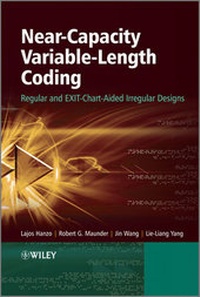
Near-Capacity Variable-Length Coding
Description

More details
Other editions
Additional editions
Persons
Lajos Hanzo University of Southampton, UK
Lajos Hanzo has held various research and academic posts in Hungary, Germany and the UK. Since 1986 he has been with the School of Electronics and Computer Science, University of Southampton, UK and has been a consultant to Multiple Access Communications Ltd., UK. He currently holds the established Chair of Telecommunications. He co-authored 17 Wiley/IEEE Press books on mobile radio communications and published in excess of 800 research papers.
Robert G. Maunder, University of Southampton, UK
Robert G. Maunder has studied with the School of Electronics and Computer Science, University of Southampton, UK, since October 2000. His research interests include video coding, joint source/channel coding and iterative decoding. In 2007 he was appointed a lecturer in the School of ECS, Univ. of Southampton.
Jin Wang, Aeroflex, UK
Jin Wang recently joined Aeroflex, Cambridge, UK. His research interests include video coding, channel coding, joint source/channel coding, and iterative detection and decoding for digital communication systems. He published numerous IEEE journal and conference papers on related topics.
Lie-Liang Yang, University of Southampton, UK
Lie-Liang Yang works in the School of Electronics and Computer Science, University of Southampton, UK, and currently holds the academic post of Readership. Dr. Yang's research has covered a wide range of topics in wireless communications, networking and signal processing. He has published over 200 research papers in journals and conference proceedings, authored/co-authored two books and also published several book chapters.
Content
Other Wiley and IEEE Press Books on Related Topics
Acknowledgments
Preface
Chapter 1 Introduction
1.1 Historical Overview
1.2 Applications of Irregular Variable Length Coding
1.3 Motivation and Methodology
1.4 Outline of the Book
1.5 Novel Contributions of the Book
Chapter 2 Information Theory Basics
2.1 Issues in Information Theory
2.2 AdditiveWhite Gaussian Noise Channel
2.3 Information of a Source
2.4 Average Information of Discrete Memoryless Sources
2.5 Source Coding for a Discrete Memoryless Source
2.6 Entropy of Discrete Sources Exhibiting Memory
2.7 Examples
2.8 Generating Model Sources
2.9 Run-Length Coding for Discrete Sources Exhibiting Memory
2.10 Information Transmission via Discrete Channels
2.11 Capacity of Discrete Channels
2.12 Shannon's Channel Coding Theorem
2.13 Capacity of Continuous Channels
2.14 Shannon's Message for Wireless Channels
2.15 Summary and Conclusions
I Regular Concatenated Codes and Their Design
List of Symbols in Part I
Chapter 3 Sources and Source Codes
3.1 Introduction
3.2 Source Models
3.3 Source Codes
3.4 Soft-Decoding of Variable Length Codes
3.5 Summary and Conclusions
Chapter 4 Iterative Source/Channel Decoding
4.1 Concatenated Coding and the Turbo Principle
4.2 SISO APP Decoders and Their EXIT Characteristics
4.3 Iterative Source/Channel Decoding Over AWGN Channels
4.4 Iterative Channel Equalisation, Channel Decoding and Source Decoding
4.5 Summary and Conclusions
Chapter 5 Three-Stage Serially Concatenated Turbo Equalisation
5.1 Introduction
5.2 Soft-in/Soft-outMMSE Equalisation
5.3 Turbo Equalisation Using MAP/MMSE Equalisers
5.4 Three-stage serially concatenated coding and MMSE equalisation
5.5 Approaching the Channel Capacity Using EXIT-Chart Matching and IRCCs .
5.6 Rate-Optimisation of Serially Concatenated Codes
5.7 Joint Source-Channel Turbo Equalisation Revisited
5.8 Summary and Conclusions
II Irregular Concatenated VLCs and Their Design
List of Symbols in Part II
Chapter 6 Irregular Variable Length Codes for Joint Source and Channel Coding
6.1 Introduction
6.2 Overview of proposed scheme
6.3 Transmission frame structure
6.4 VDVQ/RVLC encoding
6.5 APP SISO VDVQ/RVLC decoding
6.6 Simulation results
6.7 Summary and Conclusions
Chapter 7 Irregular Variable Length Codes for EXIT Chart Matching
7.1 Introduction
7.2 Overview of proposed schemes
7.3 Parameter design for the proposed schemes
7.4 Simulation results
7.5 Summary and Conclusions
Chapter 8 Genetic Algorithm Aided Design of Irregular Variable Length Coding Components
8.1 Introduction
8.2 The free distance metric
8.3 Overview of the proposed genetic algorithm
8.4 Overview of proposed scheme
8.5 Parameter design for the proposed scheme
8.6 Simulation results
8.7 Summary and Conclusions
Chapter 9 Joint EXIT Chart Matching of Irregular Variable Length Coding and Irregular
Unity Rate Coding
9.1 Introduction
9.2 Modifications of the EXIT chart matching algorithm
9.3 Joint EXIT chart matching
9.4 Overview of the transmission scheme considered
9.5 System parameter design
9.6 Simulation results
9.7 Summary and Conclusions
III Applications of VLCs
Chapter 10 Iteratively Decoded VLC Space-Time Coded Modulation
10.1 Introduction
10.2 Space Time Coding Overview
10.3 Two-Dimensional VLC Design
10.4 VL-STCM Scheme
10.5 VL-STCM-ID Scheme
10.6 Convergence Analysis
10.7 Simulation results
10.8 Conclusions
Chapter 11 Iterative Detection of Three-Stage Concatenated IrVLC FFH-MFSK
11.1 Introduction
11.2 System Overview
11.3 Iterative decoding
11.4 System parameter design and Results
11.5 Conclusion
Chapter 12 Conclusions and Future Research
12.1 Chapter 1: Introduction
12.2 Chapter 2: Information Theory Basics
12.3 Chapter 3: Sources and Source Codes
12.4 Chapter 4: Iterative Source/Channel Decoding
12.5 Chapter 5: Three-Stage Serially Concatenated Turbo Equalisation
12.6 Chapter 6: Joint source and channel coding
12.7 Chapters 7 - 9: EXIT chart matching
12.8 Chapter 8: GA-aided Design of Irregular VLC Components
12.9 Chapter 9: Joint EXIT Chart Matching of IRVLCs and IRURCs
12.10Chapter 10: Iteratively Decoded VLC Space-Time Coded Modulation
12.11Chapter 11: Iterative Detection of Three-Stage Concatenated IrVLC FFHMFSK
12.12Future work
12.13Closing remarks
Appendix A VLC Construction Algorithms
A.1 RVLC Construction Algorithm A
A.2 RVLC Construction Algorithm B
A.3 Greedy Algorithm (GA) and Majority Voting Algorithm (MVA)
Appendix B SISO VLC Decoder
Appendix C APP Channel Equalisation
Bibliography
Glossary
Subject Index
Author Index
