

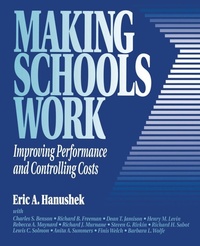
Making Schools Work
Improving Performance and Controlling Costs
Published on 1. December 2010
224 pages
978-0-8157-4644-7 (ISBN)
Description

Educational reform is a big business in the United States. Parents, educators, and policymakers generally agree that something must be done to improve schools, but the consensus ends there. The myriad of reform documents and policy discussions that have appeared over the past decade have not helped to pinpoint exactly what should be done.
The case for investment in education is an economic one: schooling improves the productivity and earnings of individuals and promotes stronger economic growth and better functioning of society. Recent trends in schooling have, however, lessened the value of society's investments as costs have risen dramatically while student performance has stayed flat or even fallen. The task is to improve performance while controlling costs.
This book is the culmination of extensive discussions among a panel of economists led by Eric Hanushek. They conclude that economic considerations have been entirely absent from the development of educational policies and that economic reality is sorely needed in discussions of new policies. The book outlines an improvement plan that emphasizes changing incentives in schools and gathering information about effective approaches. Available research and analysis demonstrates that current central decisionmaking has worked poorly. Concentrating on inputs such as pupil-teacher ratios or teacher graduate degrees appears quite inferior to systems that directly reward performance. Nonetheless, since experience with such alternatives is very limited, a program of extensive evaluation appears to be in order.
Attempts to institute radical change on the basis of currently available information involve substantial risks of failure. Many people today find proposals such as charter schools, expanded use of merit pay, or educational vouchers to be appealing. Yet there is little evidence of their effectiveness, and widespread adoption of these proposals is sure to run into substantial problems of im
More details
Language
English
Place of publication
United States
Publishing group
Bloomsbury Publishing Plc
Target group
Professional and scholarly
File size
21,77 MB
ISBN-13
978-0-8157-4644-7 (9780815746447)
Copyright in bibliographic data and cover images is held by Nielsen Book Services Limited or by the publishers or by their respective licensors: all rights reserved.
Schweitzer Classification
Other editions
Additional editions
Book
09/1994
Brookings Institution
€33.90
Shipment within 10-20 days
Person
Eric Hanushek is the Paul and Jean Hanna Senior Fellow in Education at the Hoover Institution, Stanford University.
