

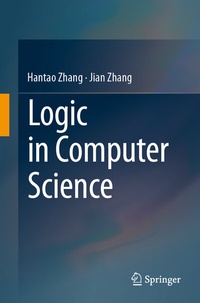
Logic in Computer Science
Description

Mathematical logic is an important basis for mathematics, computer science and artificial intelligence alike. This book provides a comprehensive introduction to various logics, including classical propositional logic and first-order predicate logic, as well as equational logic, temporal logic, and Hoare logic. In addition, it presents proof procedures for classical logics and decision procedures for checking the satisfiability of logical formulas.
The book assumes no background in logic. It presents logics as practical tools for solving various problems in artificial intelligence and formal verification. Accordingly, it is well suited for (junior and senior) undergraduate and graduate students majoring in computer science or mathematics. Each chapter includes roughly a dozen exercise problems, so as to help the reader understand the concepts and techniques discussed.
More details
Other editions
Additional editions
Persons
Hantao Zhang is a professor of Computer Science with the University of Iowa, USA. His research interests include automated reasoning, constraint solving and discrete mathematics. He is the recipient of numerous NSF awards, including the prestigious NSF Young Investigator Award. He has published more than 100 papers in these areas, including a book on automated mathematical induction and a book chapter for the Handbook of Satisfiability . He won the Skolem Award by CADE (International Conference on Automated Deduction) in 2015 as his paper on SATO has passed the test of time as one of the most influential papers in the field.
Jian Zhang is a researcher with the Institute of Software, Chinese Academy of Sciences, and a professor with the University of Chinese Academy of Sciences. His research interests include automated reasoning, constraint solving, program analysis and software testing. Jian Zhang serves on the editorial boards of several journals, including IEEE Transactions on Reliability , Journal of Computer Science and Technology , Frontiers of Computer Science , Science China - Information Sciences , and Chinese Journal of Computers . He is the author of Deciding the Satisfiability of Logical Formulas: Methods, Tools and Application s (in Chinese, Science Press, 2000) and a co-author of Automatic Generation of Combinatorial Test Data (Springer, 2014).
Content
Chapter 1. Introduction to Logic.- Part I. Propositional Logic .- Chapter 2. Propositional Logic.- Chapter 3. Reasoning in Propositional Logic.- Chapter 4. Propositional Satisfiability.- Part II. First-Order Logic .- Chapter 5. First-Order Logic.- Chapter 6. Unification and Resolution.- Chapter 7. First-Order Logic with Equality.- Part III. Logic in Programming .- Chapter 8. Prolog: Programming in Logic.- Chapter 9. Hoare Logic.- Chapter 10. Temporal Logic.- Part IV. Logic of Computability .- Chapter 11. Decidable and Undecidable Problems.- Chapter 12. Decision Procedures.
