

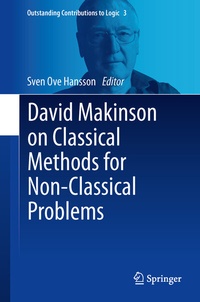
David Makinson on Classical Methods for Non-Classical Problems
Description

The volume analyses and develops David Makinson's efforts to make classical logic useful outside its most obvious application areas. The book contains chapters that analyse, appraise, or reshape Makinson's work and chapters that develop themes emerging from his contributions. These are grouped into major areas to which Makinsons has made highly influential contributions and the volume in its entirety is divided into four sections, each devoted to a particular area of logic: belief change, uncertain reasoning, normative systems and the resources of classical logic.
Among the contributions included in the volume, one chapter focuses on the "inferential preferential method", i.e. the combined use of classical logic and mechanisms of preference and choice and provides examples from Makinson's work in non-monotonic and defeasible reasoning and belief revision. One chapter offers a short autobiography by Makinson which details his discovery of modern logic, his travels across continents and reveals his intellectual encounters and inspirations. The chapter also contains an unusually explicit statement on his views on the (limited but important) role of logic in philosophy.
Reviews / Votes
From the reviews:
"A fine bunch of authors present papers about the present status of the fields of work of an outstanding logician, David Makinson, in this book. . I think that graduate students and researchers in the area of logic and artificial intelligence will especially benefit from reading this book, for the perspective it provides on what one should work on in these areas (tools and techniques) and how one should work in these areas (with clarity and precision)." (K. Lodaya, Computing Reviews, May, 2014)More details
Other editions
Additional editions
Content
Preface.- Contributors.- Introductory.- Chapter 1. Sven Ove Hansson: Preview.- Chapter 2. Sven Ove Hansson and Peter Gärdenfors: David Makinson and the extension of classical logic.- Chapter 3. David Makinson: A tale of five cities.- I. Logic of Belief Change.- Chapter 4. Hans Rott and Sven Ove Hansson: Safe contraction revisited.- Chapter 5. Pavlos Peppas: A panorama of iterated revision.- Chapter 6. Wolfgang Spohn: AGM, ranking theory and the many ways to cope with examples.- Chapter 7. Edwin Mares: Liars, lotteries and prefaces: two paraconsistent theories of belief revision.- Chapter 8. Rohit Parikh: Epistemic reasoning in life and literature.- II. Uncertain Reasoning.- Chapter 9. James Hawthorne: New Horn rules for probabilistic consequence: Is O+ enough?.- Chapter 10. Karl Schlechta: Non-monotonic logic: preferential vs. algebraic semantics.- Chapter 11. Hykel Hosni: Towards a Bayesian theory of second-order uncertainty: lessons from non-standard logics.- III. Normative Systems.- Chapter 12. Audun Stolpe: Abstract interfaces of input/output logic.- Chapter 13. Xavier Parent, Dov Gabbay and Leendert van der Torre: Intuitionistic basis for input/output logic.- Chapter 14. Jörg Hansen: Reasoning about permission and obligation.- Chapter 15. John Horty: Norm change in the common law.- IV. Classical Resources.- Chapter 16. David Makinson: Intelim rules for classical connectives.- Chapter 17. David Makinson: Relevance logic as a conservative extension of classical logic.- V. Responses.- Chapter 18. David Makinson: Reflections on contributions.- Bibliographical.- David Makinson's publications.- Index.
