

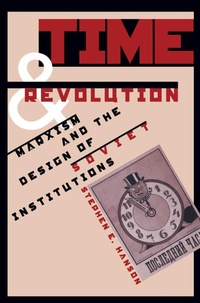
Time and Revolution
Description

Stephen Hanson traces the influence of the Marxist conception of time in Soviet politics from Lenin to Gorbachev. He argues that the history of Marxism and Leninism reveals an unsuccessful revolutionary effort to reorder the human relationship with time and that this reorganization had a direct impact on the design of the central political, socioeconomic, and cultural institutions of the Soviet Union from 1917 to 1991. According to Hanson, westerners tend to envision time as both rational and inexorable. In a system in which 'time is money,' the clock dominates workers. Marx, however, believed that communist workers would be freed of the artificial distinction between leisure time and work time. As a result, they would be able to surpass capitalist production levels and ultimately control time itself. Hanson reveals the distinctive imprint of this philosophy on the formation and development of Soviet institutions, arguing that the breakdown of Gorbachev’s perestroika and the resulting collapse of the Soviet Union demonstrate the failure of the idea.
More details
Other editions
Additional editions
Person
Stephen E. Hanson, assistant professor of political science at the University of Washington, is coeditor of Can Europe Work?: Germany and the Reconstruction of Post-Communist Societies.
Content
- Cover Page
- TIME AND REVOLUTION
- Copyright Page
- CONTENTS
- PREFACE
- ACKNOWLEDGMENTS
- 1 TRADITIONAL, MODERN, AND CHARISMATIC TIME
- 2 TIME IN THE WORKS OF KANT AND HEGEL
- 3 THE THEORETICAL CYCLE
- 4 THE POLITICAL CYCLE
- 5 THE SOCIOECONOMIC CYCLE
- 6 GORBACHEV'S PERESTROIKA AND THE CHARISMATIC-RATIONAL CONCEPTION OF TIME
- CONCLUSION
- NOTES
- BIBLIOGRAPHY
- INDEX
