

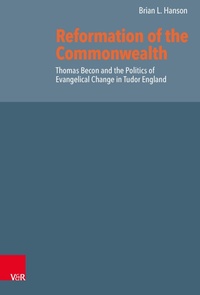
Reformation of the Commonwealth
Thomas Becon and the Politics of Evangelical Change in Tudor England
1st Edition
Published on 16. September 2019
250 pages
978-3-647-55454-9 (ISBN)
Description

This study considers sixteenth century evangelicals' vision of a >godly< commonwealth within the broader context of political, religious, social, and intellectual changes in Tudor England. Using the clergyman and bestselling author, Thomas Becon (1512-1567), as a case study, Brian L. Hanson argues that evangelical views of the commonwealth were situation-dependent rather than uniform, fluctuating from individual to individual. His study examines the ways commonwealth rhetoric was used by evangelicals and how that rhetoric developed and changed. While this study draws from English Reformation historiography by acknowledging the chronology of reform, it engages with interdisciplinary texts on poverty, gender, and the economy in order to demonstrate the intersection of commonwealth rhetoric with Renaissance humanism. Furthermore, the experience of exile and the languages of prophecy and companionship directly influenced commonwealth rhetoric and dictated the priorities, vocabulary, and political expression of the evangelicals. As sixteenth-century England vacillated in its religious direction and priorities, the evangelicals were faced with a political conundrum and the tension between obedience and >lawful< disobedience. There was ultimately a fundamental disagreement on the nature and criteria of obedience. Hanson's study makes a further contribution to the emerging conversation about English commonwealth politics by examining the important issues of obedience and disobedience within the evangelical community. A correct assessment of the issues surrounding the relationship between evangelicals and the commonwealth government will lead to a rediscovery of both the complexities of evangelical commonwealth rhetoric and the tension between the biblical command to submit to civil authorities and the injunction to >obey God rather than man<.
Brian L. Hanson is Assistant Professor of History at Bethlehem College & Seminary in Minneapolis.
More details
Other editions
Additional editions
Brian L. Hanson
Reformation of the Commonwealth
Thomas Becon and the Politics of Evangelical Change in Tudor England
Book
09/2019
1st Edition
Vandenhoeck & Ruprecht
from
€110.00
Shipment within 5-7 days
Person
Brian L. Hanson is Assistant Professor of History at Bethlehem College & Seminary in Minneapolis.
Content
- Intro
- Title Page
- Copyright
- Table of Contents
- Body
- Acknowledgements
- Abbreviations
- Introduction
- Chapter 1. Thomas Becon's early theology: evangelical conversion and household piety in the 'common weale'
- Becon's early years
- Becon's years in hiding in Kent
- The Henrician Writings
- Household piety and the Word of God
- Becon's doctrine of justification
- Becon's vision for a 'godly common weale'
- Conclusion
- Chapter 2. Nicodemism, silence, and companionship
- Becon's arrest and recantation
- 'A time to kepe scilence': The problem of exile and silence
- Wandering in the wilderness, 1543-1547
- Assessing the years of wandering
- Conclusion
- Chapter 3. Thomas Becon and his 'Christen common weale': clerical reform and charity
- Edwardian reformation and Becon's restoration
- Becon and the 'common weale'
- 'Deliver thy people out of Egypte': Polemic and clerical reform
- Poverty and poor relief in the commonwealth
- Conclusion
- Chapter 4. The evangelicals and gender in the 'common weale'
- Becon's view of women
- Gender and female identity in the Marian 'common weale'
- Conclusion
- Chapter 5. Dangerous print in the 'common weale': Prophecies and plagues
- Prophecies as Political Protest
- Rebel Political Rhetoric
- Conclusion
- Chapter 6. Marian Exile: The legacy of reformation and Becon's evolving theology
- The extent of reformation and Becon's theological evolution
- Becon's Polemic: the Catholic Mass and the spiritual nurture of children
- Becon's rhetorical devices: religious polemic and sensory stimulation
- Conclusion
- Chapter 7. 'Sedicious' words: Becon and the art of 'rayling'
- 'Sedicious' words: Thomas Becon and the rhetoric of political protest and rebellion
- Conclusion
- Conclusion
- Bibliography
- Manuscript Sources
- Printed Primary Sources
- Secondary Sources
- Unpublished Theses
- Index
- Appendix
