

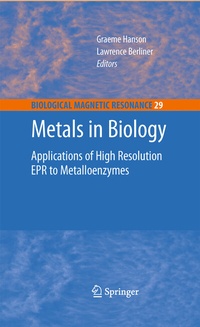
Metals in Biology
Description

Metal ions in biology is an ever expanding area in science and medicine involving metal ions in proteins and enzymes, their biosynthesis, catalysis, electron transfer, metal ion trafficking, gene regulation and disease. While X-ray crystallography has provided snapshots of the geometric structures of the active site redox cofactors in these proteins, the application of high resolution EPR spectroscopy in conjunction with quantum chemistry calculations has enabled, in many cases, a detailed understanding of a metalloenzymes mechanism through investigations of the geometric and electronic structure of the resting, enzyme-substrate intermediates and product complexes.
This volume, Part II of a two-volume set demonstrates the application of high resolution EPR spectroscopy in determining the geometric and electronic structure of active site metal ion centers in iron sulfur cluster containing metalloproteins, mononuclear molybdenum metalloenzymes, manganese-containing enzymes and novel metalloproteins.
More details
Other editions
Additional editions
Persons
Prof. Graeme Hanson, located in the Centre for Magnetic Resonance at the University of Queensland, has applied a unique synergistic approach involving both theoretical and experimental aspects of multifrequency continuous wave and pulsed EPR spectroscopy to structurally (geometric and electronic) characterise the metal binding sites in metalloenzymes and transition metal ion complexes. The development and commercialisation of the XSophe-Sophe-XeprView (CW EPR) and Molecular Sophe(CW EPR, Pulsed EPR and ENDOR) computer simulation software suites has been crucial in the characterisation of these biological inorganic systems.
Dr. Lawrence J. Berliner is currently at the Department of Chemistry and Biochemistry, University of Denver, where he was Professor and Chair for the past 8 years. He retired from The Ohio State University, where he spent a 32-year career in the area of biological magnetic resonance (EPR and NMR). He has been recognized by the International EPR Society with the Silver Medal for Biology/Medicine in 2000. He also received the Lifetime Achievement Award in Biological EPR Spectroscopy at EPR-2005. He is the Series Editor for Biological Magnetic Resonance, which he launched in 1979.
